



Use Wozber and land your dream job
Create Resume
No registration required
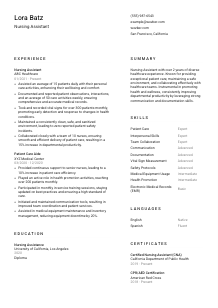
Supporting patients, but your resume seems unwell? Check out this Nursing Assistant resume example, created with Wozber free resume builder. Learn how to present your caring skills in line with job requirements, putting your career health back on steady wards!
Nursing Assistant resumes are reviewed through the lens of everyday patient care. Hiring teams want to see whether you can safely support bathing, grooming, feeding, mobility, vital signs, and documentation without losing attention to detail during a busy shift. If your resume stays broad, it can hide the practical bedside work, charting habits, and team coordination that matter most in this role.
A tailored resume also helps separate general healthcare support experience from direct nursing assistant work. Using Wozber's free resume builder and an ATS-friendly resume format makes it easier to mirror the language of the posting, surface terms like patient care, vital signs, safety protocols, and medical record documentation, and show that your background matches the pace and responsibilities of the unit.
For a Nursing Assistant role, the contact section should do two things quickly: identify you clearly and remove any friction around availability or location requirements. Keep it clean, professional, and easy to scan.
Place your full name at the top in the most prominent text on the page, then add the exact job title beneath it when it matches the role you are pursuing. For this opening, using "Nursing Assistant" immediately tells the reader that your experience is framed for bedside support, patient safety, and care-team collaboration rather than a broader healthcare support role.
Include a current phone number and a professional email address that you check regularly. Healthcare hiring often moves quickly when units need coverage, so your contact information should be easy to use and free of distractions. A straightforward email format based on your name works best.
If an employer names a location requirement, show that you meet it in your contact section. Here, listing San Francisco, California directly addresses a stated condition of the role. That kind of detail helps avoid unnecessary questions before the employer even reaches your experience section.
Include LinkedIn or a professional profile only if it supports your application with consistent work history, training, certifications, or healthcare experience. If you add one, make sure the titles, dates, and credentials match your resume. Any mismatch around CNA training, employers, or employment dates can create doubt where you want confidence.
Do not add age, marital status, photo, or other unrelated personal information unless it is standard in your market. Nursing Assistant hiring decisions should stay focused on your clinical experience, certification status, communication skills, and ability to support safe patient care.
This section is brief, but it still does important work. When your name, title, contact details, and any required location information are accurate and professional, the employer can move straight to judging your patient care background.




In Nursing Assistant hiring, experience is where employers look for proof that you can handle routine care tasks, accurate documentation, and unit teamwork under real clinical conditions. Your bullet points should show what kind of patients you supported, what tasks you handled, and how consistently you worked within safety expectations.
Read the job description closely and note the recurring care activities and operational terms. For this role, that includes daily personal care, vital signs, intake and output, sanitation, medical record documentation, and collaboration with the nursing team. Use those exact ideas where they truthfully reflect your work so both the reader and the ATS can connect your background to the position.
List your jobs in reverse chronological order and include your title, employer, and dates. Then make the setting legible through the bullets. A title like "Patient Care Aide" can still be highly relevant if the accomplishments show patient support, equipment handling, training participation, and nurse coordination. The job title matters, but the work described underneath matters more.
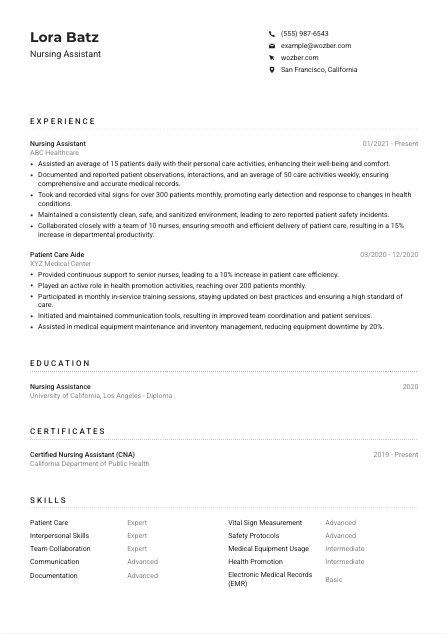
Do not stop at task lists. Write bullets that show volume, consistency, and results. The example resume does this well with details like assisting an average of 15 patients daily and recording vital signs for more than 300 patients monthly. Numbers like these help employers picture your workload, speed, and familiarity with routine care demands.
Prioritize roles and bullets that connect directly to Nursing Assistant work. If you have mixed healthcare experience, lead with bedside care, documentation, safety practices, and support to licensed nurses before less relevant administrative or general service work. Every bullet should help answer whether you can contribute on the floor with minimal ramp-up.
Healthcare employers pay attention to how you support safe care delivery, not just whether you were present on the unit. Strong bullets might mention accurate charting, zero safety incidents, improved patient care efficiency, or effective coordination with nurses. In the sample, maintaining a sanitized environment with zero reported patient safety incidents is especially useful because it ties routine housekeeping discipline to patient outcomes.
Your experience section should leave no doubt that you know the rhythm of patient care. When your bullets show daily responsibilities, measurable workload, safe practice, and collaboration with nurses, your resume reads like someone ready to step into the shift.
Education matters in Nursing Assistant hiring because it shows you completed the training that supports safe patient handling, basic care procedures, infection control, and clinical communication. Keep this section straightforward and relevant to the role you want.
Start with the education that best supports Nursing Assistant work, whether that is a nursing assistant diploma, training program, or closely related healthcare credential. In this case, a Diploma in Nursing Assistance directly supports the employer's requirement for CNA certification or completion of a nursing assistant training program.
List the school, credential, field of study, and graduation year or date in a consistent format. Hiring teams in healthcare often scan quickly, so they should be able to confirm your training without digging through extra wording or reordered details.
If you completed a training program and also hold a CNA credential, make both easy to find. Education shows your formal preparation, while the certification section confirms active qualification. Together, they present a cleaner picture than blending everything into one line.
Add coursework, workshops, or in-service learning if they reinforce skills used in patient care settings, such as infection prevention, patient handling, CPR refreshers, or EMR familiarity. Keep these additions selective and focused on practical care delivery rather than unrelated classes.
Volunteer work, clinical placements, or school activities can help when they show patient-facing experience, comfort in care environments, or early teamwork exposure. This is especially useful for candidates with limited paid experience, as long as the examples stay relevant to Nursing Assistant responsibilities.
This section does not need much space, but it should clearly confirm that you have the educational foundation for safe, supervised patient care. If your training aligns with the posting, make that connection obvious.
For Nursing Assistant roles, certifications are often a hiring threshold, not a bonus. They tell the employer that you meet required standards and can be placed into patient care workflows with the right baseline preparation.
When a posting asks for CNA certification or completion of a nursing assistant program, your CNA credential should be easy to find and clearly labeled. In the provided example, "Certified Nursing Assistant (CNA)" appears prominently and directly answers one of the first requirements in the job description.
Prioritize credentials that connect to bedside work, patient safety, and emergency response. CPR or AED certification is often worth including because it reinforces readiness in real care settings and complements your daily patient support responsibilities.
Include issue dates and renewal or active dates where relevant. In healthcare, expired credentials can slow down or end consideration, so make it easy for employers to see that your certification is current and usable.
If you have updated training in infection control, dementia care, patient mobility, or electronic documentation, include it when it strengthens your candidacy. Focus on training that supports the actual workflow of Nursing Assistant jobs rather than listing every course you have ever taken.
Your certifications section should quickly answer a practical question: are you qualified to work in this care environment now? Put the required credential first, keep dates visible, and include only training that strengthens your bedside profile.
The best Nursing Assistant skills sections reflect the real mix of bedside care, observation, communication, and routine clinical support expected on the floor. Keep the list focused on abilities you use in patient care, not broad workplace traits that could belong to any role.
Start with the terms the employer already uses. In this posting, that includes patient care principles, safety protocols, communication, interpersonal skills, task prioritization, documentation, and collaboration with the healthcare team. These are the capabilities the hiring team expects to find quickly on your resume.
List the skills that show up in your work history and certifications, such as patient care, vital sign measurement, documentation, EMR use, team collaboration, and communication with patients and families. The sample resume pairs "Patient Care," "Documentation," and "Safety Protocols" with bullets about daily care support and recorded observations, which creates a believable match.
Avoid overloading this section with every soft skill you have. A shorter list built around direct care, charting, safety, and team support is more useful than a long inventory of generic strengths. If you use proficiency levels, make sure they reflect your real comfort with the skill, especially for tasks like EMR documentation or vital sign measurement.
A focused skills section helps the employer connect your resume to the day-to-day work of the role. When the list mirrors patient care tasks, safety expectations, and charting responsibilities, it supports everything else on the page.
Language ability matters in Nursing Assistant work because patient comfort, basic instructions, and collaboration with nurses all depend on clear communication. Present your language skills in a way that reflects both the posting requirements and the patient population you may serve.
If the job description states that English fluency is required, list English first and show your level clearly. This posting makes English a direct performance requirement, so do not leave it implied.
Extra languages can strengthen your application when they help with rapport, comfort, and clearer communication in diverse care settings. In many healthcare environments, a second language such as Spanish can be useful when assisting with daily care routines or helping patients understand simple instructions.
Choose clear levels such as Native, Fluent, Intermediate, or Basic. Overstating proficiency can become a problem quickly in patient-facing work, where misunderstandings affect care quality, handoffs, and trust.
If you speak another language well enough to support patients or families, that is worth showing because Nursing Assistants often spend more direct time with patients than many other team members. Language skills can make a real difference during personal care, reassurance, and routine observations.
List only languages you can use meaningfully. The section should strengthen your case as someone who can communicate clearly in a healthcare setting, not read like a general profile of personal interests or academic study.
For this role, language skills are practical, not decorative. Present them clearly so the employer can quickly see that you can communicate safely with patients, families, and the care team.
A Nursing Assistant summary should quickly establish your level of experience, the kind of patient care you have handled, and the strengths you bring to daily clinical work. Keep it short, but make it specific enough to sound grounded in real healthcare experience.
Start with a direct statement that identifies you as a Nursing Assistant or closely related patient care professional, then mention your years of experience. This gives immediate context for everything that follows and helps position you within the expected level of the role.
Mention two or three strengths that match the employer's needs, such as personal care support, accurate documentation, safe patient environments, vital signs, or communication with patients and families. The example summary works because it stays close to the actual work: patient care, safety, collaboration, and documentation.
Aim for 3 to 5 lines with specific language instead of broad enthusiasm. This is the place for phrases like "over 2 years of healthcare experience," "supports daily personal care," or "documents patient observations accurately," not generic claims about being hardworking or passionate.
When your summary reflects actual patient care work, safe practice, and teamwork with nurses, the rest of your resume has a strong frame. It should read like a concise clinical introduction, not a general career statement.
A well-tailored Nursing Assistant resume makes bedside care experience, safety habits, documentation accuracy, and team support easy to see. That is what hiring teams need when they are filling patient-facing roles quickly and carefully.
Use Wozber's free resume builder to shape each section around the posting, strengthen ATS optimization with role-specific terms, and build an ATS-compliant resume that clearly shows you are ready for day-to-day patient care.




