



Use Wozber and land your dream job
Create Resume
No registration required
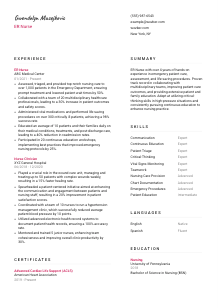
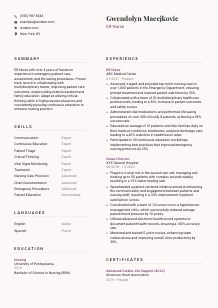
Saving lives under pressure, but your resume is flatlining? Revive it with this ER Nurse resume example, created with Wozber free resume builder. Learn how to show your critical care expertise in line with job requirements, keeping your career in stable condition!
Emergency nursing is one of the clearest proof-based specialties on a resume. Hiring teams want to see how you move through triage, stabilize critical patients, document accurately under pressure, and work with physicians, techs, and other nurses when the department is moving fast. Your resume should make that clinical judgment and pace visible right away.
A tailored ER Nurse resume helps separate true emergency department experience from broader bedside nursing backgrounds, especially when an ATS is scanning for terms tied to triage, ACLS, PALS, patient education, and charting. Wozber's free resume builder helps you line up that language in an ATS-friendly resume format so the reader can quickly recognize whether you are ready for the unit's patient flow, acuity, and teamwork demands.
In emergency care hiring, the top of the resume should answer practical questions fast. Can this nurse be reached easily, do they match the role being filled, and do they meet any location expectations named in the posting? Keep this section clean and factual.
Use your full name as the most visible text on the page so the resume is easy to identify during high-volume screening. Keep the formatting simple and professional, the same way a well-documented chart is easy to scan.
Place the job title directly under your name when it matches your background. For this opening, "ER Nurse" works well because it immediately aligns your identity with emergency department practice rather than a broader RN label.
Your contact details should support fast follow-up, not distract from your clinical background.
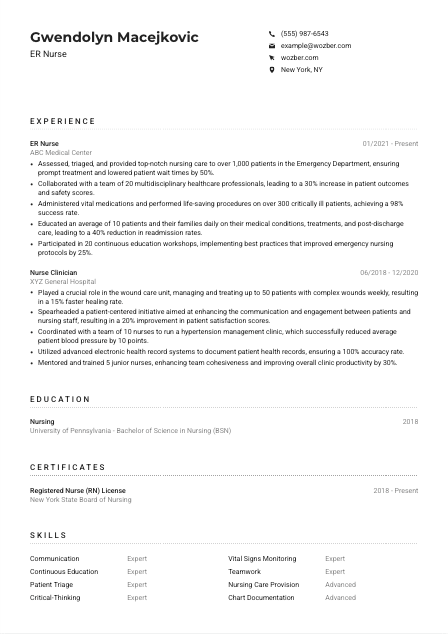
If the posting requires you to be in a specific city or willing to relocate, make that easy to see. In the example, listing "New York, NY" removes doubt about a stated hiring requirement and avoids unnecessary back-and-forth early in the process.
Include a LinkedIn profile or professional website only if it supports your application with consistent work history, credentials, or nursing accomplishments. Make sure the dates, titles, and licenses align with the resume exactly.
This section should confirm the basics in seconds: who you are, what nursing role you are targeting, how to reach you, and whether you match any stated location requirement. Make those details easy to read and move the focus quickly to your emergency care background.




ER experience is where hiring teams look for proof that you can handle acuity, speed, and constant prioritization. The strongest bullets show what kind of patients you handled, what actions you took, how you worked with the care team, and what changed because of your work.
Before editing your experience section, mark the responsibilities and requirements that define the opening. For an ER Nurse, that usually means triage, emergency assessment, medication administration, procedures, patient education, chart accuracy, and multidisciplinary collaboration. Those should shape which bullets stay and which ones get cut.
List your positions in reverse chronological order and give the most space to emergency department work. If you have a broader RN background, keep earlier roles, but frame them around transferable clinical judgment, documentation, patient communication, and pace. The example does this well by leading with a current ER Nurse role before showing earlier clinical experience.
Focus each bullet on a real emergency nursing contribution: assessed acuity, triaged incoming patients, administered medications, performed urgent procedures, coordinated with physicians, or educated families on discharge steps. In the sample, the bullet about assessing, triaging, and caring for more than 1,000 ED patients works because it names core ER workflow instead of using vague nursing language.
Use numbers where they naturally support your work. In emergency nursing, useful metrics include patient volume, reduced wait times, readmission changes, safety outcomes, procedure counts, documentation accuracy, or education delivered per shift. The sample's reduced wait times, patient counts, and readmission impact are good models because they connect nursing actions to operational and patient outcomes.
Keep the section centered on experience that helps a hospital picture you in its emergency department. An impressive bullet from another setting only belongs if it strengthens your case for triage, acute care, teamwork, patient teaching, or documentation. Every line should help answer one question: how well can this nurse function in a busy ED?
Your experience section should make the department's decision easier by showing real emergency nursing volume, clinical actions, teamwork, and outcomes. When the bullets reflect the actual flow of ER work, your background reads as immediately usable.
Education is usually straightforward for experienced nurses, but it still matters because many hospital systems screen for degree requirements before a manager reviews the file. Present it clearly so the BSN or other required nursing credential is easy to confirm.
If the posting asks for a Bachelor of Science in Nursing, list your degree in clear terms. For this role, "Bachelor of Science in Nursing (BSN)" should appear exactly if that is what you earned, since it matches the stated qualification and supports ATS alignment.
Include the degree, school, and graduation year or date in a simple structure. Hospital recruiters and HR teams do not need extra narrative here. They need to confirm the academic requirement quickly and move on to your licensure and experience.
Spell out the nursing field rather than relying on abbreviations alone when that adds clarity. The example's education entry works because the degree and field leave no doubt that the candidate meets the nursing education requirement.
Most ER Nurse candidates with solid clinical experience do not need to list coursework. Consider it only if you are early in your career and have especially relevant training in acute care, pediatrics, trauma, or pathophysiology that supports your move into emergency nursing.
Academic honors, leadership roles, or nursing society memberships can help when you are a newer nurse or when they reflect strong clinical preparation. If you already have several years of ED experience, keep these details brief so they do not crowd out more persuasive experience-based content.
For most ER Nurse applications, education does one practical job: it confirms that you meet the required nursing degree standard. State it clearly, keep the format simple, and let your emergency department experience carry the heavier weight.
In emergency nursing, certifications are not decorative. They are part of your ability to work the floor safely and legally. This section should make current licensure and life-support credentials visible without forcing the reader to hunt for them.
List the credentials the posting names before anything optional. For this opening, that means an active RN license along with current ACLS and PALS. When those appear together, the hiring team can quickly see that you meet the baseline clinical requirements.
Prioritize certifications that matter in the ED. Specialty credentials can be useful, but the core list should stay centered on licensure and emergency-relevant life support. A short, targeted section reads better than a long inventory of less relevant training.
Include issue or renewal dates when possible, especially for time-sensitive certifications like ACLS and PALS. The sample presents them as current and ongoing, which is exactly what an emergency department wants to see before moving a candidate forward.
Do a final check on expiration dates, issuing bodies, and state-specific license details before you apply. Emergency departments cannot move forward with unclear or lapsed credentials, and a current certification list also reflects professional discipline and continuing education.
Licensure and emergency certifications should be one of the easiest parts of your resume to verify. When your RN license, ACLS, and PALS are current and clearly listed, you remove a common reason for applications to stall.
The best ER Nurse skills sections do not read like generic nursing trait lists. They combine clinical abilities, decision-making skills, and communication strengths that match the pace and unpredictability of emergency care.
Pull skills from the requirements and from the work itself. A posting may name communication and critical thinking directly, while triage, medication administration, chart documentation, and patient education are implied through the responsibilities. Your skills section should cover both.
Use the employer's terminology when it honestly reflects your background. If the posting asks for strong interpersonal, communication, and critical-thinking skills, use those exact phrases if they are supported by your experience. The sample also includes triage, chart documentation, and emergency procedures, which makes the skill list more specific to ED practice.
Group or order your skills so the highest-value items stand out first. In emergency nursing, that usually means triage, patient assessment, emergency procedures, medication administration, charting, teamwork, and patient education ahead of broad phrases that could belong on any healthcare resume.
A sharp skills section should sound like someone who works in an emergency department. If the list reflects how you assess, communicate, document, and respond under pressure, it will support the rest of your resume instead of repeating it.
Emergency departments serve patients and families under stress, often when explanations need to be brief, calm, and exact. Language skills matter most when they improve understanding during assessment, treatment, discharge teaching, and handoff communication.
If the posting specifically requires English communication, make your English proficiency easy to find. For this role, listing English as Native or Fluent directly supports a stated requirement and reassures the employer that you can manage charting, patient discussions, and team communication clearly.
Order the section so the language named in the posting appears first. That small choice helps both human reviewers and ATS systems connect your resume to the communication standard the role requires.
Extra languages can be valuable in emergency care, especially in hospitals serving diverse communities. The sample includes Spanish, which is a useful example of a secondary language that can support patient rapport and discharge clarity, even when it is not formally required.
Choose plain labels such as Native, Fluent, Intermediate, or Basic. In clinical settings, overstatement creates risk. Accuracy matters because language ability can affect patient teaching, consent discussions, and real-time communication under stress.
Only include languages you can actually use in patient or team interactions. In an ER setting, the practical question is whether the language helps you assess symptoms, explain care steps, or reduce confusion during a fast encounter.
Language ability is useful when it improves care communication. Show the required English proficiency clearly, and include additional languages when they genuinely strengthen your ability to support patients and families in urgent settings.
The summary should quickly establish your level, your emergency nursing background, and the kind of department contribution you bring. Keep it focused on high-acuity care, teamwork, and patient outcomes rather than broad statements about being passionate or hardworking.
Review the posting and pick the few themes that matter most. For an ER Nurse, that often means emergency department experience, triage and assessment, clinical judgment, collaboration, and current certifications. Those are the ideas your summary should surface first.
Lead with your title and years of relevant experience. The example's opening, "ER Nurse with over 4 years of hands-on experience in emergency patient care," works because it establishes specialty and tenure in one line without wasting space.
Add two to four details that connect directly to the opening, such as life-saving procedures, multidisciplinary teamwork, patient education, improved outcomes, or strong charting in high-pressure settings. Keep the selection tight and grounded in actual work you have done.
Aim for a short paragraph that can be read in seconds before the reviewer drops into your experience section. In nursing hiring, the summary works best when it clarifies your ED background and clinical value without repeating every credential or bullet point below.
After reading the summary, a hiring manager should already know that you are an emergency nurse with the right level of experience, the right kind of clinical exposure, and the communication skills to support safe patient care. That is enough to set up the rest of the resume.
An ER Nurse resume should make a few things clear right away: you meet the education and licensure requirements, you have real emergency department experience, and you can assess, act, document, and communicate well under pressure.
Use Wozber's free resume builder, ATS resume scanner, and ATS-friendly resume templates to tighten that alignment and present your background in a clean ATS-compliant resume. The final result should make it easy for a hospital to recognize that you can step into the department and contribute safely from day one.