



Use Wozber and land your dream job
Create Resume
No registration required
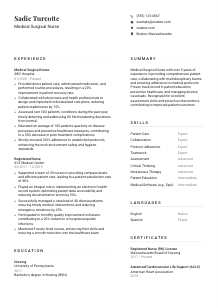
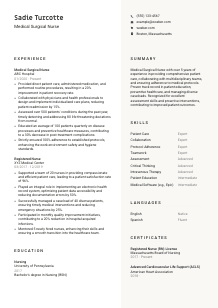
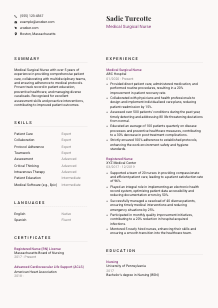
Navigating operation theaters, but your resume feels like it's in recovery? Scrub in with this Medical Surgical Nurse resume example, created with Wozber free resume builder. Learn how to stitch together your patient-centric skills to match job specifications, keeping your career as vibrant as a post-op unit!
Medical-surgical nursing is reviewed through the lens of safe patient care under constant change. Hiring teams look for nurses who can assess condition changes quickly, administer medications accurately, coordinate with physicians and allied staff, and educate patients and families without missing protocol. Your resume should make that bedside judgment, clinical range, and reliability visible from the start.
On a tailored resume, those med-surg strengths are easier to recognize in both ATS screening and human review because the language mirrors the unit's actual work. Wozber's free resume builder helps you line up your experience with the posting, keep an ATS-friendly resume format, and surface role-specific terms like care plans, patient assessment, medication administration, and patient education so your application reads clearly as med-surg practice rather than general nursing.
For nursing roles, the top of the resume should answer practical questions fast: who you are, what license-backed role you hold, and whether you are reachable for interviews or onboarding. Keep this section clean and clinical, with no extra detail that distracts from your qualifications.
Use your full name exactly as you use it in licensure, payroll, and credentialing documents. In hospital hiring, consistency matters because your resume may be cross-checked against your RN license, certifications, and application profile. Make your name easy to spot with slightly larger type, but keep the presentation straightforward.
Place "Medical Surgical Nurse" directly beneath your name if that reflects the role you are pursuing. This helps recruiters and unit managers immediately connect your background to med-surg care rather than a broader RN profile. If your current title differs, you can still align your headline to the target role when your experience supports it.
List a phone number you answer reliably and a professional email address, ideally based on your name. A missed digit or outdated inbox can derail an interview for a role that often moves quickly. If you include a professional profile or portfolio link, make sure it matches your resume details and shows the same employment dates, licenses, and clinical focus.
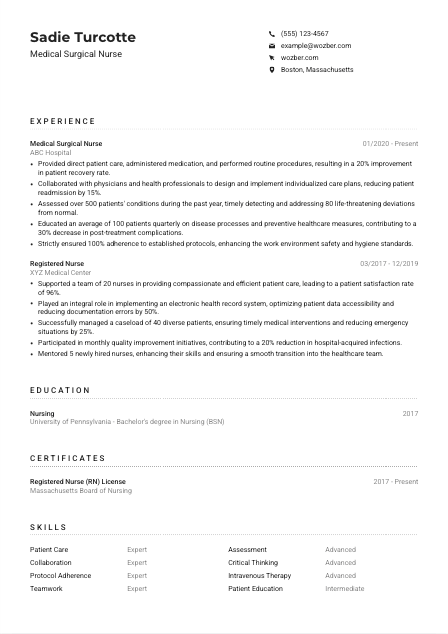
If a posting specifies a city or state, reflect that in your personal details when accurate. Here, Boston, Massachusetts is relevant because the employer wants someone already in the area or ready to relocate. A simple city and state line is enough to remove doubt about availability without turning location into the focus of the resume.
A LinkedIn profile can help if it is current and mirrors your med-surg background, education, and certifications. Keep it useful. For a bedside nursing role, an incomplete or generic profile adds little, while an updated one can reinforce your work history, hospital setting, and specialties such as patient education, EHR use, or preceptor experience.
Keep this section accurate, brief, and aligned with hiring logistics. It should confirm your professional identity and make it easy for a nurse manager or recruiter to contact you without hunting for basic information.




This section carries the most weight for a Medical Surgical Nurse. Hiring teams want to see how you handle patient loads, condition changes, interdisciplinary coordination, documentation, and outcomes on a busy unit. Broad statements about being compassionate or hardworking do not replace concrete bedside examples.
Start by marking the responsibilities the employer repeats or emphasizes. In this posting, that includes direct patient care, medication administration, routine procedures, individualized care plans, condition assessment, intervention, patient and family education, and protocol compliance. Those themes should shape your bullet points so your experience reads like med-surg practice, not generic nursing support.
List positions in reverse chronological order with your title, employer, and employment dates. For nursing resumes, this helps reviewers quickly see recency of bedside work and whether you meet the requested experience level, such as 2+ years in a medical-surgical setting. Keep the structure easy to scan because hiring teams often review many applications between patient care demands.
Describe what you actually handled in each role: assessments, medication passes, procedures, patient loads, care coordination, discharge education, or quality improvement work. Then connect that work to a result. The example resume does this well by pairing core duties with outcomes such as improved recovery rates, reduced readmissions, and lower post-treatment complications. That combination tells a fuller story than duty-only bullets.
Metrics make med-surg work more tangible when they reflect real clinical practice. Good examples include patients assessed, readmission reduction, patient satisfaction, infection reduction, charting accuracy, education volume, or response to deviations from normal. In the sample, noting over 500 patient assessments and 80 critical deviations addressed gives real scale to the nurse's vigilance and intervention skills.
Prioritize experience that shows adult inpatient care, fast-paced unit work, team communication, and adherence to care plans and protocols. Earlier or adjacent RN roles still matter, especially if they include EHR implementation, mentoring, or quality initiatives, but your strongest bullets should support the target specialty first. If you have several nursing positions, give the most space to the role closest to med-surg responsibilities.
Your experience should show that you can step into a medical-surgical unit and contribute quickly through sound assessment, safe care delivery, and reliable coordination with the rest of the care team. Make the clinical work visible, and let the metrics support it.
Education is straightforward in nursing, but it still carries screening value. For a Medical Surgical Nurse opening, this section should immediately confirm that you meet the degree requirement and have the academic foundation expected for direct patient care in an acute setting.
If the employer asks for a Bachelor of Science in Nursing, list your BSN clearly and in the same terms. That exact match matters in fast screening. In this posting, a BSN from an accredited institution is a stated requirement, so your degree should be impossible to miss.
Include degree, field of study, school name, and graduation year or date. This format works well because it lets recruiters confirm credentials at a glance without searching through extra text. Nursing resumes benefit from clean structure, especially when education is one of the formal entry requirements.
Do not shorten or paraphrase your degree in a way that creates uncertainty. If you earned a "Bachelor's degree in Nursing (BSN)," present it exactly. The sample resume handles this well by naming the degree clearly, which removes any doubt about baseline qualification for the role.
Most experienced med-surg nurses do not need to list courses. If you are early in your career, transitioning from school into bedside practice, or applying to a unit with a specialized patient population, selected coursework or clinical rotations can add context. Otherwise, your degree, licensure, and experience carry more weight.
Honors, nursing leadership activities, capstone projects, or clinical research can be worth noting if they connect to patient care, evidence-based practice, or leadership potential. Keep these additions brief. They should support your professional profile, not crowd out the degree information hiring teams need first.
This section should confirm your nursing education quickly and cleanly. When the degree requirement is visible at once, reviewers can move on to what matters most next: your bedside experience and clinical readiness.
In nursing, certifications are not decorative. They confirm legal eligibility to practice and often indicate readiness for higher-acuity situations. For a med-surg resume, list the credentials that directly support bedside care and unit expectations.
Put your current RN license first because it is essential for practice. Then add certifications the employer names or values, such as ACLS when relevant to the patient population and unit acuity. In the provided posting, the RN license is required and ACLS is preferred, so both belong here if you hold them.
Include certifications that strengthen your fit for acute care, emergency response, or specialty unit work. ACLS is useful because it points to preparedness in urgent clinical situations, which can matter on a medical-surgical floor when patient status changes quickly. Skip unrelated certificates that do not add meaning for bedside nursing hiring.
List the credential name, issuer, and date earned or active date range. This makes it easier to confirm that your license or certification is current. The sample resume's format works well here, showing both the credential source and the ongoing validity period for the RN license and ACLS.
Healthcare employers pay close attention to active credentials because expired licenses or lapsed certifications can halt hiring. Review this section before every application, especially if you recently renewed BLS, ACLS, or your state RN license. A current credential list shows professional discipline as much as qualification.
This section should remove any doubt that you are licensed, current, and prepared for the clinical pace of the role. Put the most relevant credentials first and keep every date accurate.
A med-surg skills section should read like the work of the floor. Hiring teams expect a mix of direct care abilities, clinical judgment, communication, and unit-based teamwork. Generic soft skills on their own do not say enough.
Read the posting for skills embedded in the responsibilities, not just obvious keywords. Here, patient care, assessment, medication administration, collaboration, communication, and protocol compliance all point to the daily demands of the role. Those are stronger anchors than broad terms that could apply to any job.
Choose skills you can support through your experience bullets and certifications. For a Medical Surgical Nurse, that may include patient assessment, IV therapy, care planning, EHR documentation, patient education, teamwork, and critical thinking. The sample skills list works best where the chosen items clearly connect back to documented accomplishments, such as assessment, protocol adherence, and collaboration.
Do not overload this area with every nursing capability you have ever used. Prioritize the skills most likely to matter for the target unit and patient population. A short, focused list is easier to scan and gives more weight to the abilities that define successful med-surg performance.
When this list reflects actual unit work, it reinforces the rest of your resume instead of repeating generic claims. Keep it centered on bedside care, coordination, and the clinical judgment expected in medical-surgical nursing.
Language ability matters in nursing because instructions, education, consent discussions, and handoffs depend on clear communication. For med-surg roles, list languages in a way that supports patient care and team coordination rather than treating them as a side note.
If the posting requires strong English communication, make that visible first. English proficiency matters here because nurses document in the chart, explain care plans, communicate changes in condition, and coordinate across disciplines. Put English at the top of this section if it is your primary working language.
Additional languages can strengthen your application, especially in hospitals serving diverse communities. A second language may help with patient education, discharge instructions, and family communication, even when interpreter services remain the standard for clinical accuracy. In the example resume, Spanish adds practical value without replacing English as the required core language.
If you can communicate meaningfully with patients or colleagues in another language, list it. Even when a posting does not ask for multilingual ability, it can still be a helpful differentiator in inpatient care settings where communication barriers affect comfort, adherence, and understanding.
Describe your level with terms such as "Native," "Fluent," "Intermediate," or "Basic." In healthcare, overstating language ability can create real problems in patient communication. Keep this section accurate so hiring teams know when your language skills are an asset and when interpreter support would still be necessary.
Language skills are most valuable when they improve understanding at the bedside. Consider which languages are common in the communities your target hospitals serve, but avoid padding the section with low-level ability that would not hold up in patient interaction. Relevance and honesty matter more than quantity.
Clear language information helps employers picture how you will communicate with patients, families, and staff. For nursing roles, that practical value is what makes this section worth including.
The summary should quickly place you in the right clinical lane. For this role, that means naming your med-surg background, years of experience, and a few strengths that point to safe care delivery, sharp assessment, and effective collaboration on the unit.
Before writing, identify the few points that matter most for the opening paragraph of your resume. In this case, direct patient care, assessment, care planning, education, and protocol adherence are central. Use those themes to shape a summary that sounds grounded in medical-surgical nursing rather than general healthcare language.
Start with who you are professionally and how long you have worked in nursing or med-surg settings. A line such as "Medical Surgical Nurse with 5+ years of experience" immediately gives context and helps frame everything that follows. Keep the wording direct and factual.
Choose strengths that connect to your work history, such as managing diverse caseloads, identifying changes in patient condition, coordinating individualized care plans, or improving patient outcomes through education. The example summary is effective because it highlights collaboration, preventive care, and proactive intervention, all of which are then supported in the experience section.
Aim for 3 to 5 lines. That is enough room to establish specialty, experience, and value without repeating your whole resume. Avoid vague descriptors and make each phrase earn its place with clinical meaning, whether that is patient outcomes, teamwork, education, or adherence to care standards.
A clear summary should tell the reader, within seconds, that you are an experienced nurse who can handle the pace and patient complexity of a medical-surgical unit. Keep it concise, specific, and tied to the work you actually do.
A Medical Surgical Nurse resume works best when it shows the realities of the floor: patient assessment, medication administration, care coordination, education, and protocol-driven practice. If those themes are clear in your experience, skills, licensure, and summary, your application will read as unit-ready rather than broadly clinical.
Wozber's free resume builder can help you organize that content into an ATS-compliant resume, tailor your wording to the posting, and use an ATS resume scanner to catch missing requirements before you apply. The final result should make one thing easy to judge: you are prepared to deliver safe, effective med-surg care from day one.




