




Use Wozber and land your dream job
Create Resume
No registration required
Matching nursing talents, but your resume doesn't respond? Check out this Nurse Recruiter resume example, created with Wozber free resume builder. Learn how to show your hiring insight and networking acumen to attract the best nursing candidates, making your job board as healthy as a well-staffed ward!
Nurse recruiting sits at the intersection of staffing pressure and clinical compliance. Employers need recruiters who can keep nurse pipelines active, move candidates through screening efficiently, and understand where credentialing, licensure, and culture fit can slow a hire down. Your resume should make that operating range visible quickly, especially your ability to source qualified nurses and keep the process moving with hiring managers.
When your resume is tailored well, it becomes much easier to distinguish healthcare recruiting experience from general talent acquisition work. Using Wozber's free resume builder to align your wording with the posting and create an ATS-compliant resume helps surface the details that matter here, such as nurse sourcing volume, time-to-fill improvements, credentialing knowledge, and collaboration across HR and clinical leaders.
For a Nurse Recruiter, the header should confirm basic hiring logistics without distracting from the rest of the resume. Keep it clean, professional, and aligned with the practical requirements that often matter early in review.
Use your full name in a clear font and slightly larger size than the body text. In recruiting roles, presentation matters because your work depends on organized communication, accurate records, and polished outreach to candidates and hiring teams.
Add "Nurse Recruiter" beneath your name if that matches the role you are pursuing. This immediately frames your background in healthcare staffing rather than broader recruiting, and it helps ATS matching when the employer is filtering for nurse recruitment experience.
List a reliable phone number and a professional email address. Recruiters are expected to respond quickly, coordinate interviews, and manage candidate follow-up, so your contact details should be easy to scan and error-free.
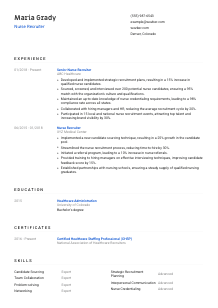
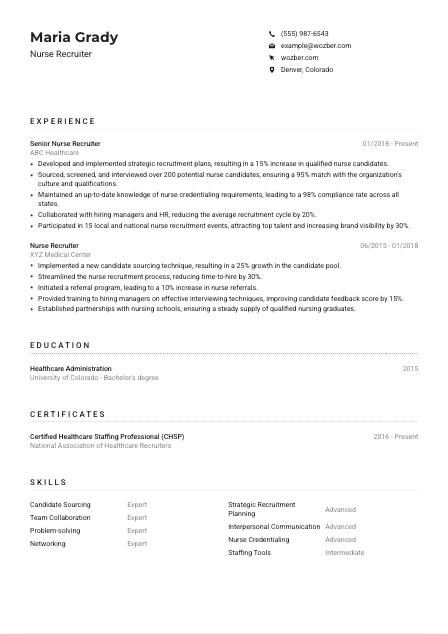
If the employer specifies a city or relocation requirement, include that information in your header. Here, Denver, Colorado is part of the posting, so showing Denver in the sample resume removes an early question about availability and local eligibility. For other roles, tailor location details only when they affect consideration.
A LinkedIn profile or professional website can support your application when it reinforces your healthcare recruiting background. For example, it may show staffing industry endorsements, recruiter networking activity, or a broader track record in healthcare hiring. Skip it if the profile is outdated or inconsistent with your resume.
Your personal details should confirm who you are, how to reach you, and whether you meet practical requirements such as location. Once that is clear, the reader can focus on your nurse recruitment results.




This section carries the most weight because Nurse Recruiter hiring decisions usually turn on actual recruiting output. Employers want to see how you sourced nurses, shortened hiring cycles, handled credentialing realities, and partnered with HR and clinical stakeholders to fill openings.
Before rewriting your bullets, identify the operational themes in the job description. In this case, the priorities include strategic recruitment planning, sourcing and interviewing nurses, understanding state licensure and credentialing, coordinating with hiring managers, and representing the organization at recruitment events. Those themes should shape which wins you highlight and which older details you cut.
Start with your current or most recent position and work backward. For each role, include employer, title, and dates, then make the scope easy to read through concise bullets. In nurse recruitment, recent experience usually tells the reader the most about your current sourcing channels, healthcare market knowledge, and process ownership.
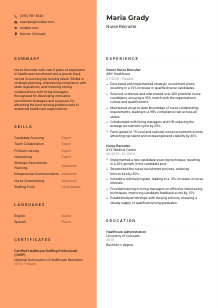
Hiring teams already know a Nurse Recruiter screens candidates and coordinates interviews. What they need from your resume is the result. The sample does this well with points like sourcing and interviewing more than 200 nurse candidates and achieving a 95% match with culture and qualification expectations. Use that model to show what changed because of your work.
Metrics are especially persuasive in recruiting because they reflect real delivery. Include numbers tied to candidate volume, time-to-hire, referral growth, event participation, compliance rates, or pipeline quality. In the example, a 20% reduction in recruitment cycle time and a 98% compliance rate give a much clearer picture than general claims about efficiency or attention to detail.
Prioritize bullets that show healthcare-specific recruiting judgment. Good examples include nurse credentialing knowledge, partnerships with nursing schools, recruitment event participation, and collaboration with HR or clinical leaders. If a bullet does not strengthen your case for handling nurse staffing demand, candidate screening, or healthcare hiring process improvement, replace it with one that does.
Your experience section should show that you can build nurse pipelines, move qualified candidates through the process, and support compliant hiring across a busy healthcare environment. Clear metrics and healthcare-specific context make that case much faster.
Education matters here because many employers want a bachelor's degree tied to HR, healthcare administration, or a related field. Present it clearly so the reader can confirm the requirement without hunting for it.
If the posting asks for a bachelor's degree in Human Resources, Healthcare Administration, or a related field, reflect your degree in direct terms. That wording helps both ATS parsing and human review. In the sample, "Bachelor's degree" and "Healthcare Administration" line up neatly with the stated requirement.
Include degree, field of study, school, and graduation year. Keep the structure straightforward so recruiters and HR partners can scan it quickly, especially when they are reviewing several candidates for the same staffing need.
For this kind of role, the field matters almost as much as the degree level. Healthcare Administration, Human Resources, and similar disciplines tell the employer that you bring some formal grounding in healthcare systems, operations, or people management.
If you are early in your career, relevant coursework in healthcare operations, HR management, or organizational behavior may add useful context. If you already have several years of nurse recruitment experience, keep this section lean unless academic distinctions clearly add value.
Nurse recruiting changes with labor market conditions, state licensure rules, and staffing models. If you have completed additional training related to healthcare staffing, interviewing, compliance, or recruitment systems, that can reinforce your ability to stay current in a fast-moving hiring environment.
This section should confirm that you meet the degree requirement and, when relevant, show ongoing learning tied to healthcare hiring. Clear formatting is enough if your experience already carries the strongest proof.
Certifications can add useful credibility in healthcare staffing, especially when they connect directly to compliance, recruiting standards, or the nurse hiring process. Include them selectively and make their relevance obvious.
When a job description calls out a credential, include it prominently if you have it. Here, Certified Healthcare Staffing Professional, or CHSP, is listed as a plus. In the sample resume, that certification immediately supports the candidate's specialization in healthcare recruiting.
Space on a resume is limited, so prioritize certifications tied to healthcare recruitment, staffing compliance, interviewing, or HR practice. A focused list tells the reader more than a long catalog of loosely related learning badges.
List the issue date or active date range, especially for certifications that require renewal or ongoing standing. That helps show the credential is current and relevant, which matters in a field shaped by changing labor conditions and regulatory expectations.
A relevant credential can signal that you stay close to healthcare staffing standards, not just general recruiting practice. That is especially useful if your work includes credential review, multi-state hiring awareness, or process guidance for hiring managers.
The right certification adds weight when it reflects real healthcare recruiting knowledge. Keep the list tight, current, and clearly connected to nurse staffing work.
The skills section should reinforce the capabilities employers expect a Nurse Recruiter to use every day. Balance recruiting mechanics with the people-facing skills needed to move nurses, hiring managers, and HR partners through a demanding hiring process.
Read beyond the obvious keywords. A posting may name candidate sourcing and communication directly, while also implying skills in interview coordination, stakeholder management, credentialing awareness, and recruitment planning. Build your list from both the stated and underlying requirements.
Use skill names that match how healthcare employers describe the work. "Candidate Sourcing," "Strategic Recruitment Planning," and "Nurse Credentialing" are stronger here than broad labels such as "recruiting" or "people skills." The sample resume does a good job of staying close to the language of the role.
Lead with the capabilities most tied to nurse recruiting performance, such as sourcing, stakeholder communication, networking, staffing tools, and compliance-related knowledge. A shorter, better-ranked list is more useful than an oversized inventory that hides your most relevant strengths.
Your skills section should echo the work you have already proven in your experience bullets. When the terminology is specific and well prioritized, the match to nurse recruiting work becomes much easier to see.
Language ability can matter in healthcare recruiting, especially when the candidate pool, patient population, or hiring footprint is diverse. Keep this section factual and connect it to the communication demands of the role.
If the posting specifies English, list it clearly with an honest proficiency level. In this case, English is essential, so placing it first removes any doubt that you meet a basic communication requirement for interviews, outreach, and stakeholder coordination.
Order matters. Start with the language the employer asked for, then add others that may support recruiting effectiveness. This keeps the section aligned with the posting instead of reading like a generic profile detail.
Extra language skills can be useful when working with diverse nursing communities, regional talent pools, or outreach events. For example, Spanish may help with relationship-building in some markets, but it should be presented as an added asset unless the employer specifically requests it.
Use clear labels such as "Native," "Fluent," "Intermediate," or "Basic." Recruiters are communication professionals, so vague claims here can undercut credibility quickly.
Some Nurse Recruiter positions focus on a local market, while others support multi-state staffing or broader outreach. If your language skills have helped you engage candidates across those settings, they are worth including. If not, keep the section brief and accurate.
This section should confirm required communication ability first, then show any added language strengths that support broader nurse outreach or relationship-building.
Your summary should quickly place you in healthcare recruitment, not just general talent acquisition. In a few lines, show your experience level, the kind of nurse staffing work you handle, and the results or strengths that make you credible for the role.
Start with the actual hiring need. If the role centers on nurse sourcing, credentialing awareness, hiring manager partnership, and recruitment planning, those ideas should shape the summary. This keeps the opening focused on the work the employer needs done now.
A direct first line works well here. Something like "Nurse Recruiter with 6+ years of experience in healthcare recruitment" immediately establishes specialization and seniority. The sample summary uses this approach effectively.
Choose details that separate you from a general recruiter. Good options include sourcing nursing talent at scale, maintaining compliance with state credentialing requirements, improving time-to-hire, or building strong partnerships with hiring managers. Use language you can support elsewhere in the resume.
Aim for three to five lines. That gives you enough room to show healthcare recruiting depth without repeating full bullet points from your experience section. A concise summary works best when each phrase points toward nurse staffing outcomes, compliance knowledge, or recruiting process improvement.
A good summary should tell the reader, within seconds, that you understand nurse recruiting and have already delivered in that environment. If it does that cleanly, the rest of the resume has a strong opening to build on.
A Nurse Recruiter resume should make your staffing results, healthcare recruiting knowledge, and process ownership easy to recognize. Focus on the work that matters most in this field: building nurse pipelines, screening effectively, partnering with hiring managers, and staying current on credentialing requirements.
Use Wozber's free resume builder to organize those details in an ATS-friendly resume format, then refine the wording with the ATS resume scanner so your experience lines up naturally with the job description. The finished resume should make one point clear right away: you can help the organization hire qualified nurses with speed, consistency, and sound recruiting judgment.




