



Use Wozber and land your dream job
Create Resume
No registration required
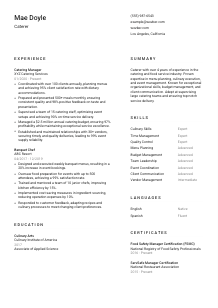
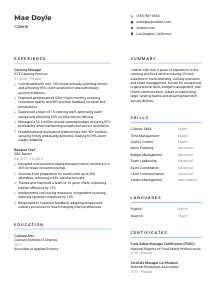
Cooking up dazzling dishes, but your resume isn't sizzling? Check out this Caterer resume example, created with Wozber free resume builder. Learn how to present your culinary talents in line with job expectations, serving your career path with the same excellence you bring to events!
Catering work is judged in real time. Food quality, timing, presentation, dietary accuracy, and crew coordination all show up at once when service begins. Your resume needs to make that operating range visible quickly, especially if you have handled menu planning, high-volume prep, event setup, and vendor follow-through under tight deadlines.
When catering resumes are tailored well, hiring teams can immediately tell whether your background is built around events, not just general food service. Wozber's free resume builder helps you align your wording with the posting, keep an ATS-compliant resume clean, and surface details like menu planning, budget control, and staff supervision that matter early in the review.
In catering, small details carry weight. If your contact information is unclear or your location does not match the employer's needs, your application can be filtered out before anyone reads about your event experience or culinary range.
Use your full name as the clearest text on the page. Hiring managers often scan dozens of resumes for event-driven roles, so your name should be immediately visible without decorative formatting or crowded headers.
Place the exact job title under your name when it reflects the role you want. Using "Caterer" here tells both the reader and the ATS that your background is being presented for catering work specifically, rather than restaurant service or back-of-house kitchen roles more broadly.
List a working phone number and a professional email address you actually monitor. In catering, interviews and event-related follow-ups often move quickly, so missed calls or outdated contact details can cost you an opportunity.
If the employer is hiring locally, show your city and state clearly. For this opening, listing "Los Angeles, California" addresses a stated requirement right away and removes doubt about availability for local events, client meetings, or early setup schedules.
Include a website or LinkedIn profile if it supports your candidacy with catering experience, event photos, culinary background, or client-facing work. Keep it current and consistent with your resume so employers do not find mismatched titles, dates, or responsibilities.
Your personal details should answer the practical basics fast: who you are, how to reach you, and whether you meet straightforward requirements like role focus and location. That keeps attention on your catering record instead of avoidable questions.




This section does the heaviest lifting for a Caterer. Employers want to see how you perform when service volume is high, client requests change, and several moving parts have to land on time without hurting food quality or profitability.
Read the job description for the work patterns behind the keywords. Here, the priorities are menu coordination, culinary execution, handling multiple events, supervising staff, vendor management, and protecting margins. Build your bullets around those operating responsibilities so your experience reads like a match for real catering work, not generic food service.
Start with your most recent role and present each entry with job title, employer, and dates. That structure helps hiring teams quickly track whether you have the required 3+ years in catering or food service and whether your background progressed into more responsibility, such as moving from banquet production into event leadership.
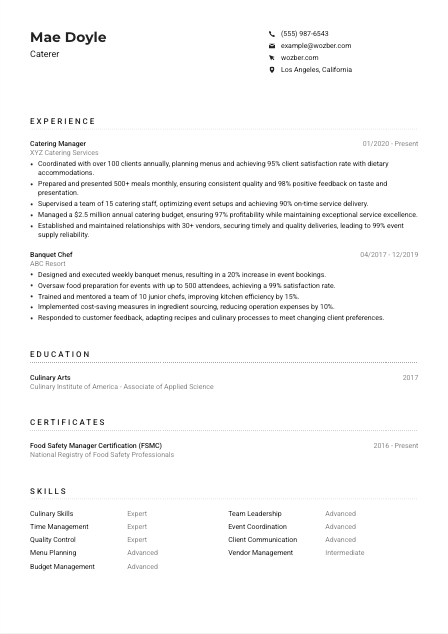
Focus each bullet on what you handled and what happened as a result. Good catering bullets mention menu planning, dietary accommodations, food volume, event size, service timing, staff oversight, or supplier coordination. The sample resume does this well by showing client planning, meal production, team supervision, and delivery reliability instead of listing kitchen tasks in isolation.
Numbers matter in catering because they show scale and control. Include metrics such as meals prepared per month, number of clients served, team size, event attendance, satisfaction scores, budget size, cost savings, or on-time service rates. Metrics like "500+ meals monthly," "team of 15," or "95% client satisfaction" make the workload and results easier to understand.
Use space on accomplishments that strengthen your case for this type of role. Prioritize bullets about menu customization, freshness and presentation standards, event execution, client communication, and cost control. If a point does not help an employer picture you running successful catered events, trim it or rewrite it.
Your experience should show that you can run catering work end to end: plan menus, deliver consistent food quality, lead staff, stay on schedule, and manage costs without letting service slip. That is the standard this section needs to make clear.
Catering is a hands-on field, but education still adds context. Culinary training, hospitality coursework, and food-service programs can strengthen your resume by showing formal grounding in technique, sanitation, and production standards.
Lead with education that supports your catering work directly, such as Culinary Arts, hospitality, food service management, or event-focused training. Even when a posting does not require a degree, role-related education can reinforce your command of food preparation, menu design, and service standards.
List the school, degree, field of study, and graduation year in a clean structure. This is enough for most catering resumes. Employers mainly want to understand the type of training you completed and how it supports your practical experience.
If your education directly supports the role, let that connection be obvious. An Associate of Applied Science in Culinary Arts, like the example resume shows, fits naturally with a job that asks for strong culinary skills and knowledge of different cuisines.
Include relevant courses, concentrations, or workshops only when they sharpen your case. Topics like food safety, nutrition, banquet production, international cuisine, or kitchen management can be useful if they connect to the target role's menu planning or event execution needs.
Honors, competitions, or leadership in culinary programs can add value when they support your professional story. Keep them concise and choose items that reinforce execution, discipline, or specialization rather than filling space with unrelated campus activities.
Education works best here as reinforcement. It should back up your culinary foundation and service knowledge, while your experience section carries the proof of how you perform in live event settings.
Food safety and compliance matter in every catering operation. Current certifications can reassure employers that you understand sanitation standards, safe handling practices, and the operational discipline needed for off-site service and high-volume food production.
When a posting mentions Food Safety and Sanitation certification, move those credentials to the top of this section. ServSafe and similar certifications are especially relevant for catering because employers need people who can protect quality and safety across prep, transport, holding, and service.
Prioritize credentials tied to catering operations, culinary execution, food handling, supervision, or event service. A long list is less useful than a short, relevant one. For this role, food safety certification carries more weight than unrelated training.
Include issue and renewal dates when a certification has to stay active. That matters for employers who need confidence that your sanitation knowledge is current and ready for immediate use. The example resume handles this well by showing ongoing validity for both food safety credentials.
Renew time-sensitive credentials before they lapse and add new training when it reflects the level of work you want. In catering, current certification supports trust with employers, venues, and clients, especially when special dietary requests or large-scale service are involved.
Relevant certificates strengthen your credibility fast. They show that you can support service quality while meeting the food safety standards that catering employers cannot afford to overlook.
A Caterer's skills section should read like an operating toolkit for events. The best lists combine culinary ability with coordination, communication, and cost awareness, because catering success depends on far more than cooking alone.
Identify the capabilities the employer actually named, then reflect them in your own wording where they are true to your background. In this posting, that means culinary skills, organization, handling multiple events, communication, budgeting, and vendor coordination. Those terms are more useful than broad labels like "hardworking" or "team player."
Arrange your list around what helps you execute catered events successfully. Menu planning, food preparation, quality control, event coordination, team leadership, client communication, and budget management are all stronger than generic kitchen language when the target role includes both production and service oversight.
Use a tidy format and avoid overloading the list. Group related strengths naturally and place the most relevant ones first. The example resume balances culinary skills with event coordination and client communication, which gives a fuller picture of catering performance than a skills list focused only on cooking.
This section should make it easy to see that you can execute the food, manage the event flow, and work well with clients, staff, and suppliers. Those are the combinations that tend to matter most in catering hires.
Language skills can matter in catering because the work is highly collaborative and client-facing. Clear communication affects menu planning, dietary requests, event setup, staff direction, and the overall guest experience.
If the posting requires strong English, list English prominently with an accurate proficiency level. This role states that English is required, so that should be visible immediately rather than buried at the bottom of the resume.
Use direct labels such as "Native," "Fluent," "Intermediate," or "Basic." Catering employers need to know whether you can discuss menus with clients, guide staff during setup, and respond quickly when service issues arise.
Additional languages can strengthen your application when they support client service or team communication. In markets with diverse staff and customers, bilingual ability can be a real practical advantage during event planning and live service.
Do not overstate proficiency. If you can hold professional conversations with vendors or staff in another language, say so honestly. Clear expectations matter in a role where misunderstandings can affect timing, food accuracy, or guest requests.
Highlight languages that match the kind of events or communities you typically serve. For example, Spanish can be valuable in many catering settings because it may support smoother communication across kitchen teams, setup crews, and vendors.
For a Caterer, languages are most valuable when they improve coordination and service. List them in a way that makes your communication range practical and believable.
Your summary should quickly establish the kind of catering professional you are. In a few lines, it should connect your years of experience with the parts of the job you handle best, whether that is menu planning, event execution, team supervision, or budget control.
Pull the two or three priorities that define the job and reflect them in your opening lines. For this role, that means catering or food service experience, culinary range, organization, communication, and the ability to run multiple events without losing quality.
Start with your title and years of experience so the reader understands your level immediately. A line like "Caterer with over 4 years of experience in the catering and food service industry" works because it is direct, relevant, and aligned with the requirement for at least 3 years of experience.
Follow your opener with capabilities that reflect how you create value in catering. Menu planning, culinary execution, event management, staff leadership, budget oversight, and client communication are all strong options when they match your actual background. The sample summary uses this approach effectively by pairing operational strengths with service delivery.
Aim for three to five lines with concrete role language. Avoid generic claims about passion or dedication unless they are backed by real scope or results elsewhere in the resume. The summary should sound like a condensed version of your catering track record, not a personal statement.
By the end of this section, an employer should already understand your experience level, the kind of catering work you handle well, and the value you bring to event execution. That sets up the rest of the resume to confirm the details.
A Caterer resume works when it makes event execution easy to picture. Before sending it out, check that your experience shows menu planning, food quality, service timing, team supervision, client communication, and cost control in language that matches the posting.
Use Wozber's free resume builder and ATS resume scanner to tighten wording, improve ATS optimization, and present your background in an ATS-friendly resume format. The final version should make one thing clear right away: you can deliver catering service that runs smoothly, tastes great, and holds up under pressure.