



Use Wozber and land your dream job
Create Resume
No registration required
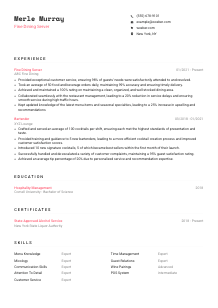
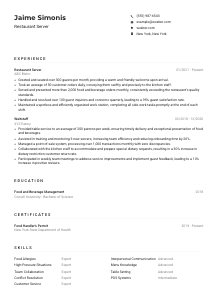
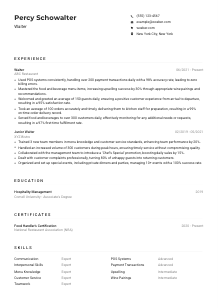
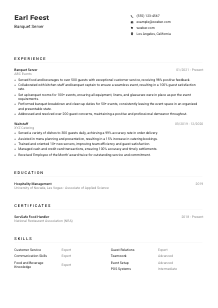
Perfecting table settings, but your resume is getting messy? Try this Fine Dining Server resume example, created with Wozber free resume builder. Learn how to present your service skills with elegance and match the tasteful demands of top-tier dining establishments!
Fine dining service runs on timing, product knowledge, and composure under pressure. A hiring manager is not looking for a generic server profile. They want to see whether you can guide guests through a menu, recommend wine or cocktails with confidence, keep service polished during a busy shift, and recover smoothly when something goes wrong at the table.
The resume gets more attention when those strengths are tied to the kind of floor work the restaurant actually needs. Wozber's free resume builder helps shape that experience into an ATS-compliant resume using the right service language, while ATS optimization keeps terms like wine pairings, guest satisfaction, and order accuracy easy to match. That gives the hiring team a faster read on whether you can handle refined service standards from day one.
In hospitality, small details carry weight. Your contact section should show the same care you bring to table settings, guest communication, and pre-service readiness.
Use your full name at the top in a clean, readable format. Keep it more prominent than the rest of the header so the resume is easy to identify during a fast hiring review.
Place "Fine Dining Server" directly under your name if that is the role you are applying for. This immediately positions your background in the right service tier and avoids any confusion if your past titles include server, bartender, or front-of-house variations.
Add a reliable phone number and a professional email address. In guest-facing roles, precision matters. A typo in your contact information suggests the same kind of carelessness restaurants try to avoid in order taking, check handling, and guest follow-up.
If the employer specifies a city requirement or relocation expectation, include that clearly. Here, listing New York, NY directly supports the posting's request and removes a practical concern early in the review.
A LinkedIn profile can be useful if it reflects the same work history, titles, and certifications shown on your resume. Include it only if it strengthens your presentation and stays consistent with the rest of your application.
This section should do one job well: make you easy to contact and easy to place. When the basics are clean and accurate, the reader can move straight to your service record, and Wozber's free resume builder helps keep that header polished in an ATS-friendly resume format.




This is where restaurants look for proof that you can work a demanding floor, not just hold a server title. Focus on service volume, order accuracy, guest satisfaction, upselling, and coordination with the kitchen and management during busy shifts.
Read the job description closely and mark the operational priorities. In this example, the recurring themes are menu knowledge, wine pairings, mixology familiarity, guest satisfaction, detail-oriented service, and calm execution under pressure. Those points should shape which bullets you lead with and which terms you repeat naturally.
Start with your most recent front-of-house position and work backward. Fine dining employers want to see your latest service environment first, especially if it involved high-end dining rooms, upscale lounges, tasting menus, or premium beverage programs.
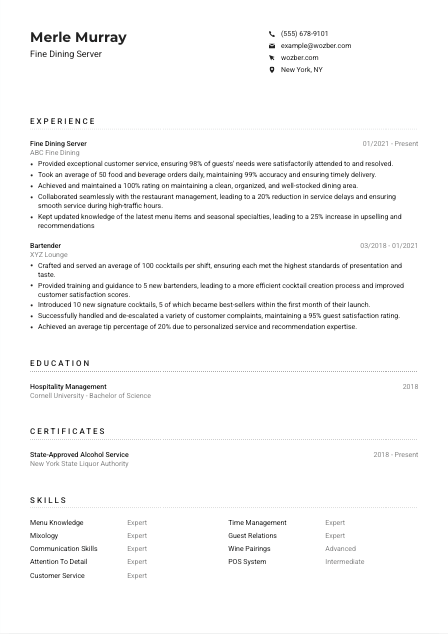
Do not stop at "took orders" or "served guests." Show what level of service you maintained. The sample resume does this well with details like resolving 98% of guest needs, maintaining 99% order accuracy, and reducing service delays through coordination with management. Those bullets show pace, standards, and consistency on the floor.
Metrics make service performance easier to trust. Good examples include covers served per shift, order accuracy, guest satisfaction ratings, upsell gains, bar output, or improvements in ticket timing. Numbers such as a 25% increase in recommendations or 100 cocktails per shift feel credible because they reflect how hospitality performance is actually measured.
Trim out tasks that do not help you compete for a fine dining role. Prioritize work that shows polished guest interaction, beverage knowledge, complaint handling, side work discipline, and collaboration with hosts, managers, bartenders, and the kitchen. Even related experience, like bartending, earns its place when it strengthens your case for wine, cocktail, and upselling knowledge.
Your experience section should make it easy to picture you on the floor during a busy service. If the bullets show polished execution, strong menu and beverage knowledge, and measurable guest results, you are giving the employer the right kind of proof. Wozber's ATS resume scanner can help you tighten that alignment with the language used in the posting.
Education is rarely the deciding factor for a Fine Dining Server, but it can add useful context. Hospitality training, restaurant coursework, or guest service education can reinforce the professional standards behind your floor experience.
Most fine dining server postings emphasize service experience first. Still, education can strengthen your resume when it connects to hospitality operations, food and beverage service, hotel or restaurant management, or customer experience. A Hospitality Management degree, like the one in the example, supports the story without replacing hands-on service experience.
List your degree, field of study, school, and graduation year in a simple structure. Hiring teams should be able to scan this section in seconds without losing time on extra wording.
If your education included wine studies, food service operations, guest relations, or hospitality management, you can note that when it strengthens your case. Keep it brief and tie it to the work you are pursuing rather than listing every class.
Honors, hospitality clubs, restaurant competitions, or leadership activities can help if they point to discipline, service standards, or industry involvement. Leave them out if they distract from stronger work experience.
If you have several years in upscale restaurants, keep education concise. If you are earlier in your career, education can carry more value, especially when paired with internships, banquet service, bar training, or hospitality-focused coursework.
Use this section to support your hospitality profile, not to carry it. When education is presented cleanly and tied to restaurant work, it adds credibility without pulling focus from the service experience that matters most.
Certifications are especially useful in restaurant hiring because they often connect directly to compliance and floor readiness. For fine dining roles, alcohol service and food handling credentials can move your resume forward faster than generic training certificates.
If the job asks for a state-approved alcohol service course or food handling certification, place those credentials prominently. In this case, those are direct requirements, so they should appear exactly and clearly on the resume.
List certifications that strengthen your ability to work in a refined dining room. Alcohol service, food safety, wine education, responsible service, and mixology-related training are all more useful here than unrelated certificates.
Include the issue date and, when relevant, note that the certification is current. Restaurants need to know whether you can step into service without a compliance delay, especially for alcohol handling and food safety.
The best additions are the ones that reflect how fine dining service evolves. Wine education, spirits knowledge, service etiquette, and advanced food safety training can all sharpen your profile when they match the restaurant's concept and beverage program.
This section should reassure the employer that you meet service compliance standards and take the profession seriously. When your certifications are current and relevant, they support both trust and interview momentum.
The skills section works best when it reflects how service is actually delivered. Choose skills tied to guest interaction, beverage knowledge, order precision, floor coordination, and maintaining standards during a demanding shift.
Use the posting as your guide for what belongs here. For this role, terms like menu knowledge, wine pairings, mixology, interpersonal communication, guest satisfaction, and attention to detail are central. Those are the skills a restaurant expects to see quickly.
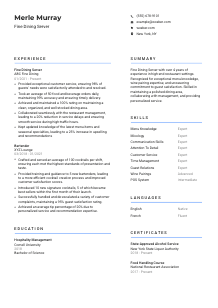
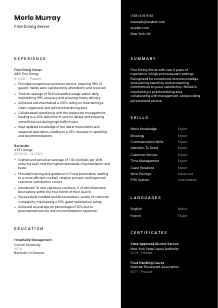
A fine dining resume should show both product knowledge and service behavior. Include skills such as menu knowledge, POS systems, wine pairings, and mixology alongside communication, guest relations, time management, and attention to detail. The example resume balances those categories well.
Do not overload this section with every trait you can name. Choose the skills most relevant to the restaurant's service model and present them in a clean structure. Wozber can help organize them in an ATS-compliant resume so both hiring teams and software can read them quickly.
A hiring manager should be able to connect each skill on the page to something you have already done on the floor. Keep the section specific, relevant, and grounded in the kind of service standards the restaurant expects.
Language ability matters in hospitality because service depends on clear, confident interaction. In fine dining, that can affect everything from explaining specials to handling guest concerns with tact.
If the posting names English as essential, place it at the top with your proficiency level. That makes one of the employer's basic communication requirements easy to confirm immediately.
Additional languages can be a real advantage in restaurants that serve international guests or a multilingual local clientele. French in the sample resume, for example, complements a fine dining environment well, but any second language is worth listing if you can use it professionally with guests.
Choose honest levels such as Native, Fluent, Intermediate, or Basic. Restaurants rely on smooth communication in live service, so overstating language ability can create problems quickly.
Some dining rooms benefit more from multilingual staff than others. If the venue draws tourists, business travelers, or an international crowd, language skills become more valuable and deserve stronger placement.
Even when a second language is not required, it can support hospitality, personalization, and problem resolution. Include it when it helps paint a fuller picture of how you connect with guests at the table.
In this section, the employer is looking for practical speaking ability that can improve service. Keep it honest and relevant so your language skills strengthen your front-of-house profile.
Your summary should quickly establish the level of service you work at. In a few lines, show your experience, your strengths on the floor, and the kind of guest experience you are known for delivering.
Before writing, pull the key themes from the posting. Here, the priorities include fine dining experience, guest satisfaction, menu and beverage knowledge, and reliable service under pressure. Your summary should reflect those points in a natural way, not as a pasted keyword list.
Start with a direct line that tells the reader who you are and where you have worked. The sample summary does this effectively with "Fine Dining Server with over 4 years of experience in high-end restaurant settings," which immediately sets the service level and scope.
Choose strengths that matter in fine dining, such as wine pairing knowledge, polished guest communication, order accuracy, upselling, or collaboration during high-volume service. Keep them anchored in real work, not broad personality claims.
Aim for 3 to 5 lines. That is enough room to show your service standard without repeating details that belong in the experience section. A compact summary with the right restaurant language is easier for both hiring teams and ATS tools to process.
Your summary should tell the restaurant, quickly and credibly, what kind of floor professional you are. When it reflects your experience, beverage knowledge, and guest service standards in clear language, it sets up the rest of the resume well.
A Fine Dining Server resume should leave little doubt about how you perform in service. It should show the level of restaurant you have worked in, how well you handle guests and pressure, and where your menu, wine, or mixology knowledge adds value during a shift.
Use Wozber to organize that experience into an ATS-friendly resume template, strengthen wording with AI-assisted tailoring, and check alignment with an ATS resume scanner. The finished resume should make one thing easy to judge: you can step onto a high-standard dining room floor and deliver polished service consistently.




