



Use Wozber and land your dream job
Create Resume
No registration required
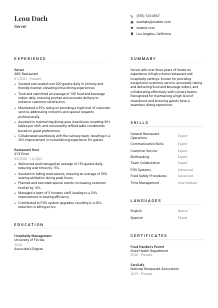
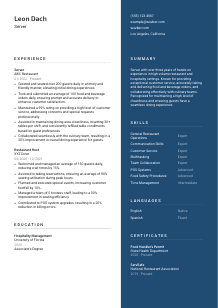
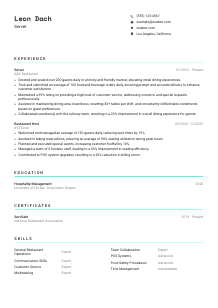
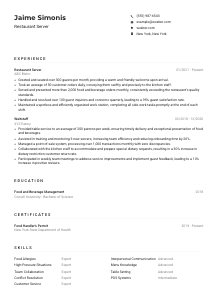
Balancing plates, but your resume seems out of sync? Steal a peek at this Server resume example, created with Wozber free resume builder. Learn how to line up your service finesse with job requirements, making your career journey as seamless as a well-timed tray flip!
Server resumes are read through the pace of the dining room. Hiring managers want to see whether you can handle a busy floor, keep orders accurate, stay composed with guest requests, and work smoothly with hosts, runners, bartenders, and the kitchen when service picks up. Your resume should make that front-of-house rhythm visible, not just say you provided great service.
When the language of your resume matches the posting, the reader can quickly connect your experience to the shift demands, guest volume, and service standards of the job. Wozber's free resume builder helps shape that alignment into an ATS-compliant resume, so terms like POS systems, food safety, and high-volume service are easy to find and your readiness for the floor is clear.
In restaurant hiring, this section is practical first. Managers need to know who you are, how to reach you quickly, and whether basic logistics line up before they spend time on your service background. Keep it clean, current, and tailored to the posting.
Use your full name in the largest text on the page so it is easy to spot at a glance. In hospitality hiring, resumes often move fast between managers, so readability matters more than design flair.
Place "Server" directly under your name if that is the role you are applying for. Matching the posting title helps frame your experience correctly, especially if your background also includes host, cashier, barback, or other front-of-house work.
Managers may call between shifts or send a quick interview request, so every detail needs to be accurate and professional.
If the employer asks for local candidates, include your city and state. In this example, listing Los Angeles, California immediately answers a stated requirement and removes questions about commuting or relocation timing.
A LinkedIn profile can be useful if it mirrors your resume and shows steady hospitality work, certifications, or customer-facing experience. Skip personal links that do not strengthen your restaurant background or availability for service roles.
This section should answer the hiring manager's first practical questions in seconds: who you are, how to contact you, and whether you are positioned to take the job. Clear details help the rest of your service experience land faster.




For a Server role, experience carries the most weight when it shows pace, accuracy, guest handling, and teamwork during live service. Hiring managers want to picture you taking orders, managing multiple tables, coordinating with the kitchen, and keeping the dining area moving without dropped details.
Read the job description closely and mark the operational terms that define the work. For this role, that includes high-volume restaurant experience, POS proficiency, multitasking, guest communication, food safety, and collaboration with front-of-house and culinary staff. Those ideas should appear naturally throughout your bullet points, not only in a skills list.
Start with your most recent job and include your title, the restaurant or venue name, and dates of employment. If your background includes adjacent front-of-house roles such as host or restaurant cashier, keep them when they support guest flow, seating, reservations, or POS accuracy.
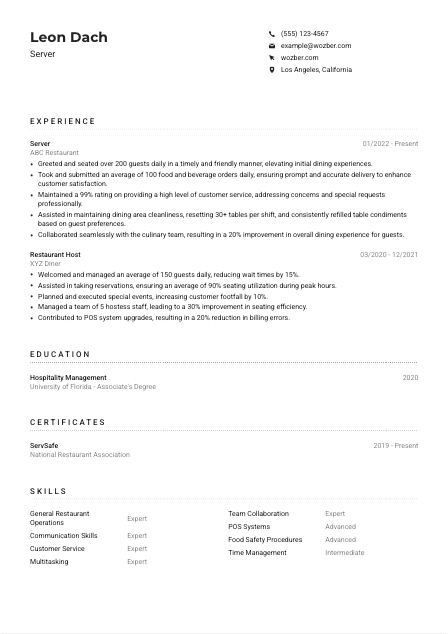
Each bullet should show what you handled on shift and what happened because you handled it well. Good Server bullets mention guest volume, order accuracy, special requests, table turnover, cleanliness, or coordination with the kitchen. The example does this well with points like greeting and seating over 200 guests daily and submitting around 100 food and beverage orders per day.
Metrics make service experience easier to trust. Count guests served, tables reset, orders handled, customer service ratings, wait-time reductions, seating efficiency, or billing accuracy improvements. Numbers such as a 99% service rating or a 20% drop in billing errors give concrete proof that you work accurately under pressure.
Lead with roles that show direct guest service in busy environments. If you have older or less relevant jobs, trim the detail so your strongest restaurant work gets the most space. A host position can still add value when it shows reservation management, seating flow, and teamwork during peak hours, as in the sample resume.
By the end of your experience section, a manager should be able to picture you handling a live shift with speed, accuracy, and good judgment. Focus on guest volume, order flow, team coordination, and service results they recognize from their own floor.
Education is usually a supporting section for Server hiring, but it can still strengthen your resume when it connects to hospitality, guest service, or food operations. Keep it concise and make relevance do the work.
Many Server jobs do not require a specific degree, and this one does not. That gives you room to keep the section brief while still using it to reinforce your background, especially if you studied hospitality, business, tourism, or customer service.
List the school, degree or diploma, field of study, and graduation date or expected date. A simple structure is enough. The goal here is to give context, not to crowd out your service experience.
If your education connects to restaurant or guest-facing work, make that visible. An Associate's Degree in Hospitality Management, like the example resume shows, adds useful context because it supports operational knowledge and service standards.
This works best for early-career applicants or anyone with limited restaurant experience. Courses in food safety, hospitality operations, communication, or customer service can support your resume when they tie directly to front-of-house work.
Academic honors, hospitality clubs, or event-service projects can help if they demonstrate leadership, service exposure, or teamwork. Leave them out if they distract from stronger restaurant experience or make the section feel padded.
Keep education in proportion to the role. For most Server applications, it should support your hospitality background without competing with the experience that shows how you perform during service.
Restaurant certifications matter because they tie directly to safe service and day-to-day compliance. When a posting mentions food safety credentials, listing the right ones can strengthen your resume quickly, especially in operations where sanitation standards are closely watched.
Look for licenses or food safety credentials the employer calls out. Here, ServSafe and a Food Handler's Permit are listed as a plus, which tells you the employer values candidates who already understand sanitation and safe handling standards.
Lead with certifications that connect directly to restaurant floor work. ServSafe, a Food Handler's Permit, alcohol service certification where relevant, or local health training all belong ahead of unrelated courses or general certificates.
Show when the certification was earned and, if applicable, whether it is current. In food service, an active certification matters more than an old one because it tells employers your knowledge of current sanitation practice is up to date.
If you plan to stay in hospitality, continue adding certifications that support guest service, food safety, or compliance. They are especially useful when moving into larger venues, busier service environments, or roles with more responsibility on the floor.
Relevant certifications tell employers you can step into service with less ramp-up on food handling and sanitation expectations. They are a practical advantage, especially when the posting already points to them.
A Server skills section works best when it reflects the actual mechanics of service. Generic soft skills are not enough on their own. You need a mix of guest-facing strengths, floor coordination, and restaurant tools that match the pace and standards of the job.
Use the job description to identify the exact terms the employer uses. In this case, that includes POS systems, multitasking, communication, teamwork, general restaurant operations, and food safety. Matching that language helps both human reviewers and ATS screening connect your background to the role faster.
List the skills that show up in your actual shift history. If you claim POS proficiency, your experience should also show order entry, billing accuracy, or register work. If you list team collaboration, your bullets should reflect coordination with kitchen staff, hosts, runners, or bussers during service.
Prioritize the skills most relevant to front-of-house restaurant work instead of building a long generic list. The sample resume handles this well by pairing operational skills such as POS Systems and Food Safety Procedures with service strengths like Customer Service, Communication Skills, and Team Collaboration.
Your skills section should read like the toolkit of someone who can step onto the floor and contribute right away. Choose the abilities that support guest service, order accuracy, sanitation, and smooth coordination during busy shifts.
Language ability can make a real difference in hospitality because service depends on quick, clear communication. For Server roles, that affects everything from greeting guests and explaining menu items to handling special requests and resolving issues without slowing the table down.
Always start with what the employer specifically asks for. Here, English proficiency is required, so it should appear clearly in your language section if it applies to you.
Start with the language most important to the role, then add others in descending order of strength. Use labels such as Native, Fluent, Intermediate, or Basic so managers understand what level of guest interaction you can handle in each language.
Extra languages can strengthen a Server resume when they help with guest rapport, menu explanations, or smoother service in diverse dining environments. In a market like Los Angeles, Spanish can be especially useful, and the sample resume reflects that well.
Do not overstate fluency. In guest-facing roles, language claims are tested quickly in real interactions, whether that means answering questions about ingredients, clarifying modifications, or managing a complaint professionally.
When a restaurant serves a multilingual local community or a steady tourist base, additional languages can be a practical advantage. Mention them as service strengths, not as filler, and keep the emphasis on better guest communication.
Well-presented language skills show that you can communicate clearly with more guests and handle service interactions with less friction. For a Server, that can directly improve guest comfort and table experience.
Your summary should sound like someone a restaurant would trust on a busy shift. In a few lines, it needs to establish your level of experience, the kind of dining environment you know, and the service strengths you bring to the floor.
Start with the requirements that matter most for the role. For this posting, that means high-volume service, customer communication, POS familiarity, food safety awareness, and teamwork with the kitchen and front-of-house staff.
State your professional identity plainly and include your experience level. A line like "Server with 3+ years of experience in high-volume restaurant settings" gives immediate context and works well for fast resume reviews.
Choose details that reflect how you perform, not just adjectives. The sample summary works because it points to customer service, accurate food and beverage order handling, collaboration with culinary teams, and maintaining a clean dining experience.
Aim for a short paragraph that can be read in a few seconds. Avoid vague claims like "hardworking team player" unless the rest of the sentence grounds them in restaurant realities such as busy shifts, guest satisfaction, or smooth order flow.
A hiring manager should finish your summary with a clear sense of the kind of service professional you are, the environment you know, and the strengths you will bring to the next shift. Keep it brief, credible, and grounded in front-of-house work.
A strong Server resume shows more than friendliness. It connects your guest service, order accuracy, POS experience, sanitation knowledge, and teamwork to the realities of a busy restaurant.
Use Wozber to turn that experience into a polished, ATS-friendly resume template with language aligned to the job description and structure that supports ATS optimization. The final result should make it easy to judge one thing quickly: whether you can step into service and keep the dining room running smoothly.




