



Use Wozber and land your dream job
Create Resume
No registration required
Taking orders, but your resume feels undercooked? Plate up this Restaurant Server resume example, created with Wozber free resume builder. Learn how to layer your service skills to match job requirements, ensuring your career is always served with a side of success!
Restaurant service moves fast, and hiring managers look for candidates who can keep pace without dropping standards. A Restaurant Server resume needs to show more than friendliness. It should make clear that you can manage a full section, communicate cleanly with the kitchen, handle guest concerns with composure, and keep service accurate when the floor gets busy.
When those details are tailored to the posting, the resume is much easier to sort in both human review and ATS screening. Wozber's free resume builder helps you align your wording with the job ad, keep an ATS-friendly resume format, and surface the service strengths that matter first, such as high-volume experience, allergy awareness, and reliable guest-facing communication.
For a Restaurant Server, the top of the resume should read cleanly and professionally. This section is simple, but it still shapes the first impression by showing that you are organized, easy to contact, and already aligned with basic job requirements.
Start with your full name in the most prominent text on the page. In hospitality, managers often review resumes quickly between service periods, so your name should be easy to spot and easy to remember.
Place "Restaurant Server" directly under your name if that is the role you are applying for. This immediately tells the reader where you fit on the floor and keeps your resume aligned with the language used in the posting.
Include a working phone number and a professional email address. Accuracy matters here. If a manager wants to schedule a trial shift, interview, or quick follow-up, they should not have to guess whether your contact information is correct.
If the employer wants local candidates, list your city and state clearly. In this example, "New York, New York" directly addresses the stated location requirement and removes doubt about availability or relocation timing.
A LinkedIn profile or professional website can be useful if it supports your hospitality background with consistent work history, certifications, or guest service experience. Include it only if it is current and adds something beyond the resume itself.
Your personal details should make one thing easy from the start: you are reachable, professional, and positioned for the job as posted. In restaurant hiring, that kind of clarity helps the rest of your experience land faster.




Restaurant managers usually spend the most time in the experience section because it shows how you work in real service conditions. This is where you prove table volume, order accuracy, guest care, teamwork with the kitchen, and how well you hold up during rush periods.
Read the job ad closely and mark the phrases tied to actual floor performance, such as high-volume restaurant experience, food allergy knowledge, dietary restrictions, communication, and handling pressure. Then reflect those priorities in your bullet points using language that matches your real background.
Start with your most recent restaurant or hospitality position and work backward. For each role, include your job title, employer, and dates so the reader can quickly see your progression and how recently you worked in active service environments.
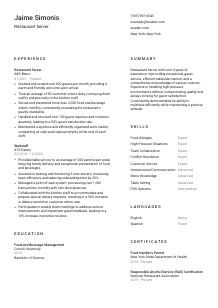
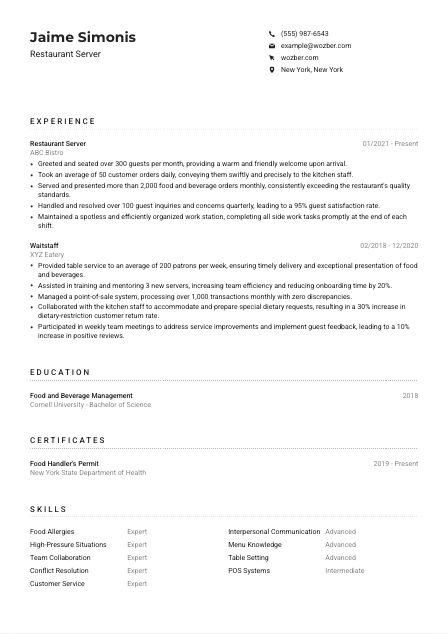
Focus each bullet on work that matters in a dining room. Strong examples include greeting and seating guests, taking accurate orders, managing POS transactions, coordinating timing with the kitchen, handling complaints, and completing side work. The sample resume does this well by pairing core server duties with concrete activity, like taking 50 orders daily and serving more than 2,000 food and beverage orders monthly.
Metrics help hiring teams picture your range and stamina. Use numbers tied to covers served, daily orders, guest satisfaction, transaction accuracy, training support, or repeat business. Figures like "300 guests per month," "1,000 transactions monthly," or "95% guest satisfaction rate" feel credible because they reflect how service performance is actually tracked.
Prioritize experience that shows guest-facing service, menu knowledge, dietary accommodations, teamwork, and speed under pressure. If you have unrelated jobs, keep them brief unless they clearly add transferable value such as cash handling, complaint resolution, or fast-paced customer service.
Your experience section should leave no guesswork about whether you can step into service and contribute quickly. Show the pace you handled, the standards you maintained, and the kind of guest experience you helped deliver.
Education is rarely the deciding factor for a Restaurant Server role, but it can still strengthen your profile when it connects to hospitality, food service, or guest experience. Keep it concise and relevant to the kind of operation you want to join.
Start by seeing whether the posting mentions a preferred academic background. Many server roles do not require a degree, but if you studied hospitality, food and beverage management, or a related field, that can support your practical service experience.
List your degree, field of study, school name, and graduation year. Straightforward formatting helps the reader scan this section quickly without distracting from the experience that will carry more weight in restaurant hiring.
If your coursework included hospitality operations, food safety, beverage service, or customer experience, make that connection clear when relevant. In the sample resume, a degree in Food and Beverage Management adds useful context because it supports the candidate's front-of-house background.
You do not need to turn this into a transcript. Still, a few specific subjects can help if they relate directly to the restaurant's style of service, such as wine studies, menu planning, hospitality management, or guest relations.
If you helped run dining events, joined a hospitality club, or contributed to food service projects, those details can strengthen your profile, especially early in your career. Keep them brief and tied to service, operations, or guest-facing responsibilities.
Use education to reinforce your familiarity with hospitality, not to overpower your service record. For most Restaurant Server applications, this section works best as a short, relevant complement to hands-on experience.
Certifications matter in restaurant hiring because they show you understand the compliance side of service. Food safety and alcohol service credentials are practical qualifications, especially when the posting asks for them directly.
If the job posting names credentials such as a Food Handler's Permit or Responsible Alcohol Service certification, list those clearly. For server roles, these are not extra polish. They can be part of basic eligibility, depending on the venue and local requirements.
Keep this section focused on credentials tied to restaurant work, food safety, beverage service, sanitation, or responsible alcohol handling. A shorter, targeted list is stronger than a broad collection of unrelated courses.
Add the issuing organization and the date earned or active range. That helps the employer confirm the certification is current. The sample resume handles this well by listing both the credential and the issuing body for each certificate.
Food service standards, alcohol regulations, and renewal timelines vary by state and employer. Staying current shows reliability and professionalism, especially in roles where servers are expected to answer menu questions, handle alcohol orders, and follow safety procedures consistently.
Your certificates should quickly show that you are prepared for the compliance side of restaurant service. When the required permits are visible and current, a hiring manager can move on to evaluating your guest service and floor performance.
A Restaurant Server skills section should reflect the actual mix of service knowledge, guest communication, and operational control the job requires. Hiring teams want to see whether you can work the floor smoothly, not just whether you can describe yourself well.
Read the posting for specific skill language and use that as your guide. For this role, that includes knowledge of cuisines, food allergies, dietary restrictions, interpersonal communication, and staying effective in a high-pressure environment. Matching the employer's wording helps both ATS optimization and human review.
List the abilities that show how you actually perform in service. Useful examples include POS systems, menu knowledge, allergy awareness, conflict resolution, guest service, table setting, team collaboration, and order accuracy. The sample resume's mix of customer service, food allergies, POS systems, and high-pressure handling is a solid model.
Do not overload this section with every soft skill you have ever used. A shorter list of role-specific hard and interpersonal skills is easier to trust. Aim for a mix that reflects both technical execution on the floor and the people side of hospitality.
Every skill listed here should feel supported by the rest of your resume. If you claim allergy knowledge, your experience should show dietary accommodations. If you list POS systems, your background should show transaction volume or cash handling accuracy.
Language ability can be useful in restaurants, especially in cities and venues that serve a diverse guest base. This section works best when it supports guest communication and team coordination rather than reading like a generic add-on.
If the posting specifies English, list it at the top with an accurate proficiency level. For this opening, strong English matters because servers need to explain menu items clearly, take precise orders, and handle guest concerns without confusion.
After the required language, add any others that could be useful with guests or coworkers. In some restaurants, a second language can help with upselling, special requests, or smoother communication during a busy shift.
Only list languages you can use in a practical restaurant setting. A language is worth including if you can greet guests, answer basic menu questions, clarify preferences, or assist with common service interactions.
Terms like "Native," "Fluent," "Intermediate," and "Basic" give managers a quick sense of your communication range. Keep the ratings honest so expectations match what you can actually handle on the floor.
Some restaurants benefit more from extra language ability than others. In a diverse market like the example city, Spanish or another widely spoken language can be a practical advantage, but it should stay secondary to the core requirement of strong service communication in English.
Use this section to show that you can communicate confidently with the people around you, whether that means guests, hosts, bartenders, or kitchen staff. For a server, language skills matter most when they improve the service experience.
Your summary sits at the top of the resume, so it should quickly frame you as someone who can step into active service and handle the demands of the room. A strong Restaurant Server summary highlights experience level, service style, and a few job-relevant strengths without drifting into generic personality claims.
Use the job description to decide what belongs in the summary. For a server opening, that usually means pace of service, guest interaction, menu knowledge, dietary awareness, and the ability to stay composed during rushes.
Start with a direct professional introduction such as "Restaurant Server with 4+ years of experience..." That immediately gives the reader your function and level. In the sample resume, this opening works because it establishes both role identity and service tenure in one line.
Choose points that connect directly to the employer's needs, such as high-volume service, knowledge of various cuisines, guest satisfaction, food allergy awareness, or calm complaint handling. Keep the details grounded in work, not broad self-description.
Three to five lines is usually enough. The summary should read like a fast, accurate introduction before the manager gets to your experience bullets. Tight wording is especially effective when every phrase connects to restaurant service standards and guest-facing performance.
By the end of the summary, the reader should already understand your service level, your operating style, and the kind of dining room you can handle. That sets up the rest of the resume to confirm those strengths with detail.
Once each section reflects the demands of the dining room, your resume starts reading like a hiring decision instead of a generic application. Focus on the parts that matter most in restaurant service: volume, order accuracy, guest care, menu knowledge, dietary awareness, and composure under pressure.
Wozber helps turn that experience into an ATS-compliant resume with clear structure, targeted language, and practical ATS optimization. Use Wozber's free resume builder, ATS resume scanner, and ATS-friendly resume template to align your resume with the job posting and present your front-of-house strengths in a format managers can review quickly.
That gives employers a clearer read on whether you can walk onto the floor and deliver steady service from your first shift.




