



Use Wozber and land your dream job
Create Resume
No registration required
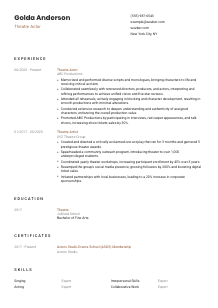
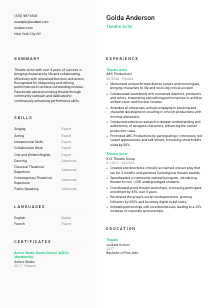
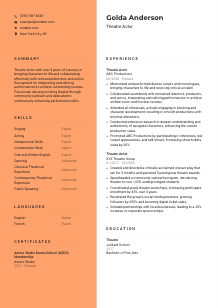
Dazzling on stage but your resume feels like a dress rehearsal? Step into the spotlight with this Theatre Actor resume example, created with Wozber free resume builder. Learn how to showcase your thespian talents in line with casting calls, setting the stage for your acting journey to take center stage, and not end up on the cutting room floor!
Casting teams scan a theatre actor resume for more than talent. They want signs that you can carry a role through rehearsal, take direction, adapt in the room, and deliver a consistent performance in front of a live audience. Your resume needs to make that discipline visible, whether your background leans toward straight plays, musicals, devised work, or ensemble productions.
When the resume is tailored well, the first read quickly answers a practical question: can this actor step into this production's demands? Using Wozber's free resume builder helps you shape an ATS-compliant resume around the language of the posting, so training, stage experience, vocal or movement strengths, and collaborative credits are easy to find before anyone decides who gets called in.
This section handles the practical details that let casting, production, or representation contact you without friction. For theatre work, it should also remove avoidable questions about role alignment, location, and professional presentation.
Use your full professional name in the most prominent spot on the page. Keep it clean and easy to read, the way it would appear on a program, website bio, or casting submission. If you work under a stage name, be consistent across your resume, portfolio site, and audition materials.
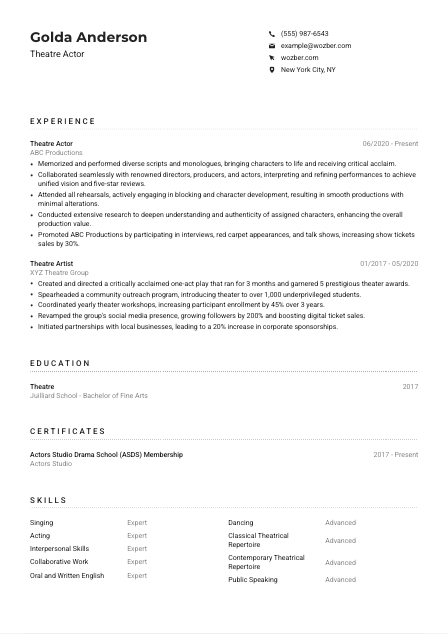
Place "Theatre Actor" directly under your name if stage performance is the lane you want considered first. That small line helps frame the rest of the resume, especially if you also have credits in teaching, directing, film, or arts outreach. In the example, that title immediately aligns the candidate with the role being pursued.
List a current phone number and a professional email address that you check often. Theatre hiring can move quickly when callbacks, schedule changes, or promotional requests come up. If you include a website, make sure it leads to relevant materials such as performance clips, press, bio, or headshots rather than a generic landing page.
Some theatre roles are local-hire friendly, some expect relocation, and some are tied to a specific production market. Here, New York City is a stated requirement, so showing "New York City, NY" in the personal section answers that question immediately. Use this only when location is relevant to the role you are targeting.
A personal site or professional profile can strengthen your resume when it extends your stage work with a reel, performance photos, press mentions, repertoire, or union information. Keep the design simple and the content current. It should support the impression created by your credits, not compete with it.
When these details are handled well, the hiring team can move straight to your training and performance history. That is exactly what the top of a theatre resume should do.




The experience section is where theatre resumes separate training from proven practice. Casting teams and artistic staff want to see the kind of work you have handled, the collaborators you have worked with, and the outcomes that show reliability in rehearsal and on stage.
Start with the employer's language. Here, the job emphasizes memorizing scripts and monologues, rehearsal attendance, character research, collaboration, and promotional participation. Those points should guide which credits and bullet points you bring forward so your experience reflects the actual demands of the production.
List roles in reverse chronological order so recent stage work appears first. Include the company name, your title, and dates. This makes it easy to see whether you meet expectations such as 3+ years of professional theatre experience, and it gives a quick sense of your consistency in the field.
Focus each accomplishment on the work theatre professionals care about. Mention script memorization, character interpretation, movement or blocking work, ensemble collaboration, live performance quality, audience response, or director feedback when relevant. The strongest bullets sound like actual stage practice, not generic job language.
Not every acting credit needs numbers, but measurable outcomes can strengthen the section when they are real. Ticket sales lift, length of a successful run, awards, workshop participation growth, audience reach, or press response all add context. In the example, a 30% increase in ticket sales tied to promotional appearances gives concrete business value to work that often gets described too vaguely.
You do not need to document every performance, especially if your history spans different types of work. Lead with the credits that best show professional theatre experience, range across repertoire, and comfort working with directors and ensembles. If one role highlights outreach or directing, keep it only if it supports the larger picture of you as a stage professional.
Your experience should leave no doubt that you can learn material, contribute in rehearsal, and help carry a production from first table read to final performance.
Formal training matters in theatre because it gives context to technique, repertoire, and performance discipline. Even when casting is driven by credits and auditions, the education section still helps show the foundation behind your voice, movement, text work, and stage practice.
If a posting asks for a bachelor's degree in Theatre, Performing Arts, or a related field, list that information clearly. Include the degree, field of study, school, and graduation year. In this case, a Bachelor of Fine Arts in Theatre lines up directly with the requirement and should be easy to spot.
Keep this section simple so the reader can process it in seconds. Theatre resumes do not benefit from overdesigned education entries. A clean line with degree, discipline, institution, and year is usually enough unless your training includes especially notable conservatory work or specialized study.
When your degree closely matches the role, there is no need to bury it under extra detail. Put the theatre-focused qualification first and keep the wording exact. Schools with strong stage training, classical study, or musical theatre programs can add weight, but the degree itself should stay the main point.
If you are earlier in your career or pivoting within theatre, a few specifics can help. Voice, movement, stage combat, Shakespeare, devised theatre, scene study, or dance training may be worth naming when they connect to the kind of work you want. Skip generic class lists that do not change how your readiness is understood.
Academic awards, showcase participation, or theatre-related thesis work can support your profile when they are relevant and recent enough to matter. For established actors with solid production credits, these details are secondary and should not crowd out professional stage experience.
A concise education section confirms that your craft has formal grounding. After that, your resume should naturally steer the reader back to productions, collaborators, and performance outcomes.
Theatre job postings do not always require certificates, but this section can still strengthen your resume when it reflects active professional development. The key is relevance. Include training, memberships, or credentials that add useful context to your performance profile.
List certificates, memberships, or recognized training programs that support your acting practice. Useful examples include conservatory affiliations, acting studio memberships, voice or movement training, stage combat certification, dialect coaching, or camera technique if it complements your theatre work. The example's Actors Studio affiliation works because it reinforces ongoing engagement with craft.
A short list of meaningful credentials carries more weight than a long list of unrelated short courses. Prioritize affiliations and programs that theatre professionals will recognize or that clearly connect to your repertoire, performance style, or technical preparation.
Dates help readers understand whether a credential reflects current development or older training. Ongoing memberships and recent workshops can be especially useful because they show you are still training, still connected to the field, and still expanding technique.
Theatre practice changes with new methods, repertory demands, and physical or vocal techniques. Update this section when you complete training that materially improves your profile for the work you want, whether that means classical text work, dance intensives, or audition-focused coaching.
Well-chosen credentials add depth without distracting from your credits. They work best when they show continued investment in performance technique and professional community.
A theatre actor skills section should read like a practical casting snapshot. It needs to show what you can actually bring into rehearsal and performance, from core performance abilities to ensemble habits that matter once the production process starts.
Start with what the posting explicitly asks for, then add closely related strengths you genuinely use. Here, singing, dancing, acting, interpersonal skills, collaboration, repertoire familiarity, and English proficiency are all directly relevant. That gives you a clear map for what belongs in the section.
Put the most role-critical abilities first. For a theatre actor, that usually means acting, singing, dance or movement, voice, dialects, text interpretation, or repertoire strengths before broader workplace skills. In the example, performance abilities are backed by collaborative work and communication, which makes sense for rehearsal-heavy productions.
Do not turn this into a catalogue of every creative strength you have ever used. Choose the skills that match the role's style, format, and expectations. A concise list reads better in ATS screening and gives casting teams a cleaner picture of your usable range.
When the right skills are surfaced in the right order, the reader can quickly place you within the production's artistic and practical needs.
Language skills matter in theatre when they affect text work, communication, audience reach, or casting flexibility. For some productions, English fluency is simply a baseline. For others, additional languages can broaden the kinds of characters, scripts, or outreach work you can handle.
If the posting specifies oral and written English, list English first and state your level clearly. That removes uncertainty around script work, rehearsal notes, interviews, and communication with directors, stage management, and castmates.
Additional languages can support multilingual productions, touring work, educational programming, or community-facing performances. They are especially relevant when they connect to the repertoire you pursue or the audiences a company serves.
Use clear labels such as Native, Fluent, Conversational, or Basic. Theatre work can expose language ability quickly through table reads, talkbacks, press events, or accent demands, so accuracy matters more than ambition here.
If you would be comfortable learning lines, taking direction, or participating in interviews in that language, it likely belongs on the resume. If not, leave it off. The point is to clarify usable performance range, not to decorate the page.
For some actors, language ability supports classical training, international collaborations, or culturally specific productions. For others, it plays a smaller role. Include it when it adds real context to how you work on stage and with creative teams.
Handled well, this section tells the reader something concrete about communication, text handling, and the kinds of productions you may be equipped to join.
The summary is where you frame your professional identity before the reader reaches the credits. For theatre actors, that means a few lines that establish experience level, performance strengths, and the type of professional presence you bring into rehearsal and performance.
Read the role requirements first, then shape your opening around the parts you can truly claim. If the production values professional stage experience, versatility across acting, singing, and movement, or ensemble collaboration, those points should appear early instead of generic self-description.
Start with a direct line such as your title, years of experience, and primary stage strengths. "Theatre Actor with 4+ years of professional experience" immediately gives the reader context. You can then add whether your work leans toward character-driven plays, musical theatre, classical repertoire, or contemporary productions.
Use the next sentence to name specifics that help you stand out. That could be critical acclaim, strong collaboration with directors, success in promotional appearances, multilingual performance ability, or a track record of audience or ticket growth. The example summary works best where it ties performance credibility to collaboration and production impact.
Aim for three to five lines with no filler. Every phrase should help a director, producer, or casting lead understand what kind of actor you are hiring and what you are likely to contribute once rehearsals begin.
A sharp summary gives the reader an immediate sense of your stage experience and strengths, then makes the credits beneath it feel consistent and well chosen.
A theatre actor resume works when it shows both artistry and professional reliability. Credits, training, repertoire, collaboration, and measurable production impact should all point in the same direction.
Wozber's AI resume builder can help you tailor each section to the production brief, strengthen ATS optimization, and present everything in an ATS-friendly resume format that keeps your stage experience easy to scan.
Once that is in place, your resume should make one thing clear fast: you can step into rehearsal prepared and contribute to the production from day one.




