



Use Wozber and land your dream job
Create Resume
No registration required
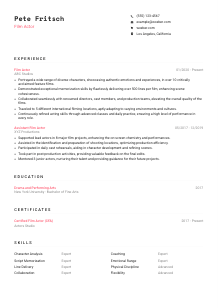
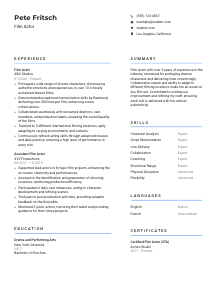
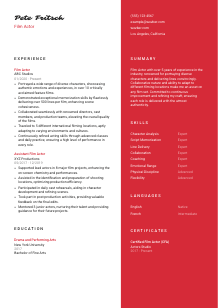
Stealing scenes, but your resume feels like a blooper reel? Dazzle directors with this Film Actor resume example, created with Wozber free resume builder. Learn how to spotlight your talent to match casting calls, making sure your career always has a take that's as gold as the Oscar stage!
On-screen acting resumes are read through the lens of performance range, camera-ready discipline, and how well you work inside a production process. Casting teams and production staff want to see more than a list of credits. They need a quick sense of your screen experience, character range, rehearsal habits, and whether you can step into a shoot prepared, collaborative, and consistent.
A tailored resume changes which parts of your background stand out first, especially when an ATS is sorting for screen experience, collaboration, and location requirements. Wozber's free resume builder helps organize those details in an ATS-friendly resume format, so your resume surfaces the acting work, training, and practical production readiness that matter most for a Film Actor opening.
This section should answer the practical questions a casting coordinator or production assistant checks first: who you are, how to reach you, and whether basic logistics line up with the shoot. Keep it clean, professional, and easy to scan.
Your name should be the most visible text on the page, set clearly and without extra design flourishes. In acting, name recognition matters, and your resume should read more like a professional credit sheet than a heavily styled marketing document.
Place "Film Actor" directly under your name if that is the work you are targeting. This immediately frames your resume around on-screen performance rather than stage, commercial, or general entertainment work, which helps when a production is screening for film-specific experience.
List a phone number you answer reliably and a professional email address based on your name. Production schedules move quickly, and missed calls or casual email handles can work against you when auditions, callbacks, or travel coordination happen on short notice.
If a posting asks for a local hire or a specific base, show that clearly in your city and state. Here, Los Angeles, California matters because the role specifically asks for candidates located there. Stating that upfront removes an avoidable screening question.
A personal website, casting profile, or reel link can support the resume by showing footage, headshots, or selected credits. Keep the link current and relevant. If your reel highlights emotional range, dialogue delivery, or contrasting character work, it strengthens the story your resume is already telling.
A concise personal section helps the reader move quickly from logistics to your acting credentials. For film roles, that means no friction around contact information, location, or how to view your work.




For a Film Actor, experience is where casting teams look for proof of screen time, character depth, and reliability in production environments. Your bullets should show what kind of roles you played, how you worked, and what scale or pace of production you handled.
Lead with professional film work that shows on-screen acting, rehearsal discipline, and work with directors or ensemble casts. If you also have theatre, voice, or commercial experience, include it only when it strengthens the story of your film work or fills an early-career gap.
Start with your most recent acting work and include the production company or studio, your role title, and dates. This structure helps readers track momentum in your career and quickly confirm that you meet requirements such as 3+ years of professional film experience.
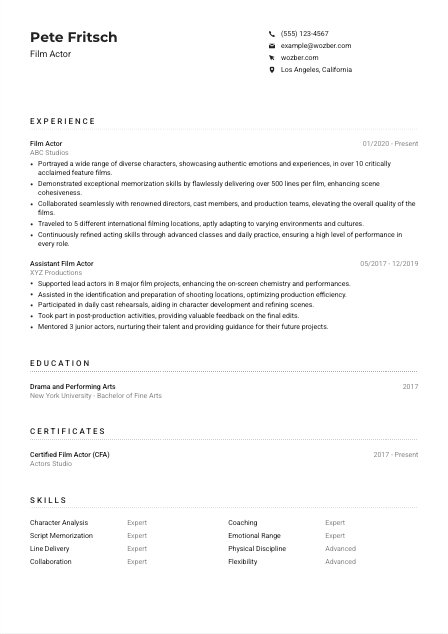
Go beyond saying that you acted in a project. Show what you handled as a performer: diverse characters, emotionally demanding scenes, memorization load, on-set collaboration, rehearsals, or travel for shoots. The example resume does this well by tying acting work to concrete responsibilities like delivering more than 500 lines per film and collaborating with directors and production teams.
Metrics can make acting experience more credible when they reflect real production scope. Number of films, featured roles, lines delivered, filming locations, rehearsal cycles, or festival-selected projects can all help. "Appeared in 10 feature films" or "traveled to 5 filming locations" says more than a vague claim about being versatile.
Every bullet should help the reader picture you in a film production setting. If a past job does not support your acting range, discipline, or production collaboration, trim it or leave it out. Even support roles should be framed around relevant contributions such as rehearsals, scene preparation, or cast coordination, as shown in the assistant actor example.
Your experience section should show that you can carry a role, take direction, memorize fast, and work smoothly on set. Those are the details that move a Film Actor resume from general interest to real casting consideration.
Formal education is not always the deciding factor in film casting, but training still matters. It shows how you built your technique, whether you studied performance seriously, and how much structure sits behind your screen work.
If you hold a degree in drama, theatre, film acting, or performing arts, list it clearly. A Bachelor of Fine Arts in Drama and Performing Arts, like the one in the example, immediately supports your foundation in character work, scene study, and performance technique.
Use a standard format with institution name, degree, field of study, and graduation year or date. Casting and production teams are usually scanning quickly, so keep the structure straightforward rather than adding long descriptions here.
If your education included film acting, camera technique, movement, voice, improvisation, or script analysis, make sure the field of study reflects that where accurate. This is especially useful when the role values authentic emotional portrayal and strong line delivery.
If you do not have a formal acting degree, relevant workshops, studio programs, or reputable coaching can strengthen this section. Prioritize training that improved on-camera performance, audition technique, dialect work, or physical discipline rather than listing every class you have ever taken.
Honors, showcase performances, thesis productions, or selective acting programs can be worth noting if they are credible and relevant. Keep the emphasis on training that sharpened your performance process, not on general campus activity.
Education should reinforce that your screen work is backed by craft, study, and repetition. Even a brief section can add useful context when it points clearly to acting technique and performance preparation.
In film acting, certificates matter most when they represent respected training, current coaching, or specialized development. Use this section to show that you continue to work on technique, not to fill space.
Prioritize certificates tied to acting, on-camera performance, movement, voice, stunts, dialects, or other role-relevant specialties. A credential like the example's "Certified Film Actor (CFA)" works because it directly supports the target profession.
Only include certifications that casting teams or production staff can connect to your work on screen. A short, relevant list is stronger than a long list of loosely related courses that do not change how you would perform in a film role.
Add the date earned, and if the training is ongoing, present that clearly. Current study can reinforce the job requirement around continuously refining acting skills through classes, coaching, and practice.
Acting careers are built through continued coaching, new methods, physical training, and scene work. Updating this section with recent study helps show that your technique is current and that you are still investing in performance quality between projects.
A focused certificates section adds value when it reflects real development in acting technique or performance readiness. Keep it current, credible, and closely tied to the kind of film work you want next.
The best skills section for a Film Actor reads like a concentrated version of your working toolkit. It should reflect how you prepare, perform, and collaborate, using language that matches the production's needs.
Start with the capabilities named or implied in the job description: portraying diverse characters authentically, memorizing lines, delivering dialogue convincingly, collaborating with directors and cast, and maintaining physical discipline. Then keep only the ones you can support elsewhere in your resume.
Lead with skills that matter most for on-screen work, such as Character Analysis, Script Memorization, Emotional Range, Line Delivery, Camera Performance, Collaboration, or Body Awareness. The example resume handles this well by foregrounding acting craft rather than generic workplace traits.
Put the most role-specific skills first and avoid overloading the section with soft skills like "hardworking" or "passionate." For a Film Actor, a shorter list of sharp skills is more useful because it points the reader toward your rehearsal process, screen presence, and set discipline.
When the skills section mirrors the language of the role and matches the substance of your experience, it quickly reinforces your value as a prepared, versatile on-screen performer.
Language ability can affect casting options, script work, and communication on set. Even when only one language is required, list languages in a way that supports the role rather than treating them as filler.
If the role calls for strong English literacy, list English clearly and use an accurate proficiency label such as Native or Fluent. That directly answers a stated requirement and supports line reading, script analysis, and on-set communication.
Additional languages can matter for bilingual roles, international productions, accent work, or culturally specific characters. If you speak another language, include it, especially when it could broaden the kinds of projects you can book.
Use clear labels such as Native, Fluent, Intermediate, or Basic. Production teams need an honest sense of whether you can handle dialogue, interviews, or direction in that language. The example's "English - Native" and "French - Intermediate" is a good model of simple, usable wording.
If a language has helped you with auditions, international shoots, multilingual scenes, or character work, it has resume value. That context does not need a long explanation, but it should feel relevant to film performance rather than ornamental.
If you are training in another language or improving fluency, keep that effort current. For actors, language study can support dialect control, role flexibility, and access to productions outside one market or genre.
For a Film Actor, language proficiency can expand both casting possibilities and communication on set. Present it clearly enough that a production team knows exactly what you can work with.
Your summary should give a compact, credible picture of who you are as a film actor. In a few lines, it should cover your experience level, strongest performance traits, and the kind of production value you bring to a set.
Look at the posting and pull out the essentials first: years of on-screen experience, ability to portray varied characters, memorization strength, collaboration, physical discipline, and English proficiency. Those are the points your summary should answer quickly.
Open with your title and years of experience, then add a brief phrase about your acting range or specialty. The example summary does this effectively by naming 5+ years in the industry and emphasizing diverse characters and convincing line delivery.
Choose the abilities that matter most for the role, such as authentic emotional portrayal, fast script retention, adaptability across filming locations, or strong collaboration with directors and cast. Keep these tied to how you work, not just to flattering adjectives.
Aim for 3 to 5 lines with no filler. This section should read like a concise casting introduction, not a biography. If every sentence points to a hiring requirement or a clear performance strength, you have enough.
A sharp summary gives the reader an immediate sense of your screen experience, discipline, and collaborative style. By the time they reach your credits, they should already understand what kind of Film Actor you are and why you belong in the audition pool.
A Film Actor resume works best when it shows the full working picture: credible screen experience, range across characters, disciplined preparation, and the ability to collaborate under production pressure. When each section is tailored to those realities, your resume does more than list credits. It gives casting teams and production staff a practical sense of how you will show up on set.
Use Wozber's AI resume builder to refine wording, align your resume with the posting, and strengthen ATS optimization without losing the truth of your work. The result should make your experience, training, and on-camera readiness easy to recognize at a glance.




