



Use Wozber and land your dream job
Create Resume
No registration required
Trapping emotions in invisible boxes, but your resume is far from silent? Explore this Mime Artist resume example, created with Wozber free resume builder. It shows how to present your nonverbal talents to match job cues, painting your career story without a single word spoken!
Mime hiring turns quickly on whether your resume shows performance craft, not just stage enthusiasm. Directors and producers need to see that you can build a routine, hold an audience without dialogue, and work with physical precision across rehearsals, live shows, and collaborative productions. Your resume should make that artistic discipline visible in concrete credits, training, and performance outcomes.
When mime experience is described too broadly, it can blur into general theater or movement work. A tailored resume, shaped in Wozber's free resume builder and checked for ATS optimization, helps surface the exact language that matters here, such as original routines, non-verbal storytelling, object manipulation, rehearsal work, and audience engagement, so the hiring team can quickly see your range as a performing mime artist.
For a performance role, the top of the resume should identify you quickly and professionally. Casting teams and production staff often move fast, so your contact details need to be clean, current, and aligned with any stated logistics, including location when the posting asks for it.
Use your full name as the most prominent text on the page. Keep it easy to read and slightly larger than the rest of the resume so your identity is immediately clear on a casting shortlist or rehearsal packet.
Place the target title directly under your name. If the posting is for a "Mime Artist," use that wording rather than a broader label like performer or actor. It helps frame the rest of the resume around physical theater and non-verbal performance from the first line.
Your phone number and email should be easy to find and professional enough for production outreach, callback scheduling, and workshop coordination.
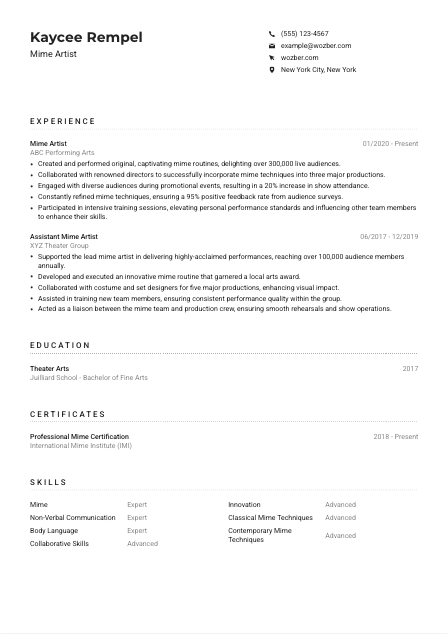
If a role requires you to be based in a specific city, include that clearly. In this example, New York City, New York belongs in the header because it answers a stated requirement right away and removes uncertainty about local availability for rehearsals and live performances.
Include a personal website, portfolio, or polished profile if it helps employers review your stage work. For mime artists, this can be especially useful when it shows performance clips, production credits, festival appearances, or press mentions that support the claims in your experience section.
This section should answer basic logistical questions immediately: who you are, what role you do, how to reach you, and whether you meet practical requirements such as location. Keep it simple and stage-ready.




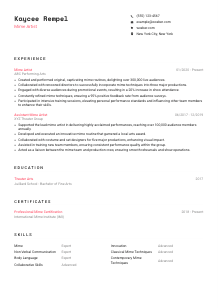
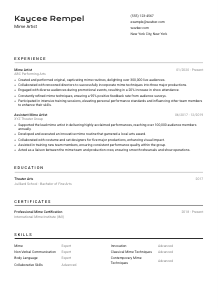
This section carries the most weight for a Mime Artist. Hiring teams want to see where you performed, what kind of routines you created, how you contributed to productions, and whether your work connected with live audiences in measurable ways.
Read the posting closely and map your experience to the actual work named there. For mime roles, that often means original routine creation, non-verbal storytelling, illusion work, object manipulation, rehearsal discipline, and collaboration with directors or producers. The sample resume does this well by directly showing original performances and production collaboration instead of relying on vague artistic claims.
Start with your most recent performance work and move backward. Include the company, troupe, theater, or arts organization, your title, and dates. That structure helps reviewers understand your progression from supporting performance roles into lead or independently created mime work.
Each bullet should show what you performed, built, improved, or contributed. Strong mime bullets mention routines, productions, rehearsals, workshops, audience interaction, and team coordination. For example, a line about collaborating with directors on three major productions says far more than a generic statement about being a team player.
Metrics work well when they match live performance work. Audience size, attendance growth, production count, workshop participation, awards, repeat bookings, or audience feedback scores can all strengthen credibility. In the example, reaching 300,000 audience members and contributing to a 20% attendance increase gives scale to the artistic work without overstating it.
Prioritize experience that shows physical performance, stage collaboration, and audience engagement. If you have broader theater or entertainment work, keep the bullets focused on the parts that transfer directly, such as movement performance, devised pieces, ensemble rehearsal work, or visual storytelling. That keeps the section centered on mime rather than general performing arts exposure.
Your experience section should show a working mime artist with stage discipline, creative range, and live audience impact. If a producer can quickly see the routines you built, the productions you supported, and the outcomes you influenced, this section is doing its job.
Formal education is not the only path into mime, but relevant training still adds useful context. Theater arts, physical theater, movement studies, and conservatory work help establish your technical foundation and show long-term commitment to performance craft.
If the posting mentions theater arts or related credentials, place your most relevant degree or formal training first. For a mime role, education in theater, movement, performance, or physical expression carries the most weight because it supports the technique behind your stage work.
List the school, degree, field of study, and graduation year or date. A simple format works best because the value here comes from the subject and institution, not decorative detail.
A degree such as a Bachelor of Fine Arts in Theater Arts fits naturally for mime work because it signals training in performance, interpretation, staging, and ensemble practice. The sample resume uses that kind of alignment well with a Theater Arts degree from Juilliard.
If you completed workshops or focused coursework in mime, movement, clowning, physical theater, stage composition, or improvisation, include them when they strengthen your case. This is especially useful for earlier-career applicants who may have less production history to show.
Mention distinctions, showcases, festival participation, or theater group involvement if they demonstrate serious practice or recognition. Skip minor campus activities unless they directly relate to performance training or staged work.
Use this section to show where your technique was developed and how your training supports the demands of live mime performance. Keep the focus on study that strengthens your credibility on stage.
Certificates can strengthen a mime resume when they point to recognized training, continued study, or formal development in performance methods. They are especially useful if a posting mentions mime or theater credentials directly, as this one does.
When an employer asks for relevant certifications in Mime or Theater Arts, make sure those appear clearly if you have them. The example resume includes a Professional Mime Certification, which is a strong illustration of matching the posting language without overloading the section.
List credentials tied to mime technique, physical theater, stage movement, performance pedagogy, or related disciplines. A short, relevant list carries more weight than a long collection of loosely connected arts courses.
Add the year earned or validity range, especially if the training is recent, ongoing, or requires renewal. That helps employers see that your technique and professional development are current.
Mime is a craft shaped by repetition, coaching, and refinement. If you continue training through workshops, intensives, or advanced certifications, update this section so your resume reflects active development rather than past study alone.
This section should reinforce technical commitment. A relevant certificate tells the employer that your physical vocabulary and performance discipline have been developed through formal study, not only informal practice.
For a Mime Artist, the skills section should read like a concise map of your performance toolkit. Focus on abilities that shape rehearsal work, stage execution, and audience connection, not generic adjectives that could belong on any arts resume.
Start with the wording in the job ad, then match it to skills you can genuinely back up in your experience. Here, non-verbal communication, physicality, contemporary and classical mime techniques, illusions, object manipulation, and collaboration are all clear priorities.
Place your strongest role-specific skills first. "Mime," "Non-Verbal Communication," and "Body Language" are stronger opening choices than broad terms because they describe the craft directly. The sample resume gets this right by leading with core mime abilities before softer traits.
Choose skills you can demonstrate through performances, training, or production work. A tighter list is more persuasive, especially when it balances technical ability with practical ensemble strengths such as collaboration, creative development, and performance innovation.
This section should give a quick read on your technique and working style. If the list reflects the physical, expressive, and collaborative demands of mime performance, it will support the rest of the resume well.
Mime is built on visual communication, but spoken and written language still matters in professional settings. Rehearsal notes, production emails, workshop participation, and promotional events often require clear verbal communication alongside stage craft.
If the posting specifies written English, list English at the top with an accurate level such as Native or Fluent. This matters for communicating with production teams, understanding direction, handling written materials, and participating in promotional work.
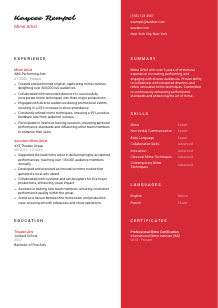
Additional languages can be valuable in audience-facing settings, touring productions, community engagement, or multicultural arts programming. In the example, French adds useful range, especially for an art form with strong international traditions.
Use clear levels such as Native, Fluent, Intermediate, or Basic. Avoid overstating ability, since language use may come up in rehearsals, interviews, teaching settings, or public-facing events.
If you perform for diverse audiences or work in festivals, educational outreach, or international collaborations, language range can strengthen your profile. Keep the emphasis on practical communication, not decoration.
Language development, like performance training, is cumulative. Add new proficiency when it becomes professionally useful, especially if it helps you work with broader creative teams or audiences.
This section does not replace your non-verbal craft, but it can support collaboration, audience outreach, and professional communication. Lead with the language the job requires, then add others that broaden your reach.
The summary is your opening professional statement, and for a Mime Artist it should quickly establish experience level, performance strengths, and the kind of stage contribution you bring. Keep it compact, specific, and closely aligned with the work described in the posting.
Before writing, identify the few themes that matter most in the job ad. Here, those include original mime routines, non-verbal storytelling, collaboration with production teams, and continued refinement of technique. Build the summary around those ideas rather than broad artistic passion.
Open with your title and years of experience in a direct line, such as "Mime Artist with 5+ years of professional experience." That immediately gives the reader a frame for your level and commitment to the craft.
Follow with strengths that connect to the role, such as creating original routines, performing for live audiences, collaborating with directors, or refining classical and contemporary mime techniques. The sample summary works because it names audience engagement, collaboration, and ongoing technique development instead of generic creativity.
Aim for three to five lines. Every phrase should earn its place by clarifying your artistic scope, production experience, or audience impact. If a sentence could apply just as easily to a general actor or entertainer, sharpen it until it clearly sounds like mime work.
By the end of this section, the reader should understand your level, your specialty, and the kind of performance value you bring to a production. A concise summary makes the rest of the resume easier to read in the right frame.
A Mime Artist resume should show disciplined physical performance, creative authorship, and the ability to connect with audiences without relying on dialogue. When your experience, training, skills, and summary all point to that same professional story, the application reads with much more clarity.
Use Wozber to shape that story into an ATS-compliant resume with focused language, clean structure, and role-matched terminology. The result should make it easy for a hiring team to see that you can step into rehearsals, collaborate with a production, and deliver compelling mime performance from day one.




