



Use Wozber and land your dream job
Create Resume
No registration required
Stealing the spotlight, but your resume doesn't shine as bright? Cue this Commercial Actor resume example, created with Wozber free resume builder. Learn how to naturally match your on-camera talents to job cues, making your career the star of the show!
Commercial acting moves fast. One day you are in a callback, the next you are expected to take direction instantly, adjust delivery for a brand voice, and hold up through long production days. Your resume needs to show that you can do more than perform on camera. It should make your audition volume, improvisation range, script learning speed, and on-set collaboration easy to understand at a glance.
Casting teams and production coordinators often sort quickly between performers with stage or general screen experience and those who already know the rhythm of commercial work. Using Wozber's free resume builder helps you shape an ATS-friendly resume format around the language that matters in commercial casting, from ad-libbing and memorization to working with directors and agents. That makes it easier for hiring teams to see whether your background translates cleanly to paid commercial sets.
This section should read like a clean slate on a casting profile. For commercial acting, the essentials are simple: who you are, what you do, how to reach you, and whether you meet practical requirements such as location.
Use your full name in the largest text on the page so it is immediately visible. Keep it clean and professional. In commercial casting, where resumes may be reviewed alongside headshots, demo reels, and audition notes, easy identification matters.
Place "Commercial Actor" directly under your name when that is the work you are pursuing. Matching the role title helps position you correctly for casting teams, especially when your background also includes theater, film, voiceover, or modeling work.
List one reliable phone number and a professional email address. If you work through representation, your resume can still center your own direct details unless a submission specifically asks for agent contact. Make sure every digit and character is correct. Missed callbacks often come down to simple errors.
If a posting requires local availability, state your city and state clearly. Here, listing "Los Angeles, California" directly supports the employer's requirement and signals that you can attend auditions, callbacks, and shoots without relocation delays. For other applications, use location based on what the production actually requests.
A personal website, casting profile, or reel link can strengthen this section if it is current and easy to navigate. Use it to support your resume with footage, credits, or updated headshots. Keep the content aligned with the kind of commercial work you want next.
Keep your personal details practical and precise. Casting teams should be able to confirm your identity, reach you quickly, and see any logistics that matter for booking.




For a commercial actor, experience is less about listing every appearance and more about showing how you perform in real production conditions. Hiring teams want to see proof that you can audition often, take direction quickly, adapt scripts, and deliver usable takes on schedule.
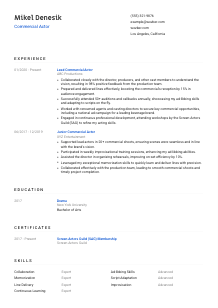
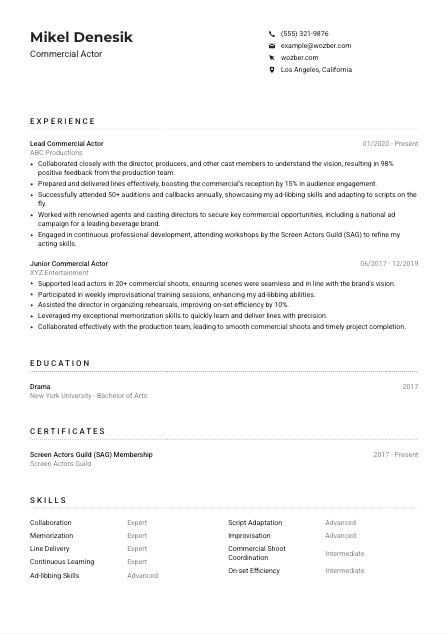
List your work in reverse chronological order and prioritize credits that involve commercial shoots, branded campaigns, recurring ad work, or closely related on-camera performance. If a role sharpened the exact abilities the employer wants, such as frequent auditions, quick script adaptation, or collaboration with directors, make that obvious in the bullets. The sample resume does this well by opening with commercial-specific work and noting 50+ auditions and callbacks annually.
Under every role, write bullet points that show what you actually did on set or in the audition process. Mention line delivery, improvisation, rehearsal support, brand alignment, callback volume, or coordination with producers and cast. "Lead Commercial Actor" alone is not enough. The value comes from how you contributed to smooth shoots, strong performances, and bookable outcomes.
Commercial acting can be quantified when the numbers are real and relevant. Auditions attended, shoots completed, campaign scale, audience engagement, positive production feedback, or efficiency gains during rehearsals all help. In the example, metrics such as 98% positive feedback and a 15% lift in audience engagement give hiring teams a clearer sense of performance quality and production impact.
Keep unrelated work brief unless it directly strengthens your candidacy through camera presence, memorization, client-facing performance, or improvisation. A casting director reviewing commercial talent does not need a full history of every entertainment job. They need the credits and results that show you can step into a commercial brief and execute.
Commercial performers are expected to stay sharp. Add workshops, coaching, improv training, camera acting sessions, or union-backed professional development when they materially improve your range. The sample resume mentions Screen Actors Guild workshops, which is a good illustration of how to show ongoing training without turning the section into a class list.
Your best bullets should make a producer or casting team picture you in the room already. Focus on auditions, adaptability, direction, and the kind of on-set reliability commercial projects depend on.
Education carries weight in acting when it explains where your technique comes from. Formal study is especially useful if the employer prefers training from a recognized acting school or wants confidence in your foundation for script work, improvisation, and camera performance.
Start with the degree, diploma, or acting program that best supports your commercial acting work. A Bachelor of Arts in Drama, conservatory training, or focused camera-acting education all belong here. In the example, the NYU drama degree quickly establishes formal preparation.
Use a clear format: school, degree, field of study, and graduation year or date. Casting and production teams should be able to scan this in seconds. Clean structure matters more than decorative detail.
If your education included improvisation, scene study, voice, commercial audition technique, or on-camera acting, mention those areas when they reinforce the job requirements. This is especially useful early in your career or when your recent credits are still building.
Performance awards, showcases, competitive acting programs, or standout production roles can help if they add real context to your development. Choose details that support castability or training quality, not every academic honor you received.
Workshops, study intensives, or related experiences can sit here when they are substantial and role-relevant. For commercial actors, that might include improv labs, movement training, dialect work, or camera-specific coaching. Keep the emphasis on training that improves audition and on-set performance.
Whether you came through a university program or focused acting study, this section should show where your technique was built and how it supports commercial performance today.
Commercial acting does not always require formal certification, but credentials can strengthen your profile when they reflect recognized training, union standing, or continued development in areas producers value.
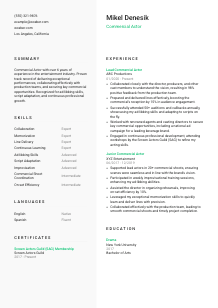
List certificates, memberships, or formal training credentials that carry weight in acting and production circles. Screen Actors Guild membership, accredited acting programs, or respected improv training can all signal professional commitment. In the example, SAG membership helps establish industry credibility.
Choose certificates that reinforce skills such as improvisation, camera presence, vocal control, script interpretation, or adaptability. A credential should help explain why you can handle auditions, callbacks, and branded performance work effectively.
Add the year earned or the active date range where relevant. This gives context to your professional timeline and shows whether your training is recent, ongoing, or longstanding. Current memberships and recent workshops are especially useful in an industry that changes quickly.
As your career grows, this section can expand to include commercial audition intensives, stunt basics, voiceover certification, motion capture workshops, or dialect coaching. Add new credentials when they meaningfully broaden the kinds of projects you can book.
Use this section to show discipline and industry connection. A short list of credible, relevant credentials says more than a long list of loosely related courses.
The skills section should reflect how commercial actors are actually hired. That means balancing performance ability with production practicality: learning copy fast, adjusting delivery, collaborating well, and staying effective through repeated takes and changing direction.
Start with the abilities named or strongly implied in the job description. Here, improvisation, ad-libbing, collaboration, memorization, and script adaptation belong near the top because they are central to the work. Mirror the employer's wording when it matches your real strengths.
Lead with capabilities that show up in auditions and on set, not broad traits. For commercial actors, that usually means line delivery, cold reading, listening, timing, improvisation, memorization, and taking direction. The sample resume handles this well by giving prominence to collaboration, memorization, and ad-libbing rather than generic soft skills.
Do not overload this section with every performance-related term you can think of. A concise list of relevant skills is easier to scan and more believable. Group your strongest, most role-specific abilities first, then add supporting capabilities such as on-set efficiency or shoot coordination when they reflect real experience.
Your skills should sound like they belong in an audition room and on a live set. If a skill would help you book, adapt, or deliver on a commercial shoot, it is worth considering.
Language ability can affect casting in obvious and subtle ways. For commercial work, it may determine whether you can deliver copy naturally, handle bilingual campaigns, or appeal to specific audience markets.
Check the job description for any explicit language requirement and match it clearly on your resume. In this case, English proficiency is required, so your English level should be stated plainly and accurately.
Lead with the language you use most confidently in performance settings. If English is your native language, label it accordingly. That immediately supports your ability to handle memorization, timing, and delivery in auditions and on camera.
Additional languages can open doors to regional, multicultural, or international campaigns. If you can genuinely perform in Spanish, for example, that may broaden the roles you can pursue beyond English-only commercial work.
Use straightforward labels such as Native, Fluent, Advanced, or Intermediate. Commercial acting often depends on natural delivery and quick script handling, so overstating a language can create problems in the room.
If you are targeting campaigns for multilingual audiences or brands with global reach, language skills deserve more visibility. If not, keep them concise but still accurate. Either way, include only languages you could realistically use in a professional setting.
List the languages you can actually use in auditions and on set. Done well, this section can widen your casting range without overstating your capabilities.
Your summary should quickly tell casting professionals what kind of commercial actor you are and why your background is relevant. Keep it focused on bookable strengths, not broad passion statements.
Read the job description closely and pull out the two or three capabilities that define the opportunity. For this posting, experience level, improvisation, memorization, and collaboration are central. Your summary should reflect that mix rather than trying to cover every part of your career.
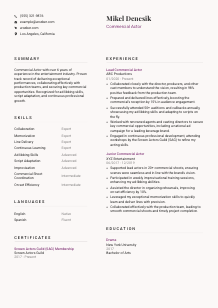
Start with a direct line that states your title and years of experience. The sample summary uses "Commercial Actor with over 6 years of experience in the entertainment industry," which immediately places the candidate at the right level. Use your own version with accurate tenure and focus.
Add two or three strengths tied to commercial performance, such as ad-libbing, fast script adaptation, strong collaboration with directors, or a track record in callbacks and campaign work. Choose strengths you can support elsewhere in the resume.
Aim for a short paragraph, not a personal statement. Commercial casting teams do not need your full artistic philosophy here. They need a fast read on your experience, working style, and whether you can deliver what the production requires.
When this section is working, the reader understands your level, your key strengths, and the kind of commercial work you are prepared to handle. That is enough to move them into the rest of the resume with confidence.
A commercial actor resume works best when it reads like a clear casting profile, not a generic entertainment CV. Every section should support the same picture: you can audition consistently, take direction, adapt quickly, and deliver on set under real production constraints.
Use Wozber to organize that story into an ATS-compliant resume with language aligned to the role, then refine each section until the hiring team can quickly judge your commercial experience, training, and booking potential. Your resume should now make that decision easier.




