



Use Wozber and land your dream job
Create Resume
No registration required
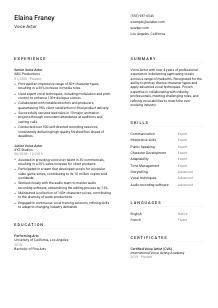
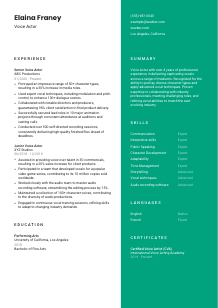
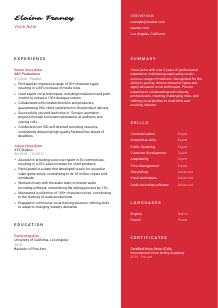
Breathing life into characters, but your resume feels like a monologue? Rehearse this Voice Actor resume example, created with Wozber free resume builder. Learn how to match your vocal versatility to job callouts, harmonizing your career journey as expressively as your performances!
Voice acting resumes get reviewed in a practical context. Casting teams and producers want to know whether you can deliver the right performance, take direction well, and work reliably across sessions, revisions, and deadlines. Your resume needs to make that visible fast by showing vocal range, medium-specific experience, recording capability, and the kind of results or credits that reflect professional consistency.
A tailored resume changes how quickly that picture comes into focus, especially when a role calls for specific mediums, vocal techniques, or self-recording ability. Wozber's free resume builder helps you shape an ATS-compliant resume around the language of the job description, so your experience in commercials, animation, games, or audiobooks is easier to match to what the hiring team needs first.
In voice acting, personal details do more than identify you. They confirm whether you're reachable, professionally presented, and available for the production setup the role requires. Keep this section clean and useful.
Use your full name as the clearest visual anchor on the page. Casting professionals often skim quickly between resumes, reels, and audition notes, so your name should be easy to spot without decorative formatting getting in the way.
Use the target title from the posting when it fits your background. Listing "Voice Actor" directly under your name immediately aligns you with the role being filled and avoids confusion with adjacent profiles like actor, narrator, or audio producer.
Add a current phone number and a professional email address that you check regularly. If a producer wants to book a callback, confirm availability, or request pickup lines, they should not have to work around outdated contact information.
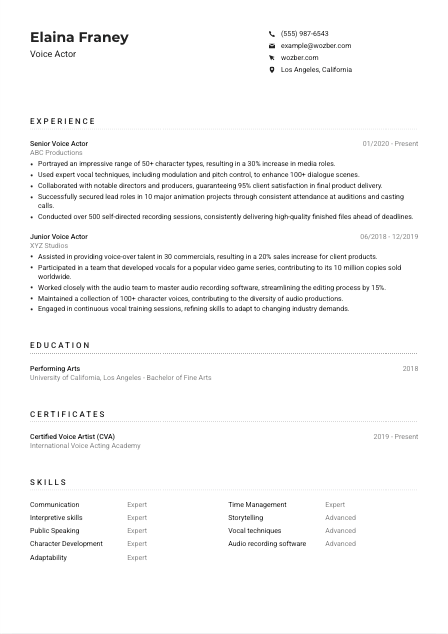
Some voice acting jobs are fully remote, but others depend on local availability for studio sessions, live direction, or rapid turnaround. In the example here, Los Angeles, California is a stated requirement, so showing that location upfront removes a potential screening issue immediately.
Add a website, demo reel page, or portfolio link that shows your range across formats such as commercial reads, character work, narration, or game dialogue. Make sure the material matches the level and style suggested by your resume, and keep the link current.
This opening block should answer the practical questions first: who you are, how to reach you, and whether you're available in the right market. Once that is clear, the rest of the resume can focus on your voice, credits, and recording work.




For a voice actor, experience is where casting teams look for range, consistency, and professional habits. The best entries show what you voiced, where you worked, how you collaborated, and what outcomes followed from your performance.
Pull out the details that define the work. Here, that includes multiple mediums, character range, vocal control, collaboration with directors and producers, auditions, and self-directed recording. Those points should shape which credits and accomplishments you lead with.
List your most recent voice acting work first, with job title, company or studio, and dates. If you have experience across animation, commercials, games, or audiobooks, present the roles in a way that shows progression and increasing scope rather than a random list of projects.
Each bullet should show a hiring-relevant contribution. Strong examples include the number of character types portrayed, scenes recorded, productions supported, or directors collaborated with. In the sample resume, "portrayed 50+ character types" and "conducted over 500 self-directed recording sessions" work well because they connect vocal range to dependable output.
Quantify work where the numbers mean something. That could be booking lead roles, improving client satisfaction, increasing recording efficiency, supporting a title with major audience reach, or delivering files ahead of schedule. The sample's 95% client satisfaction and lead roles in 10 animation projects give a hiring team more to assess than a generic claim about strong performance.
Keep the emphasis on work that proves you can handle the vocal styles and production setup in front of you. If a posting leans toward character acting and self-recording, those points should take priority over unrelated stage work or general creative experience unless they clearly strengthen the case.
Your experience section should leave no doubt that you can perform, adapt, and deliver finished work in a professional workflow. The more clearly your bullets connect voice work to production outcomes, the more credible your resume becomes.
Education usually supports a voice acting resume rather than carrying it, but it still helps frame your training. Formal study in performance, theatre, speech, or related fields can reinforce your command of interpretation, character work, and vocal discipline.
Many voice acting jobs prioritize credits, reels, and vocal ability over strict academic requirements. When a posting does not require a degree, use education to support your craft, not to take attention away from professional work.
Include your degree, school, field of study, and graduation year or completion date. Keep the format straightforward so the section reads quickly between experience and training.
If your degree directly connects to acting or performance, make that obvious. A Bachelor of Fine Arts in Performing Arts, like the one in the example resume, is worth featuring because it reinforces training in performance technique and artistic interpretation.
Workshops or coursework in voice, diction, acting, microphone technique, or audio production can be useful additions, especially earlier in your career. Include them when they help explain skills that are central to the target job.
Honors, performance groups, or theatre programs can stay if they point to serious training, recurring performance work, or specialization. Keep them concise and relevant to the kind of vocal work you want to book.
This section should reinforce your training in performance and voice without competing with your credits. If it helps explain your technique, discipline, or artistic background, it belongs here.
Voice acting is a craft built on repetition, coaching, and refinement. Certifications are not always required, but relevant training can show that you keep developing your technique and stay current with production expectations.
List certifications or formal programs that strengthen your case for the specific role. Voice performance, narration, character work, dialect coaching, or studio-recording training all carry more weight here than broad creative certificates.
Choose credentials that connect directly to the work on the page. The example's "Certified Voice Artist" helps because it clearly supports a professional voice acting profile and signals continued investment in the craft.
Add the year earned or the active date range so employers can see whether the training is recent and ongoing. In a field shaped by changing performance trends, home studio standards, and evolving content formats, recency matters.
Continue adding training as your target work changes. A commercial-heavy resume may benefit from copy interpretation coaching, while character or game work may call for combat vocals, creature sounds, or advanced acting study.
Relevant certifications tell a useful story when they support the type of voice work you pursue. They are most effective when they sharpen the picture already created by your credits, reel, and skills.
A voice actor's skills section works best when it reflects both performance ability and recording workflow. Hiring teams are looking for vocal control, interpretive strength, and enough technical comfort to work smoothly with direction and audio delivery.
Use the posting to identify the abilities that deserve space on your resume. In this example, vocal modulation, pitch control, breath control, storytelling, interpretation, communication, and audio recording software all deserve attention because they are named or strongly implied in the work.
Combine performance-focused skills with production-relevant ones. Character development, storytelling, and adaptability show how you approach the read, while recording software knowledge and time management show you can deliver files cleanly and on schedule.
Do not turn this section into a personality inventory. Select skills that would matter in a casting room, directed session, or self-recorded assignment. The sample resume does this well by pairing interpretive and communication skills with audio recording software and vocal techniques.
Every skill you list should connect to how voice work gets done, whether that is taking direction, sustaining a character, or producing usable audio from your own setup. If a skill would matter in the booth or in post, it belongs here.
Language skills can expand the kinds of projects you can handle, especially in dubbing, multilingual campaigns, narration, and character work. Even when only one language is required, listing proficiency clearly helps define your usable range.
If the posting names a language requirement, place it first. Here, strong English communication is essential, so English should appear at the top with an accurate proficiency level.
Use clear labels such as Native, Fluent, Advanced, or Conversational. Casting teams need a realistic sense of what you can perform in, not an inflated claim that creates problems during auditions or sessions.
If you can perform confidently in other languages, include them. Extra language ability can support international campaigns, bilingual scripts, or characters that call for authentic pronunciation and rhythm.
Only claim proficiency that you could support in a directed session or recorded performance. If your reading ability is stronger than your spoken performance, avoid overstating it.
Language ability is especially valuable when your target work includes global media, localized games, dubbing, or culturally specific narration. Even a second language can become a meaningful edge when it aligns with the production slate.
For voice actors, language ability matters most when it expands believable performance options. Present it clearly so producers can judge where your voice can travel.
Your summary should sound like an experienced professional introducing their range, not a string of generic adjectives. In a few lines, show what kind of voice actor you are, where you've worked, and which strengths matter most for the target role.
Before writing the summary, identify the two or three requirements that define the job. For this role, that includes range across character types, strong vocal technique, work across multiple mediums, and the ability to collaborate and self-record reliably.
State your title and experience level in a direct first line. The sample summary's "Voice Actor with over 4 years of professional experience" works because it establishes seniority immediately before moving into range and technique.
Follow with specifics that connect to the posting, such as portraying diverse character types, delivering across commercials and animation, or using advanced vocal control to shape tone and pacing. Keep the language grounded in actual performance work rather than broad claims about passion or creativity.
Aim for three to five lines. That is enough space to show your profile, strongest qualifications, and the kind of production environment you work well in without repeating bullets from the experience section.
A good summary gives casting and production teams an immediate sense of your range, professionalism, and likely fit for the assignment. If it is tailored well, the rest of the resume reads with clearer context.
Once each section reflects the actual work of voice acting, your resume becomes far more useful to casting directors, producers, and clients. It should show that you can interpret copy, shift vocal style across mediums, collaborate under direction, and deliver finished recordings on schedule.
Use Wozber to tighten the wording, align your resume with the posting, and build an ATS-friendly resume format that keeps those qualifications easy to read. The result should make one thing clear quickly: you are prepared to step into the booth and perform at a professional level.




