



Use Wozber and land your dream job
Create Resume
No registration required
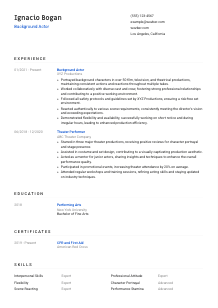
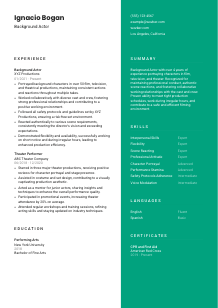
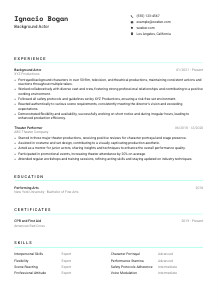
Blending in with the scene, but your resume feels like a cutaway? Check out this Background Actor resume example, created with Wozber free resume builder. Learn how to artfully match your set experience to casting calls, making your career shine as bright as the stars up front!
Background acting looks quiet on screen, but on set it depends on precision. Productions need people who can hit marks, repeat the same behavior across multiple takes, respond naturally without pulling focus, and stay professional through long waits, resets, costume changes, and last-minute direction. Your resume should make that reliability visible fast.
Casting and production teams often sort through large volumes of applicants, so the resume that rises quickly is the one that clearly matches the practical demands of set work. Using Wozber's free resume builder helps you shape an ATS-compliant resume around the language of the posting, so availability, on-set discipline, safety awareness, and relevant production experience are easy to pick up at a glance. That makes it easier to see whether you can step onto a working set and do the job well.
For background work, personal details do more than identify you. They confirm whether you are reachable, local enough for call times, and easy to slot into a fast-moving production schedule. Keep this section simple, accurate, and directly relevant to booking.
Your name should sit at the top in a clean, readable format. Casting coordinators may scan dozens of resumes at speed, so avoid decorative styling and make sure your name is the clearest element on the page.
Place "Background Actor" directly under your name when that is the work you want. A specific title helps connect your resume to the posting immediately, especially when the production is sorting applicants by role type rather than by broad entertainment experience.
Phone number and email need to be current and professional. Background roles can come together quickly, and a missed call or bounced email can cost you the booking. If you include a website, make sure it leads to an up-to-date reel, portfolio, or profile rather than a placeholder page.
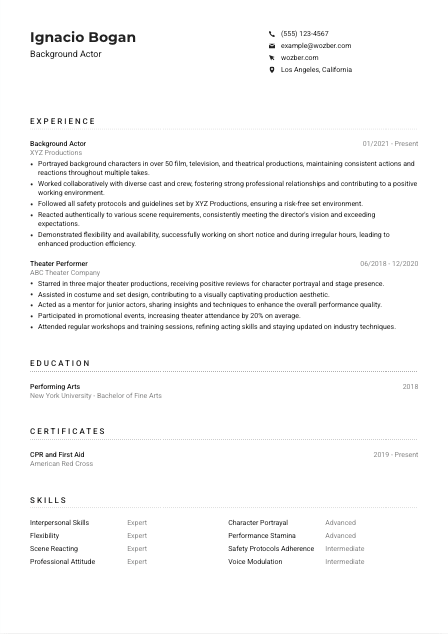
Some productions want local hires to reduce travel coordination and keep call-time planning simple. In the example posting, Los Angeles, California is a stated requirement, so listing Los Angeles, California in the header helps remove doubt about your availability for short-notice set calls.
If you have a website, casting profile, or reel, include it only if it strengthens your case. For background acting, useful material can include production stills, union profile links, or clips that show comfort on camera, costuming range, or period-set adaptability. Keep the link clean and easy to open.
This section should answer the practical booking questions first: who you are, how to reach you, and whether you can realistically show up when production needs you. If those basics are clear, the rest of the resume can focus on how you work on set.




Experience matters here because productions are hiring for consistency, patience, and control as much as screen presence. Your bullets should show that you can take direction, maintain continuity, adapt to changing scene needs, and stay professional across long shooting days.
Start by pulling forward credits that relate most closely to background performance, film, television, live performance, or any role that required staying in character and following cues. Even if your background includes theater or related performance work, frame it around transferable set habits such as timing, discipline, and responsive performance.
List roles in reverse chronological order with the production company or employer, your title, and dates. That structure helps coordinators see how recently you have worked and whether you have steady experience. In the example, the current Background Actor role appears first, which immediately anchors the resume in relevant production work.
Focus your accomplishments on the parts of the job that keep scenes usable. Good bullets mention authentic reactions, continuity across takes, safety compliance, prompt arrival, flexibility with wardrobe or makeup, and calm collaboration with assistant directors, cast, and crew. Those details say more than vague claims about being passionate or hardworking.
Quantified experience can work well in this field when it shows scale or repetition. The sample resume's "over 50 film, television, and theatrical productions" quickly communicates range and reliability. You can also mention the number of productions, length of contracts, repeat bookings, or attendance gains from theater work when those figures are accurate and relevant.
Keep the focus on experience that supports your ability to contribute on set. Older or less relevant work can stay if it adds something useful, such as stage discipline, movement training, or crowd-scene experience, but cut unrelated detail that does not help explain why you can handle background acting demands.
After reading this section, a production team should understand that you know how to behave on set, take direction cleanly, and stay dependable through resets, delays, and repeated takes. Those are the qualities that turn a credit list into a bookable resume.
Education is rarely the deciding factor for background acting, but it can still strengthen your resume when it points to training, performance discipline, or familiarity with production environments. Present it as supporting context, not as filler.
If you have a degree in performing arts, theater, film, dance, or a related discipline, include it clearly. A Bachelor of Fine Arts in Performing Arts, like the example shows, adds credibility because it suggests formal training in performance, movement, rehearsal, and stage awareness.
Use a straightforward format with school, degree, field of study, and graduation year or date. Casting teams do not need a long academic explanation here. They need to understand the credential quickly and move back to your production experience.
If your studies sharpened skills that matter for background work, let that connection come through. Training in movement, improvisation, voice, stagecraft, or ensemble performance can all support your ability to react naturally and work within a scene without drawing focus away from principal action.
Short courses in screen acting, movement, improv, stage combat, or camera awareness can be worth adding if they are recent and relevant. They are especially useful if your formal education is older or outside the performing arts and you want to show active skill development.
Theater clubs, student productions, or backstage production work can help early-career candidates show commitment and practical exposure. Use them when they add something specific, such as ensemble performance experience or familiarity with rehearsal discipline, not just to fill space.
Education should support the story your experience already tells. For background acting, that usually means showing training, performance discipline, and continued development without letting the section overshadow your actual production work.
Most background acting jobs do not hinge on certifications, but when a posting names one, include it clearly and exactly. Safety-related credentials can strengthen your profile because productions care about compliance, preparedness, and smooth set operations.
If the job asks for CPR and First Aid, put that certification in its own section rather than burying it elsewhere. The example posting does exactly that, so the sample resume correctly gives CPR and First Aid visible placement. When a requirement is explicit, mirror the wording closely.
Choose certificates that support production work, safety, performance, or scheduling readiness. CPR and First Aid are useful because they show responsibility in environments where large crews, equipment, and long shooting days are involved. Skip unrelated certificates that do not strengthen your case.
List the certificate name, issuing organization, and date or renewal window. That makes it easy to see whether the credential is current. In the example, the American Red Cross issuer and active date range help the certification read as valid rather than historical.
If a credential requires renewal, keep the dates updated. Productions that care about safety do not want to guess whether your certification has lapsed. Current credentials carry more weight than a long list of expired ones.
This section works best when it supports the practical demands of the job. For background acting, that usually means showing current safety credentials when requested and presenting them in a way that is easy to confirm.
The skills section should reflect how background actors actually work. That means less emphasis on broad personality traits and more emphasis on set behavior, continuity, responsiveness, and professional collaboration under production pressure.
Read the posting closely and note both stated and implied skills. In this example, follow-through on direction, staying in character, interpersonal ability, schedule flexibility, professional conduct, and safety awareness all belong in the skill mix because they describe how the work gets done.
A useful list combines acting-related abilities with operational ones. Character portrayal, authentic scene reacting, continuity, movement control, and performance stamina pair well with punctuality, adaptability, collaboration, and safety protocol adherence. The sample resume handles this well by mixing scene skills with professionalism and flexibility.
Prioritize the skills most relevant to the target job and avoid stuffing in every acting term you know. If you use ratings, keep them honest and consistent. A shorter list of accurate strengths is more useful than an inflated catalog that casting cannot trust.
Someone scanning this section should immediately understand how you operate in a scene and on a set. If your skills point clearly to continuity, direction-following, collaboration, and composure, the section is doing its job.
Language matters in background acting when it affects direction, safety communication, and the kinds of productions you can work on. Keep this section factual and aligned with what the job actually asks for.
If fluent English is required, list English first and state your level clearly. On set, that matters for understanding direction, safety briefings, holding instructions, and quick adjustments between takes. The example resume does this correctly by placing English first and marking it as fluent.
Additional languages can support casting for specific neighborhoods, crowd scenes, period pieces, tourism settings, or multilingual productions. They are a plus when real, but they should stay secondary to the language the job requires.
Stick to straightforward levels such as Fluent, Advanced, Intermediate, or Basic. Avoid vague wording. Honest proficiency helps prevent mismatches once you are on set and expected to respond quickly to direction or dialogue cues.
If you have dialect skills, accent versatility, or conversational ability that supports casting for certain production types, you can mention it when relevant. Keep it practical. Only include it if you can actually perform with consistency under direction.
Extra languages can widen the kinds of productions you are considered for, especially in large markets and diverse ensembles. They are an advantage when paired with strong on-set reliability, not a replacement for it.
This section should clarify whether you can understand direction and contribute in the production environment at hand. For many background roles, fluent English is the baseline and any additional language ability is a useful bonus.
Your summary should read like a fast, credible introduction to your working style. In a few lines, show your experience level, the types of productions you have supported, and the habits that make you dependable in background roles.
Start with a direct line that tells the reader who you are professionally. Mention your years of experience and whether your work is in film, television, theater, or a mix. The sample summary does this well by establishing more than 4 years of background acting experience right away.
Choose strengths that matter in actual production conditions. Good examples include maintaining consistent action across takes, reacting authentically, following direction, working well with cast and crew, and staying professional during long days or irregular hours.
A summary becomes more convincing when it includes a specific detail such as production volume, repeat bookings, or the kind of environments you have worked in. The example uses broad production coverage across film, television, and theater to show range without overcrowding the section.
Finish by reinforcing the practical result of hiring you. For background acting, that might be dependable on-set conduct, schedule flexibility, continuity awareness, or contribution to a safe and efficient shoot. Keep it focused on what helps the production run well.
By the end of this section, a casting or production reader should know your level, your environment, and your reliability. If those three things are clear, your summary is doing real work instead of repeating the rest of the resume.
A Background Actor resume works when it presents you as someone production can use immediately: local when needed, reachable, steady under direction, and reliable across long days, resets, and repeated takes. Keep every section tied to how you actually contribute on set.
With Wozber's free resume builder, ATS-friendly resume format, and ATS resume scanner, you can align your resume with each casting notice, surface missing requirements, and tighten the language around the experience that matters most. The finished resume should make one thing easy to judge: you can step onto set, follow direction, and deliver consistent background performance.




