




Use Wozber and land your dream job
Create Resume
No registration required
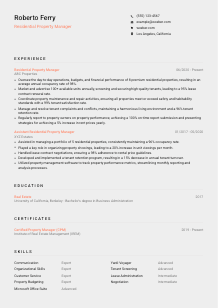
Overseeing homes, but your resume feels cramped? Check out this Residential Property Manager resume example, created with Wozber free resume builder. Learn how to showcase your knack for managing abodes to match job needs, drafting a career journey as spacious and inviting as your best listings!
Residential property management is operational work with very visible results. Occupancy, lease renewals, maintenance response, tenant satisfaction, and owner reporting all show quickly whether a manager can keep a portfolio running smoothly. Your resume needs to make that operating range clear, with examples of the units, properties, budgets, and resident issues you have handled.
A tailored resume also helps hiring teams separate hands-on residential managers from candidates with only adjacent leasing or admin experience. Using Wozber's free resume builder to shape an ATS-compliant resume around the posting's language makes software proficiency, lease administration, reporting, and resident-facing results easier to spot early. That gives a clearer read on whether you can step into the day-to-day demands of the portfolio.
For Residential Property Manager roles, the top of the resume should answer practical questions fast. Can this person be reached easily, are they presenting themselves at the right level, and do they meet any location-based requirement tied to the portfolio? Keep this section clean and businesslike.
Use your full name in a larger, professional font so it anchors the page right away. Property management hiring often starts with a quick scan, and your header should make the document easy to navigate, much like clear building signage helps residents and vendors get where they need to go.
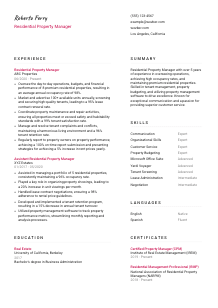
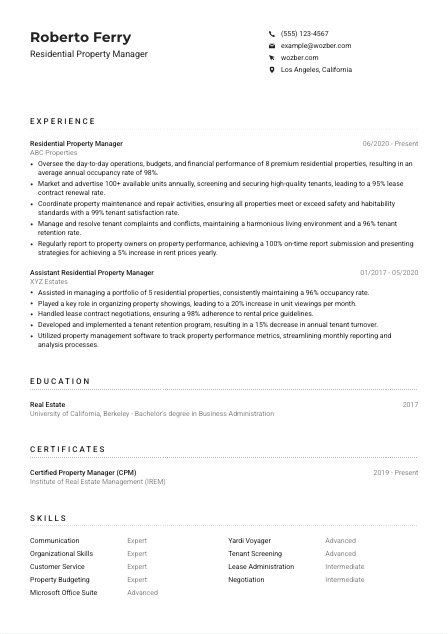
Place "Residential Property Manager" directly beneath your name when that is the job you are pursuing. It aligns your resume with the role from the first line and avoids any confusion with adjacent titles such as leasing manager, assistant property manager, or operations coordinator. The example resume handles this well by matching the target position exactly.
List a current phone number and a professional email address with no casual wording. If you include a website or LinkedIn profile, make sure it supports your candidacy with relevant portfolio experience, certifications, or real estate background. Broken links or outdated profiles create doubt in a role built on organization and follow-through.
Some property roles are tied to a specific market because of on-site responsibilities, local vendor coordination, or regional housing regulations. When a posting requires a location, include your city and state clearly. In this example, "Los Angeles, California" directly answers that requirement without adding unnecessary detail like a full street address.
A digital profile can help if it reinforces your property management experience, designations, or market knowledge. Leave it out if it is empty, generic, or unrelated. Every line in this section should support the picture of someone who can manage residents, owners, maintenance workflows, and reporting with professionalism.
This section should remove easy objections before the reader reaches your experience. Clear contact information, the right target title, and any required location detail make you look ready to step into the portfolio, not just interested in it.




This is the section that carries the most weight for a Residential Property Manager. Hiring teams want to see what kind of properties you managed, how you handled leasing and maintenance, and whether your work improved occupancy, retention, reporting, or financial performance. Generic responsibility lists will not do much here.
Read the posting for the work that drives the role, then build your bullets around those themes. For residential property management, that usually includes day-to-day operations, budgets, lease administration, tenant screening, maintenance coordination, complaint resolution, and owner reporting. These terms also matter for ATS optimization because they reflect how employers describe the actual workload.
Present each job with your title, company name, and dates in a consistent format. A clear timeline matters in property management because employers often want to see progression from assistant or leasing support roles into broader portfolio ownership. If you managed different property types or larger portfolios over time, your structure should make that growth obvious.
Lead with accomplishments that show business and resident outcomes, not just tasks performed. Strong bullets mention occupancy, renewal rates, tenant retention, reporting discipline, maintenance standards, or budget performance. The sample resume does this effectively with outcomes like a 98% occupancy rate, a 95% lease renewal rate, and 100% on-time owner reporting.
Numbers matter here because the role is measured through portfolio performance. Include property count, unit volume, occupancy percentage, lease renewal rate, tenant satisfaction, retention, rent growth, maintenance turnaround, or reporting cadence when you can support them. These metrics tell a hiring manager far more than general claims about leadership or customer service.
Prioritize experience that proves you can manage residents, vendors, leases, budgets, and property performance. If older bullets focus on unrelated administrative work, replace them with achievements tied to showings, contract accuracy, delinquency follow-up, inspection readiness, or maintenance coordination. A tighter experience section helps the employer see your readiness for residential portfolio responsibility much faster.
Your experience should read like a record of properties run well. When the section makes occupancy, lease execution, resident service, and owner reporting easy to see, you give the employer a concrete reason to picture you managing their buildings.
Education usually plays a supporting role in Residential Property Manager hiring, but it still matters when the posting asks for a specific degree background. Present it clearly and let it reinforce your business, real estate, or operations foundation without taking space away from stronger experience and results.
If the posting calls for a bachelor's degree, make that easy to find. In this case, a bachelor's in Business Administration or a related real estate field lines up directly with the requirement, so list it clearly rather than burying it below other details.
Include school, degree, field of study, and graduation year or date in a consistent structure. This section should be easy to verify in seconds. Property management resumes often work best when education is compact and clean, leaving more room for portfolio achievements and certifications.
When your degree closely matches the posting, use precise wording. The example resume's "Bachelor's degree in Business Administration" with a Real Estate field of study maps well to the employer's request. Exact alignment helps both ATS matching and human review, as long as the phrasing stays truthful to your academic record.
If you are early in your career, relevant coursework in real estate, finance, business operations, or property law can help explain your preparation. The same goes for honors that suggest strong analytical or organizational ability. For experienced managers, keep these details brief unless they directly support the target role.
Memberships, student projects, or capstone work tied to housing, real estate finance, facility operations, or customer service can strengthen this section when experience is lighter. If you already have several years managing properties, those extras should stay secondary to your operating record and certifications.
This section should confirm that you meet the academic bar without distracting from the experience that usually decides the hire. Clear degree information and relevant field of study are enough to support the rest of the resume.
Professional designations carry real weight in property management because they signal formal training in operations, ethics, leasing, financial oversight, and resident relations. When a posting names a required certification, your resume should make that qualification unmistakable.
Start with the certifications the employer specifically asked for. Here, CPM and RMP are not nice-to-have extras. They are explicit requirements, so they belong at the top of this section where both the hiring team and the ATS can find them quickly.
Residential property management favors certifications that support leasing, compliance, budgeting, maintenance oversight, and portfolio operations. A short list of directly relevant designations is stronger than a longer list of unrelated courses. The sample resume gets this right by highlighting CPM and RMP without clutter.
List the certifying organization and the date earned or active range. That detail adds credibility and helps show your standing is current. In a profession shaped by regulations, fair housing practices, and changing market conditions, active credentials suggest you stay engaged with the field.
If you are still working toward a major designation, include it only if the wording is accurate, such as "in progress" where appropriate. Ongoing professional development in areas like residential operations, compliance, or asset performance can strengthen your profile, especially when paired with measurable portfolio results.
For this kind of role, certifications can be a deciding factor rather than a bonus. Present them clearly, keep them current, and use this section to confirm your professional standing in residential property management.
A Residential Property Manager's skills section should read like the toolkit behind stable occupancy, smooth resident communication, accurate lease handling, and reliable property performance. Keep it specific to how the job is actually done, with a mix of operational, technical, and interpersonal strengths.
Start with the capabilities the employer named directly. In this case, that includes communication, organizational ability, property management software, and Microsoft Office. These are baseline requirements because the job involves resident interaction, vendor follow-up, reporting, and administrative control across multiple properties.
Mirror terms from the posting and support them with role-specific skills you genuinely use. Tenant screening, lease administration, budgeting, owner reporting, maintenance coordination, and customer service all fit naturally for residential management. The example resume strengthens this section further with software detail like Yardi Voyager, which is useful when it reflects real experience.
Keep the list focused on skills that help you run properties effectively. A tighter section is easier to trust and easier for ATS systems to parse. Choose the strengths that connect most clearly to occupancy, retention, resident satisfaction, financial oversight, and operational follow-through, then leave out generic fillers that do not add hiring value.
This section should sound like someone who manages leases, residents, vendors, budgets, and reporting in the real world. When your listed skills match the operating demands of the portfolio, the rest of your resume lands more convincingly.
Communication is a daily part of residential property management. You may be handling lease conversations, service updates, complaint resolution, vendor coordination, and owner reports in the same week. If language ability helps you do that work better, it deserves a clear place on the resume.
If the posting names a language requirement, include it plainly and state your proficiency level. This role requires proficient English, so your resume should confirm that without making the reader search for it. Clear language labeling also helps avoid uncertainty in resident-facing positions.
Additional languages can be a real advantage in residential settings, especially in diverse rental markets and mixed communities. The example resume lists fluent Spanish, which could be valuable when communicating with tenants, explaining lease terms, or handling service issues across a broader resident base.
Use clear labels such as Native, Fluent, Advanced, or Conversational. Avoid vague descriptions that make your ability hard to gauge. In a role where miscommunication can affect leasing, maintenance access, and tenant satisfaction, precision matters.
Some markets benefit from multilingual communication more than others, particularly where property teams regularly interact with residents from varied backgrounds. If an additional language helps you support leasing, renewals, or conflict resolution more effectively, include it as a practical business asset rather than a personal detail.
If you are studying another language, include it only if you can describe the level honestly. Language growth can be helpful, but overstating it creates risk in a role built on clear communication with tenants, vendors, and owners.
For residential property management, language skills matter when they help conversations move faster, reduce misunderstandings, and support residents well. Present them clearly so employers can see where they add practical value.
The summary should quickly establish the scale of your experience and the parts of property management you handle well. Focus on the operating picture: residential portfolio oversight, leasing performance, resident relations, financial responsibility, maintenance coordination, and the systems you use to keep it all organized.
Before writing, note the themes repeated in the job posting. For this role, that includes day-to-day operations, budgets, financial performance, tenant screening, lease accuracy, maintenance oversight, safety standards, complaint resolution, and owner reporting. Your summary should reflect the parts of that work where you have the strongest proof.
Start with your title and years of relevant experience so the reader immediately knows your level. The example resume opens with "Residential Property Manager with over 5 years of experience," which works because it places the candidate in the field right away and establishes depth before moving into achievements.
Choose strengths that matter in residential operations and connect them to results or scope. High occupancy, lease renewals, tenant retention, budgeting, or software-backed reporting are all stronger than broad claims about being hardworking or detail oriented. This is where you show what kind of portfolio manager you are.
Aim for a short paragraph that can be read in moments but still feels specific. Two to four sentences is usually enough. The best summaries sound grounded in daily property management work and make the reader expect strong experience bullets to follow.
A well-written summary should quickly position you as someone who can manage residential properties, protect performance, and handle resident and owner expectations professionally. If it does that in a few clear lines, the rest of the resume has room to prove it.
A Residential Property Manager resume works best when every section supports the same message: you can keep properties occupied, residents supported, maintenance moving, and owners informed. That means matching your experience, certifications, software skills, and summary to the operational demands named in the posting.
Use Wozber's free resume builder and ATS resume scanner to tailor your wording, strengthen ATS optimization, and present everything in an ATS-friendly resume format that highlights the qualifications employers actually care about. The finished resume should make it easy to judge whether you can step in and run the portfolio with confidence.




