



Use Wozber and land your dream job
Create Resume
No registration required
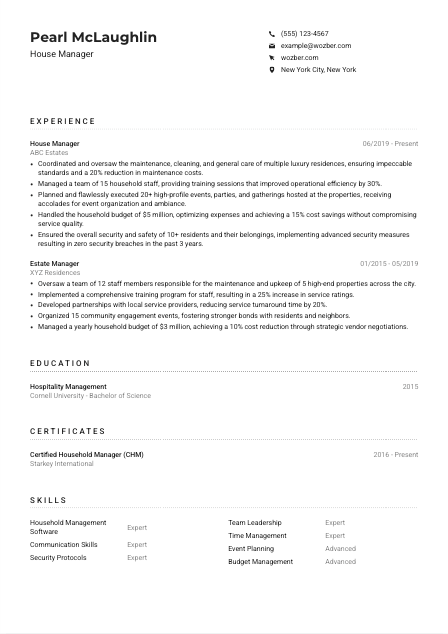
Balancing multi-room dynamics, but your resume feels like empty chambers? Check out this House Manager resume example, created with Wozber free resume builder. Learn how to effortlessly spotlight your managerial finesse to match job profiles, so your career stays as harmoniously structured as the homes you oversee!
House Managers are trusted with the parts of a residence owners rarely want to think about twice: staff coverage, vendor follow-up, event execution, household spending, and the quiet prevention of service or security problems. A resume for this work needs to show calm control in a high-expectation environment, especially if you've managed luxury homes where discretion, presentation standards, and flawless daily operations matter.
When the resume is tailored well, the hiring team can quickly tell whether your background is household administration or true residence leadership with staff oversight, budgeting authority, and formal service exposure. Wozber's free resume builder helps shape that experience into an ATS-compliant resume using the right household management language, so your application makes it easy to see where you've handled residences, people, and standards at the level the role requires.
In household leadership roles, small details carry weight. Owners, chiefs of staff, and recruiters notice whether your contact information looks orderly and professional, because this job depends on precision, discretion, and responsiveness from the first interaction.
Place your full name at the top in a clean, readable format. Avoid nicknames or overly decorative styling. In a role tied to trust, confidentiality, and direct contact with principals or family offices, your header should feel polished and straightforward.
If the role is House Manager, use "House Manager" beneath your name unless a closely related title such as Estate Manager truly reflects your recent work and the posting's language. Matching the target title helps position you correctly in ATS-friendly resume format and reduces confusion with hospitality, facilities, or property management roles that carry different scope.
Include one reliable phone number and a professional email address. This role often involves urgent coordination with staff, service providers, and household vendors, so your contact details should look dependable and easy to use. Check that voicemail, email signature, and linked profiles all present the same level of professionalism.
If a posting asks for someone already based in a specific area, include your city and state. Here, listing New York City, New York directly addresses the employer's requirement and removes doubt about local availability for in-person oversight, staff supervision, and event support.
A LinkedIn profile can help if it reinforces your work history, certifications, or recommendations from principals, family offices, or hospitality leaders. If you include a website or profile, make sure it is current and consistent with the resume. For House Managers, a sparse or outdated profile does more harm than leaving it off.
Your personal details should already reflect how you run a household operation: clear, accurate, and easy to trust. That tone matters before a hiring manager reaches your experience section.




This is where a House Manager resume proves operating range. Hiring teams look for signs that you have handled the moving parts of a private residence: staff management, maintenance oversight, vendor coordination, event logistics, budgets, and security routines, ideally in homes where service standards are high and mistakes are visible.
Before writing bullets, mark the responsibilities that define the job. For this role, that includes managing luxury residences, supervising household staff, planning social events, handling budgets, and maintaining safety and security. Use those as your filter so your experience section centers on residence operations rather than general administration.
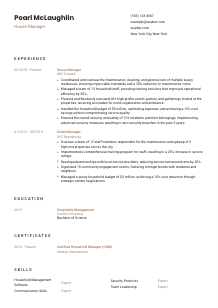
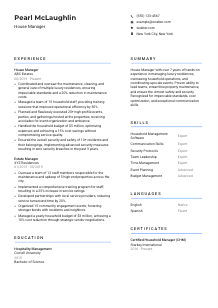
List positions in reverse chronological order and make the connection to residential management obvious through your job titles, employers, and scope. If your background includes related titles like Estate Manager, explain the overlap through the bullets. In the example, both roles stay anchored in high-end properties, staff oversight, and household operations, which keeps the career story aligned with House Manager hiring.
Focus on what you improved, controlled, prevented, or delivered. Good House Manager bullets mention staffing results, vendor performance, event execution, cost control, property condition, or security outcomes. The example does this well with accomplishments such as training household staff, coordinating high-profile events, and reducing maintenance costs while preserving service quality.
Numbers help hiring teams understand the size and sensitivity of the residences you've managed. Include staff counts, number of properties, event volume, budget size, cost reductions, service improvements, or safety results when they are accurate. Managing a $5 million household budget or leading 15 staff members says far more than a generic claim about leadership.
Private residence hiring can be strict about context. Bullets that sound more like hotel operations, office administration, or building maintenance should be rewritten to show household-facing responsibility if that is what you actually handled. Keep the emphasis on service standards, household workflows, discretion, and oversight that translates directly to a luxury home environment.
Your experience section should leave no doubt that you can run a residence smoothly, lead staff well, and protect standards across daily operations and special events. That is the operating proof this role needs.
Education usually plays a supporting role for House Managers, but it still helps frame your training. Degrees in hospitality, business, or related service fields can reinforce your background in operations, guest standards, budgeting, and leadership, especially when paired with strong private residence experience.
If you hold a degree connected to hospitality management, business administration, or service operations, place it clearly in this section. Even when a posting does not require a degree, that training can strengthen your profile by showing formal grounding in service delivery, team coordination, and operational planning.
List the school, degree, field of study, and graduation year or date range. Keep the layout simple so the information is easy to scan. For a House Manager, the value here comes from relevance and clarity, not from extra formatting.
A degree such as Hospitality Management connects naturally to private residence operations because it points to service standards, event coordination, and guest-facing judgment. The sample resume's Bachelor of Science in Hospitality Management is a strong example of education that supports luxury household leadership without needing much explanation.
If you are early in your career or changing from a related field, a short mention of relevant coursework in event planning, facilities operations, finance, or hospitality supervision can help. If you already have 5+ years of directly relevant residence experience, keep this section lean and let experience lead.
Honors, leadership roles, or notable extracurriculars belong here only if they add something useful, such as service leadership, hospitality association involvement, or event management experience. Avoid filling space with general student activities that do not connect to household operations.
For most House Managers, education should support the story rather than carry it. A clear, relevant entry is enough when the rest of the resume already demonstrates strong residence management experience.
Certifications can carry real weight in private service hiring because they show training in household standards, etiquette, operations, or security-conscious service. They are especially useful when the employer mentions household management certification as a plus, as this posting does.
List certifications that relate directly to managing residences, supervising staff, formal service, estate administration, or hospitality leadership. A credential like Certified Household Manager speaks directly to the field and is far more useful here than a broad, unrelated certificate.
Order certificates by relevance, not by prestige alone. If a posting mentions household management training, move that credential to the top. In the example, the Certified Household Manager designation is exactly the kind of qualification that strengthens alignment with a luxury residence role.
Name the issuing organization and add the completion or active date so the credential feels current and verifiable. This matters in private household hiring, where employers often pay attention to formal training and professional standards.
If you are aiming for higher-end residences, look for training in formal dining service, household security awareness, staff leadership, vendor management, or luxury hospitality operations. Each relevant certification gives you another concrete way to show that your methods are structured, not improvised.
A well-chosen certification tells the employer that your household management approach is informed by professional practice. In a luxury residence, that added credibility can make a difference.
A House Manager's skills section should reflect how the household actually runs. That means a blend of operational tools, people management, service judgment, and administrative control, not a generic list of soft skills with no connection to residence work.
Start with the posting and identify the capabilities behind the duties. Here, that includes household management software, staff coordination, communication with family members and vendors, formal service etiquette, budgeting, and security awareness. Build your skills list from those real operating demands.
Include both technical and interpersonal abilities. For House Managers, that often means household management software, scheduling, budget administration, inventory tracking, event planning, staff training, vendor management, discretion, and communication. The sample resume handles this balance well by pairing software and security knowledge with leadership and time management.
Lead with the abilities the employer is most likely to screen for. If the posting stresses software proficiency and formal service protocols, those belong higher than broad traits like adaptability. Order helps the reviewer quickly see whether you can step into the household's systems, staff routines, and service expectations.
Every skill on the page should connect to a task you have handled in a residence or estate setting. That makes the section more believable and far more useful in both ATS screening and human review.
Language ability matters in household settings because communication often moves across family members, domestic staff, drivers, chefs, vendors, and outside service providers. If the residence has international guests or multilingual staff, language skills can also support smoother day-to-day operations and more polished service.
When English proficiency is a stated requirement, place English at the top with an accurate level such as Native or Fluent. This immediately addresses a core qualification for staff direction, written communication, scheduling, and interaction with principals and vendors.
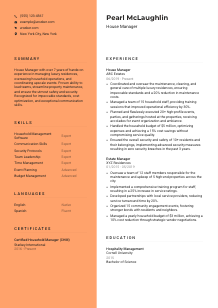
Use straightforward labels such as Native, Fluent, Conversational, or Basic. House Managers often handle sensitive instructions, service standards, and logistical details, so clarity matters more than embellishment. In the example, "Native" English and "Fluent" Spanish are easy to understand at a glance.
A second language can be valuable when working with multilingual household teams, international family members, or frequent overseas guests. Spanish, French, or other commonly used languages can strengthen your application if they are genuinely part of how you operate.
Do not overstate fluency. If you can manage casual conversation but not detailed staff instruction or event coordination, mark that honestly. In a private residence, communication errors can affect service quality, scheduling, and trust.
Not every House Manager role requires more than English. But if the residence serves international visitors, employs multilingual staff, or operates across multiple properties, language ability becomes more than a bonus. Tailor the emphasis to the environment rather than treating extra languages as automatically essential.
Language skills matter most when they support clear instruction, smooth service, and better coordination across the people who keep the residence running. Present them accurately and in the right context.
The summary should quickly establish the level of household work you have handled. For House Managers, that usually means years of experience, type of residences, scope of oversight, and a few standout strengths such as staff leadership, event execution, budget control, or property security.
Start with a direct line that names you as a House Manager, Estate Manager, or comparable private residence professional, followed by your years of experience. This immediately frames your seniority and helps the reader place you in the right hiring tier.
Choose two or three strengths that match the role, such as luxury residence management, household staff supervision, formal event coordination, budget oversight, or security administration. The sample summary works because it highlights luxury residences, household operations, events, and safety without drifting into broad claims.
Aim for a short paragraph with concrete language. "Managed luxury residences and led household teams" is stronger than vague phrases about being results-driven or passionate. Include scale or emphasis only where it adds real clarity, such as 7+ years in private household operations.
Close with the standards you are known for, whether that is impeccable upkeep, discreet service, cost control, smooth event delivery, or reliable household leadership. This gives the hiring team a clear sense of how you operate before they move into your detailed experience.
A strong summary should read like an accurate introduction to someone ready to manage a private residence at a high standard. Keep it grounded in household operations, leadership, and service quality.
A House Manager resume should show control, discretion, and follow-through across the parts of residence life that owners depend on every day: staff, property condition, budgets, events, and security. When each section is tailored to those responsibilities, the application reads like someone who already understands the rhythm and standards of a luxury home.
Use Wozber's free resume builder and ATS resume scanner to align your wording with the posting, strengthen section-by-section matching, and present everything in an ATS-friendly resume template. The result should make one thing clear right away: you can step into the household and run it well.




