



Use Wozber and land your dream job
Create Resume
No registration required
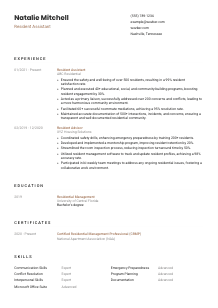
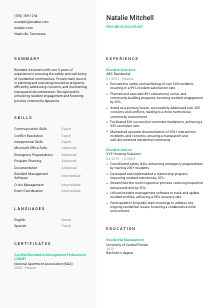
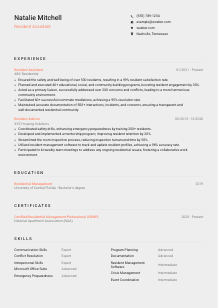
Juggling floor dynamics, but your resume feels off-balance? Check out this Resident Assistant resume example, created with the Wozber free resume builder. Learn how to align your resident relations skills with job requirements, setting your career compass on a path as engaging and communal as your dorm wing!
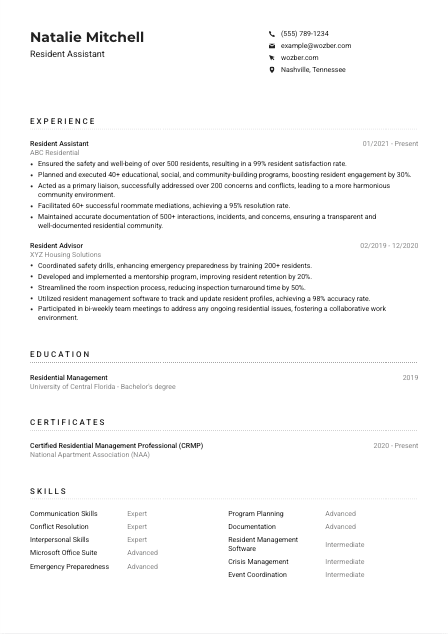
Resident Assistant hiring turns quickly on one question: can you keep a residential community safe, steady, and well-supported when issues surface at odd hours, roommates clash, or residents need help navigating campus systems? Your resume should make that operational side of the job easy to see through concrete examples of resident support, incident response, program delivery, and day-to-day follow-through.
Screening gets much easier when those responsibilities are named in the same language the employer uses. Wozber's free resume builder helps you align your wording with the posting, keep an ATS-compliant resume structure, and surface details such as housing experience, mediation work, and documentation habits so the hiring team can quickly understand how you would handle a real resident community.
Residential life teams need fast, reliable contact details because interviews, reference checks, and shift-related follow-up often move on tight timelines. This section should be clean, professional, and tailored to the practical requirements in the posting.
Your name should sit at the top in a readable size and simple format. For Resident Assistant roles, that clarity matters because hiring teams may be reviewing many student housing or residential life applications at once, and they need to identify candidates quickly during scheduling and internal discussion.
Place "Resident Assistant" under your name when that is the role you are applying for. It immediately frames your resume around community support, resident safety, and program coordination rather than a broader student services background. If your past title was "Resident Advisor," you can still tailor the headline to the target role while keeping your experience entries accurate.
If the posting specifies a city or state, reflect that clearly in your contact details. In this example, listing "Nashville, Tennessee" answers a stated requirement and removes doubt about local availability. Only do this when location is relevant to the role, not as a filler detail.
A LinkedIn profile or relevant portfolio link can help if it supports your application with leadership roles, campus involvement, housing work, or event coordination experience. Keep the content aligned with your resume so a reviewer sees the same dates, titles, and scope of responsibility across both.
This section should confirm that you are easy to contact, professionally presented, and responsive to the posting's practical requirements. Get those basics right, and the rest of the resume can stay focused on resident care and community operations.




For Resident Assistant positions, experience is less about impressive titles and more about what you handled directly. Hiring teams want to see resident-facing work, calm decision-making, clear documentation, and the kind of follow-through that keeps a housing community functioning well.
Read the job description line by line and build bullets around the same areas of responsibility: resident safety, conflict resolution, program planning, maintenance coordination, and documentation. That gives your experience section immediate relevance. The sample resume does this well by covering community programs, roommate mediations, resident concerns, and recorded interactions rather than relying on vague leadership claims.
List your most recent housing or student-facing role first so the employer sees your current level of responsibility right away. Include employer name, title, and dates clearly, especially if your experience builds from Resident Advisor or housing support work into broader Resident Assistant duties.
Choose verbs and phrases that belong to the work itself: "facilitated roommate mediations," "coordinated room inspections," "addressed resident concerns," "maintained incident documentation," or "planned community programs." This kind of wording tells the reader you understand the daily workflow of residence life and helps your resume align naturally with ATS screening.
Numbers matter here because they show scale, consistency, and outcomes. Useful metrics include number of residents supported, programs delivered, concerns resolved, mediation success rate, documentation volume, inspection turnaround time, or resident engagement results. In the example, supporting more than 500 residents and running 40+ programs gives hiring teams a much clearer sense of scope than a generic statement about "building community."
If you have mixed experience, lead with roles that involve supervision, student support, housing operations, customer service under pressure, or incident handling. A Resident Assistant resume does not need every past job in equal detail. Prioritize the work that proves you can manage residents professionally, communicate across staff and student groups, and keep records accurate when issues arise.
Your experience section should leave little doubt that you can step into resident support quickly. Focus on the moments where you kept people safe, resolved friction, coordinated housing processes, and documented what happened with care.
Education matters in Resident Assistant hiring when it helps explain your grounding in student support, community living, psychology, education, residential management, or related fields. Present it clearly, then let your housing experience carry the heavier weight if you already have it.
If the posting asks for a bachelor's degree or equivalent background, show that match plainly. Include the degree, field, school, and graduation year. A degree such as Residential Management, education, psychology, social work, or student affairs can reinforce your readiness for resident-facing responsibilities, though equivalent experience may also meet the requirement depending on the employer.
List degree, institution, field of study, and graduation date in a straightforward format. Residential life teams do not need decorative formatting here. They need to confirm credentials quickly and move back to your hands-on experience.
When your degree connects directly to housing, student development, or community management, make that visible. The sample's "Bachelor's degree in Residential Management" is a strong illustration because it supports the operational and resident-support side of the work. If your major is less direct, your experience bullets can carry the alignment instead.
Coursework, campus leadership, peer mentoring, orientation leadership, or residence hall involvement can be useful if you are earlier in your career or have limited formal housing experience. Include them only when they reinforce mediation, student support, event planning, or community-building skills that matter in residential life.
Additional workshops or non-degree learning in areas such as crisis response, student conduct, mental health awareness, Title IX support, or conflict mediation can strengthen this section or support your certifications section. They show that you take resident care and community standards seriously.
This section works best when it confirms the required degree and adds context for your resident-support background without distracting from your practical housing experience. Let it support the story, not overtake it.
Most Resident Assistant postings do not hinge on certifications alone, but the right ones can strengthen your case, especially when they relate to safety, mediation, student support, or housing operations. List certificates that add practical value to the work, not generic filler.
Prioritize credentials that support the real demands of the job, such as conflict resolution, crisis intervention, emergency preparedness, first aid, mental health response, or residential management. The sample's residential management certification works because it aligns with housing operations rather than adding an unrelated credential.
Show when the certification was earned and whether it is current. That matters most for training linked to safety procedures, emergency response, or compliance-related responsibilities, where recency can affect how relevant the credential feels.
Order your certificates by usefulness to the target job, not by prestige alone. If the posting emphasizes emergencies and resident issues, a crisis-response or mediation credential will likely matter more than a broad professional development course.
A short certificates section can show that you have continued building the skills this work depends on: de-escalation, documentation, community standards, and resident support. That is especially helpful if your formal education was in a broader field and your housing experience developed on the job.
The best certificates here support the realities of residence life. They should make it easier for a hiring team to picture you handling residents, incidents, and community issues with sound judgment.
Resident Assistant skills should reflect the actual mix of community support, operational coordination, and calm judgment the role requires. A useful skills section balances people skills with the tools and processes that keep a residence hall running smoothly.
Start with the skills named or implied in the job description. For this role, that includes interpersonal communication, conflict handling, emergency response, clear writing, and familiarity with Microsoft Office Suite or resident management systems. These are not filler keywords. They map directly to resident meetings, incident reports, maintenance follow-up, and staff communication.
Resident Assistant work depends on both relationship-building and administrative reliability. Pair skills like conflict resolution, mediation, and community engagement with practical tools such as Microsoft Office, documentation, event coordination, and resident management software. The sample resume handles this balance well by combining communication and crisis-related skills with software and documentation capabilities.
Put the skills most central to the role near the top, especially those tied to resident interaction and issue handling. Long skill lists lose value when critical abilities are buried. If a posting emphasizes emergency situations and written communication, those should appear before less essential extras.
A hiring manager should be able to scan this section and see someone who can talk with residents, calm tense situations, track issues accurately, and work inside the systems a housing team uses every day.
Language ability matters in Resident Assistant work when it affects how clearly you can support residents, document issues, and communicate across a diverse community. Present languages in a straightforward way, with honesty about your actual working level.
If the posting specifically requires clear written English, list English at the top with an accurate proficiency level such as "Native" or "Fluent." This signals that you can handle resident emails, incident reports, policy communication, and follow-up documentation without creating confusion.
Additional languages can be valuable in communities with diverse student or resident populations. They may help during move-in, community events, parent communication, or everyday resident concerns. Spanish in the sample resume is a good example of a language that could improve access and rapport, though it is an added strength rather than a universal requirement.
Use clear labels such as Native, Fluent, Advanced, Conversational, or Basic, and avoid overstating your ability. In resident-facing work, inaccurate language claims can create problems during conflict mediation, emergency communication, or written follow-up.
If another language has helped you welcome residents, support families, or build trust across cultural backgrounds, it deserves space. That is where language ability becomes more than a line item and starts to look like a practical asset in community-building work.
Strong language skills reflect communication range, cultural awareness, and adaptability in a shared living environment. For Resident Assistant roles, that can strengthen your profile when the community includes varied backgrounds and frequent person-to-person interaction.
List only the languages you can genuinely use. When they are presented accurately, they add depth to your ability to communicate, document, and support a residential community well.
Your summary should quickly tell a residential life team what kind of community support experience you bring. Keep it brief, specific, and grounded in the parts of the job that matter most: resident well-being, conflict handling, program delivery, and reliable documentation.
Identify the few qualifications that best match the posting before you write. For Resident Assistant roles, that often means years in student housing or residential settings, experience supporting resident safety, and success handling concerns or community programming.
Your first sentence should state your title or closest equivalent, your level of experience, and the setting you have worked in. A line like the sample's opening works because it immediately places the candidate in residential communities and ties their background to resident well-being.
Choose strengths that map directly to the posting, such as conflict resolution, educational or social program planning, liaison work with staff, or maintaining clear records. This is the place to echo the employer's priorities in natural language rather than repeat a list of keywords.
Aim for three to five sentences with concrete substance. If you mention achievements, use the ones that best show community results, such as engagement gains, successful mediations, or strong resident satisfaction. A concise summary with real housing context is far more convincing than broad statements about passion or leadership.
By the end of the summary, the hiring team should already understand your experience level, the kind of resident community you have supported, and the responsibilities you are prepared to take on. That clarity sets up the rest of the resume well.
A Resident Assistant resume works when it shows that you can support residents consistently, handle conflict calmly, document issues clearly, and contribute to a healthy community culture. Keep every section tied to the realities of residential life rather than broad campus leadership language.
Use Wozber's free resume builder to shape those details into an ATS-friendly resume template, check alignment with an ATS resume scanner, and tighten your wording around the exact priorities in the posting. The final result should make your readiness for resident support, mediation, programming, and housing coordination easy to judge.




