



Use Wozber and land your dream job
Create Resume
No registration required
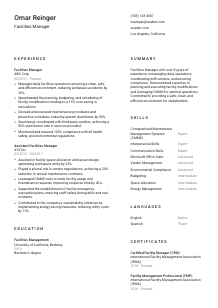
Keeping facilities tip-top, but your resume seems out of place? Check out this Facilities Manager resume example, created with Wozber free resume builder. Learn how to align your maintenance mastery with job specifications, so your career stands as solid as the buildings you manage!
Facilities management sits at the intersection of operations, safety, budgets, and building performance. A hiring team scanning your resume wants to see whether you can keep sites running smoothly, manage contractors, control maintenance costs, and stay ahead of health, safety, and environmental requirements without disrupting the people who use the space every day.
When your resume is tailored well, your operating scope becomes easier to read quickly, especially in an ATS-compliant resume. Wozber's free resume builder helps you line up your experience with the posting's terminology, from CMMS use to preventive maintenance and vendor coordination, so the resume points clearly to the kind of facility oversight the employer needs.
This section is simple, but it still does real work. For a Facilities Manager, it should immediately confirm who you are, how to reach you, and whether you meet practical requirements such as location or relocation for site-based operations.
Place your name at the top in a clean, readable format so it stands out at a glance. Facilities hiring often moves quickly once a candidate looks operationally credible, so basic identification should never get lost in design choices.
Add "Facilities Manager" under your name if that is the role you are pursuing. This creates immediate alignment, especially when the employer is sorting applicants across adjacent titles such as Facilities Coordinator, Assistant Facilities Manager, or Operations Manager.
Use a current phone number and a professional email address. If you include a website or LinkedIn profile, make sure the content supports your resume with relevant project scope, vendor oversight, maintenance planning, or compliance work rather than unrelated material.
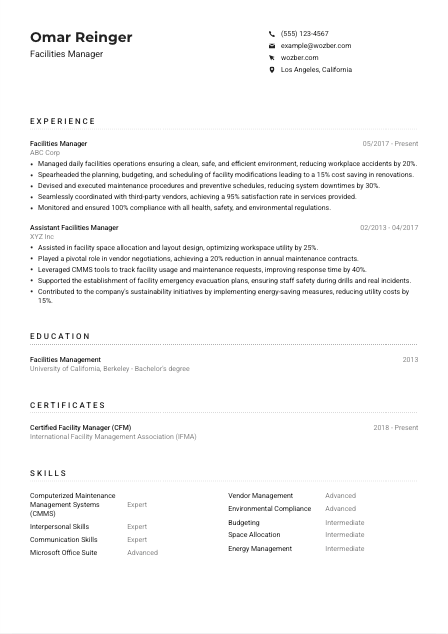
If the role requires you to be in a specific market, include your city and state so there is no ambiguity. In the example here, listing Los Angeles, California immediately answers a stated requirement and helps the employer move past a common screening question for on-site facilities leadership.
A LinkedIn profile can help if it reinforces the same career story with consistent titles, dates, and accomplishments. For facilities roles, it is especially useful when it shows building portfolio scope, certifications, capital projects, or contractor management that could not fit in a one-page resume.
Your personal details should remove friction, not create it. If this section confirms your identity, contact information, and any practical requirement such as location, the reader can focus on your facility operations record right away.




Experience carries the most weight in facilities management because the work is measured through uptime, safety, cost control, service quality, and execution across vendors and internal teams. Your bullets should show what systems, sites, budgets, or programs you managed and what improved because you were responsible for them.
Start by identifying the operational themes in the posting, then match your history to them. For this role, that means daily facilities operations, preventive maintenance, vendor coordination, budgeting, scheduling modifications, and regulatory compliance. Those themes should appear clearly across your recent positions, not be buried under generic management language.
List each role with job title, employer, and dates in reverse chronological order. Facilities careers often show progression from coordinator or assistant roles into broader site responsibility, and that progression helps employers understand your readiness to oversee larger buildings, more contractors, or more complex maintenance programs.
Each bullet should connect a responsibility to a concrete outcome. Good facilities bullets mention accident reduction, downtime improvement, contract savings, response times, audit performance, energy savings, or occupant service levels. The example bullet about reducing workplace accidents by 20% works because it ties daily operations directly to a safety result.
Numbers matter in this field because they reflect how well a facility is run. Include percentages, dollar savings, response-time improvements, uptime gains, square footage, headcount served, or compliance rates when you have them. A bullet like "reduced system downtimes by 30%" says far more than simply stating that you managed preventive maintenance.
Prioritize experience that supports facilities leadership. Space planning, CMMS usage, contract negotiation, renovation planning, emergency preparedness, and environmental compliance all strengthen your case. If an older role is less relevant, trim it down so the strongest evidence of site operations and maintenance oversight stays at the center.
The best experience sections read like a track record of reliable building performance. When your bullets show systems managed, vendors directed, budgets handled, and measurable outcomes delivered, the employer can picture you running the site.
Education usually supports rather than carries a Facilities Manager resume, but it still matters when the posting asks for a specific academic background. Present it clearly so the employer can confirm the requirement in seconds and move on to your operating experience.
List your most relevant completed degree first, especially when the employer asks for a bachelor's degree in Facilities Management, Business Management, or a related field. In the example, a Bachelor's degree in Facilities Management directly aligns with the requirement and needs no extra interpretation.
Include the school, degree, field of study, and graduation year or date. Straightforward formatting works best because education in this profession is typically reviewed for baseline qualification, not for elaborate presentation.
If your degree aligns closely with the posting, use clear wording that reflects that connection. Writing "Bachelor's degree in Facilities Management" makes the match obvious and avoids forcing the reviewer to infer whether your background meets the requirement.
If you are earlier in your career or your experience is lighter, selected coursework or projects can add value. Facilities planning, safety management, business operations, construction coordination, or sustainability projects can reinforce your readiness for maintenance scheduling, budget planning, and site support.
Honors, leadership roles, or relevant student projects are worth adding when they strengthen your professional story. Keep them if they connect to operations, planning, compliance, or team coordination. Leave them out if they distract from stronger workplace achievements.
Education should confirm that you meet the stated baseline and, when useful, add context to your operational background. Once that is clear, your experience and certifications can do the heavier lifting.
Facilities certifications carry real weight because they show familiarity with recognized standards, maintenance practices, compliance expectations, and the broader discipline of facility operations. If you hold them, make them easy to find.
Check the posting for preferred credentials and list those first when you have them. Here, CFM and FMP are directly relevant examples, so featuring them prominently helps show professional commitment beyond day-to-day job experience.
Prioritize certifications tied to facilities management, building operations, safety, maintenance, environmental practices, or related compliance areas. Certifications outside that scope only belong here if they clearly support the kind of sites or systems you manage.
Show when the certification was earned and whether it is current when applicable. That gives the employer a quick sense of whether your credential reflects recent professional development and active standing in the field.
Facilities work evolves with new compliance expectations, sustainability targets, maintenance technology, and vendor management demands. Continued certification or renewal activity helps show that your knowledge has kept pace with the operational side of the profession.
Well-chosen certifications strengthen your profile when they align with the actual work of the role. They should reinforce your ability to manage buildings, systems, vendors, and compliance responsibilities with current professional knowledge.
A Facilities Manager skill section should feel practical. Hiring teams look for a mix of systems knowledge, coordination ability, compliance awareness, and administrative control that maps to real building operations, not a broad list of soft skills with no operating context.
Read the posting closely and extract both explicit and implied skills. In this case, CMMS proficiency, Microsoft Office, vendor management, budgeting, preventive maintenance planning, compliance monitoring, and communication all belong because they connect directly to how the facility is operated.
List the skills that appear both in the job ad and in your work history. If you claim CMMS expertise, your experience section should show how you used it to track maintenance requests, improve response times, or support preventive schedules. The same applies to budgeting, contractor coordination, and environmental compliance.
Place the most relevant operational skills near the top, then follow with supporting capabilities. For a Facilities Manager, that often means systems and maintenance tools first, then vendor and compliance skills, then communication or space planning. The example skills list works because it keeps CMMS, communication, vendor management, and compliance close to the top where they are easy to spot.
The most convincing skills section mirrors the language of the posting and matches the substance of your experience. When those two sections support each other, your qualifications look consistent and credible.
Language ability matters in facilities roles when the job involves vendor negotiations, contractor coordination, tenant communication, or support across a diverse workforce. If language is mentioned in the posting, handle it as a practical job requirement rather than a minor extra.
If the employer specifies a language for negotiation, reporting, or day-to-day coordination, list it first with an honest proficiency level. In this example, English is essential, so it should appear clearly and prominently.
Order languages by job value, not personal preference. For many facilities environments, the most useful languages are the ones that help with contractor instructions, incident communication, service requests, and vendor discussions.
Extra languages can strengthen your profile when they help you communicate across maintenance teams, front-line staff, building occupants, or service partners. Spanish, for instance, may be useful in many facilities environments even when it is not formally required.
Choose straightforward levels such as Native, Fluent, Intermediate, or Basic. Avoid vague descriptions. Hiring teams need a realistic sense of whether you can negotiate contracts, handle day-to-day coordination, or simply hold casual conversation.
If the role supports a diverse tenant base, multiple vendors, or regional operations, language skills can become a real operating advantage. Add them when they strengthen the picture of you as someone who can keep communication clear during routine work and urgent situations alike.
For facilities leadership, language skills matter when they improve coordination, negotiation, and response on the ground. Present them in a way that shows how they support the operation.
Your summary should quickly establish the scope of your facilities background and the type of environment you can manage. Keep it specific enough to signal operational competence, but concise enough that the reader gets the message before moving into your experience.
Start with the responsibilities the employer cares about most. For a Facilities Manager, that often includes site operations, preventive maintenance, vendor coordination, facility modifications, budgeting, and compliance oversight. Those ideas should shape the summary instead of generic leadership language.
Open with your years of experience and your core professional identity. A line such as "Facilities Manager with 8+ years of experience in building operations, maintenance planning, and vendor oversight" gives the reader immediate context and sets the tone for the rest of the resume.
Mention a few high-value strengths backed by your experience, such as CMMS use, contractor management, renovation planning, safety performance, or compliance results. The sample summary works best where it connects operations experience with CMMS and facility efficiency rather than staying purely broad.
Aim for 3 to 5 lines. That is enough room to cover tenure, functional scope, and one or two distinguishing strengths without repeating the full experience section. A concise summary helps the employer quickly understand what scale of facility responsibility you are ready to take on.
A well-written summary should make your operational background clear within seconds. By the time the reader reaches your experience section, they should already know that you can manage facilities, vendors, maintenance programs, and compliance with confidence.
A Facilities Manager resume works when it connects your background to the realities of the job: safe operations, reliable maintenance, controlled costs, effective contractor oversight, and consistent compliance. Every section should help the employer see that you can keep a facility functioning well under daily operational pressure.
Wozber's free resume builder can help you shape that story into an ATS-friendly resume format, align your wording with the posting, and refine sections with ATS optimization in mind. The finished resume should make one thing easy to judge: whether you can take responsibility for the facility from day one.




