



Use Wozber and land your dream job
Create Resume
No registration required
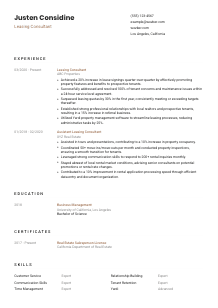
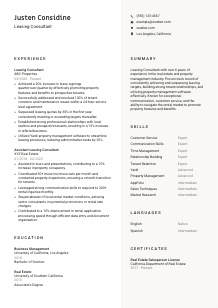
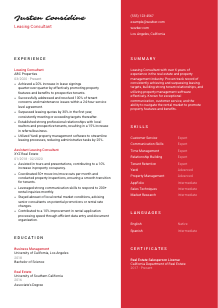
Navigating rental waters, but your resume feels adrift? Check out this Leasing Consultant resume example, created with Wozber free resume builder. Learn how to match your leasing prowess to job specs, ensuring your career sails smoothly into the anchor spot!
Leasing teams hire for people who can turn a property tour into a signed lease, keep follow-up moving, and handle day-to-day tenant interactions without letting details slip. A Leasing Consultant resume works best when it shows that mix clearly: sales results, responsive communication, clean application handling, and enough operational range to support move-ins, inspections, and resident concerns.
Screening usually narrows fast when resumes stay vague about leasing volume, occupancy impact, or property management systems. Using Wozber's free resume builder helps you shape an ATS-friendly resume format around the exact language of the opening, so hiring teams can quickly connect your background to leasing quotas, tenant-facing work, and software such as Yardi or AppFolio.
In leasing, small details matter because the role is built on responsiveness, professionalism, and local availability. Your personal details section should make it easy to contact you, confirm where you are based when that matters, and show that you understand the role you are applying for.
Use your full name in a clear, readable style at the top of the resume. Leasing is a client-facing role, so the presentation should feel polished and straightforward, much like the first impression you would make with a prospect on a property tour.
Place "Leasing Consultant" directly under your name if that is the role you are targeting. This keeps your positioning clear from the first line and helps when employers or ATS tools scan for direct title alignment.
Include a reliable phone number and a professional email address you check often. Since leasing work depends on timely replies to inquiries, tour scheduling, and follow-up communication, your contact information should look current and easy to use. Add LinkedIn or a professional website only if it supports your candidacy with relevant experience, recommendations, or property-related work.
If a posting asks for a candidate based in a specific city, include that city and state. In the example, listing Los Angeles, California immediately supports a stated location requirement and removes a common screening question before it comes up.
A website is useful when it reinforces your leasing background, not when it fills space. If you have a page that highlights properties leased, occupancy wins, resident engagement work, or real estate credentials, include it. If not, leave it out and keep attention on the sections that show leasing performance.
This section should answer the basics fast: who you are, how to reach you, what role you want, and whether you meet any location requirement. That gives the rest of the resume room to prove your leasing results.




For Leasing Consultants, the experience section carries the most weight because it shows whether you can generate leases, manage tenant interactions, and keep operations moving. Focus less on generic duty lists and more on leasing outcomes, service standards, software use, and the pace or volume you handled.
Start by marking the phrases the employer repeats. In this opening, that includes touring prospects, closing leases, following up on inquiries, handling deposits and lease signing, coordinating move-ins and move-outs, and staying current on rental market conditions. Your bullets should echo that language where it matches your real work. The example does this well by naming lease signings, Yardi use, tenant issue resolution, and quota performance.
Begin with your most recent leasing or property management role and work backward. For each job, include the employer, your title, and dates. If your background includes adjacent roles such as leasing assistant, sales consultant, or property operations support, keep them when they show transferable work like tour coordination, application processing, occupancy support, or resident communication.
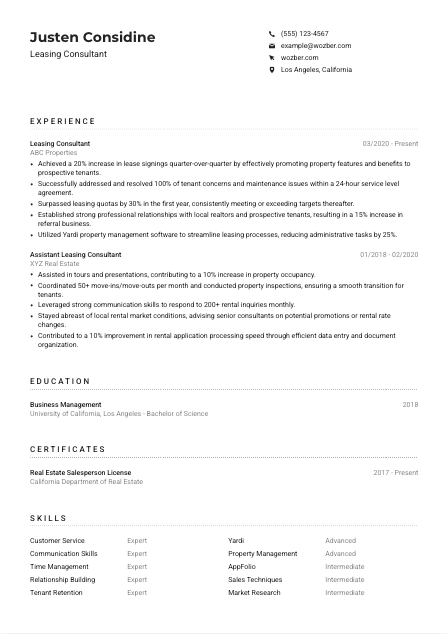
Bullet points should show what changed because you were in the role. Use outcomes that matter in leasing, such as lease conversion, occupancy growth, inquiry response volume, renewal support, service turnaround time, referral business, or faster application processing. In the sample resume, "20% increase in lease signings" and "resolved 100% of tenant concerns within a 24-hour service level agreement" are far more persuasive than broad claims about customer service.
Numbers help employers judge pace and consistency. Include leasing quotas achieved, percentage above target, number of inquiries handled monthly, tours conducted, move-ins coordinated, occupancy improvements, or administrative time saved through software and process changes. The sample's "30% above quota" and "200+ rental inquiries monthly" are strong examples because they show both sales performance and workload capacity.
Prioritize the parts of your history that relate to resident-facing sales, property operations, and real estate administration. If an older role is unrelated, shorten it or remove it unless it adds something clearly useful, such as high-volume sales, conflict resolution, or customer retention. Space on the page should go to experience that supports leasing, tenant service, and property management workflows.
A Leasing Consultant resume should leave little doubt about what you handled and what you achieved. When your bullets show leases signed, tenants served, systems used, and day-to-day property support, the hiring team can picture you in the role much faster.
Education is rarely the deciding factor in leasing hires, but it can strengthen your profile when it connects to business, real estate, or customer-facing operations. Keep this section simple and relevant, and let it support the experience section rather than compete with it.
If the posting requires a high school diploma and prefers a bachelor's degree in Business, Real Estate, or a related field, list any matching education clearly. The example resume helps here by showing both a Business Management bachelor's degree and an associate degree in Real Estate, which closely match the employer's preference.
List your most recent or highest qualification first, followed by earlier education. Include the school name, degree, field of study, and graduation year. That is usually enough for leasing roles unless a specific program, coursework, or academic honor directly supports your candidacy.
If your education connects to leasing work, do not bury it. Degrees or coursework in business, real estate, marketing, communications, or property management can reinforce your understanding of leasing fundamentals, tenant relations, and market positioning.
Short courses can add value when they support the actual work. Training in Fair Housing, property management software, real estate fundamentals, lease administration, or customer service may be worth including if you do not yet have deep experience or if the training is directly relevant to the opening.
Leasing practices change with local market conditions, software adoption, and compliance expectations. If you recently completed coursework that improves your tenant communication, leasing systems knowledge, or understanding of property operations, include it to show current engagement with the field.
This section should reinforce that you have the academic background or relevant training to support leasing work. If your experience is stronger than your education, let education stay concise and clearly tied to the role.
Certifications matter most in leasing when they show legal eligibility, market knowledge, or practical training that helps with property operations and tenant-facing work. Treat this section as a place for credentials that directly strengthen your candidacy, not as a list of every course you have taken.
Start with the licenses or certifications that matter most for leasing, real estate, or property management. A Real Estate Salesperson License, Fair Housing training, or recognized property management credential can add immediate relevance. In the example, the California Real Estate Salesperson License is a strong inclusion because it directly supports the profession.
Choose certificates that support leasing performance, compliance awareness, software capability, or tenant service. Skip unrelated credentials that do not help explain your ability to lease units, manage applications, or work within property operations.
Include issue dates, renewal dates, or "Present" when the credential is active. For regulated or time-sensitive credentials, current status matters because employers do not want to guess whether you can use the qualification right away.
If you are working toward a certificate in property management, leasing, housing compliance, or a platform used in the industry, you can mention it. That is especially useful when the role values growth in operational knowledge or familiarity with leasing systems.
A focused certificates section tells employers that your leasing background is backed by recognized training or licensing. That can be especially helpful when your target role involves regulated processes, tenant documentation, or local market knowledge.
Leasing roles sit at the intersection of sales, service, and property coordination. Your skills section should reflect that balance clearly, showing how you communicate with prospects, manage resident needs, and work inside the tools and processes that keep occupancy moving.
Pull the highest-priority skills from the job description and match them to your own experience. For this role, that includes customer service, communication, rapport-building, and meeting leasing targets. If you have those strengths, use the same language so the connection is obvious to both recruiters and ATS tools.
Property teams often need someone who can step into existing systems with minimal ramp-up time. If you know Yardi, AppFolio, CRM tools, digital leasing platforms, scheduling systems, or inspection and work order workflows, include them. The example's Yardi and AppFolio entries help show readiness for software-driven leasing operations.
Put the most relevant skills first instead of mixing everything together randomly. A Leasing Consultant resume usually benefits from leading with tenant-facing and sales skills, then adding technical tools and market knowledge. For example, communication, customer service, relationship building, tenant retention, property management software, and market research form a more useful sequence than a generic keyword pile.
When this section is well built, it tells a hiring team that you can attract prospects, move applications forward, and handle the systems and resident interactions that come with the job.
Language ability can matter in leasing because clear communication shapes tours, follow-up, application support, and resident relationships. Even when a role requires only English, listing additional languages can strengthen your profile in markets where properties serve diverse communities.
If the posting specifically asks for strong English communication, make sure English appears clearly in your language section. That matters in leasing because the role depends on explaining property features, answering questions accurately, and guiding applicants through lease documents and policies.
A second language can be useful when properties serve multilingual neighborhoods or when tenant communication is a big part of the role. The example includes Spanish, which can be an advantage in many leasing markets, but the broader point is to list any language that helps you build rapport and handle day-to-day interactions more effectively.
Label your level in a way employers can trust, such as native, fluent, intermediate, or basic. Overstating language ability creates problems quickly in a role where conversations with prospects and tenants happen every day.
If you are applying to communities with a clear demographic pattern, your language section can support the rest of your resume by showing you can communicate with tenants comfortably and professionally. This is especially relevant for roles with heavy front-desk interaction, tours, and resident issue follow-up.
Extra languages are valuable when they improve prospect experience, reduce communication friction, or help residents feel understood. Present them as practical strengths tied to tenant interaction, not as generic personal traits.
List the languages you can actually use on the job and the level you can use them at. For leasing roles, that helps employers gauge how well you can communicate with prospects, residents, and local partners.
Your summary should quickly establish your leasing background, the kind of results you produce, and the strengths that make you effective with prospects and residents. Keep it short, but make sure it reflects the work employers are actually hiring for.
Start with your title and years of relevant experience in leasing, real estate, or property management. If your background includes several years of tenant-facing leasing work, say so directly. The sample summary works because it immediately positions the candidate as a Leasing Consultant with more than 6 years in the industry.
Choose achievements that fit the target role, such as exceeding leasing quotas, increasing lease signings, supporting occupancy growth, or improving response and processing speed. These details give the summary substance. Results like the sample's quota performance or software-driven efficiency gains make the opening paragraph far more convincing.
Use the summary to reinforce skills that matter most for the role, especially communication, customer service, relationship building, leasing conversion, and property management software knowledge. Match the posting's language naturally rather than stuffing it with every keyword.
Aim for three to five lines with a clear throughline. A hiring manager should come away understanding your leasing experience, the kind of properties or workflows you support, and the value you bring to tenant acquisition and service. Save detailed examples for the experience section.
A clear summary helps frame the rest of your resume before the reader reaches the first bullet point. When it combines years of experience, leasing results, and tenant-facing strengths, it gives the hiring team a sharp picture of your candidacy.
A Leasing Consultant resume should show that you can generate interest, convert tours into signed leases, manage the administrative steps accurately, and keep resident communication professional. When each section points back to those outcomes, your application reads like someone ready to support occupancy from day one.
Use Wozber to build an ATS-compliant resume with an ATS-friendly resume template, then refine it with the ATS resume scanner so your wording matches the target opening without losing the reality of your experience. The final result should make it easy to judge your leasing performance, software readiness, and tenant-facing professionalism.




