



Use Wozber and land your dream job
Create Resume
No registration required
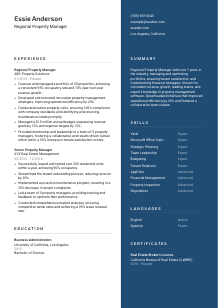
Overseeing regions, but your resume feels out of place? Check out this Regional Property Manager resume example, created with Wozber free resume builder. Learn how to present your territory management strengths to match job specifications, making sure your property portfolio looks as impressive as your career trajectory!

Regional Property Managers are trusted with performance across multiple properties, which means hiring teams look past broad management claims very quickly. Your resume needs to show that you can control occupancy, revenue, compliance, site standards, and staff performance across a portfolio, not just keep one building running day to day.
A tailored resume makes that portfolio-level scope easier to read in both an ATS and a human review. Using Wozber's free resume builder helps you align your wording with the posting, keep an ATS-friendly resume format, and surface details such as multi-site leadership, budgeting scale, software proficiency, and regulatory knowledge before your resume is filtered into a general property management pile.
Regional property management hiring often starts with a few practical checks before anyone reads your achievements. Your header should make title alignment, contact access, and location status easy to confirm without adding clutter.
Use your full name as the clearest line on the page so the resume feels immediately professional and easy to reference. A simple, readable format works best here, especially for a role where the rest of the document needs to communicate control, structure, and operational judgment.
Place "Regional Property Manager" directly under your name when that is the role you are pursuing. This helps recruiters distinguish you from candidates who have only managed a single site or worked in assistant roles, and it keeps your positioning consistent from the first line.
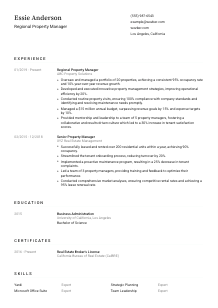
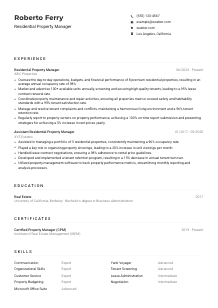
If the employer requires someone based in a specific market, state that clearly. Here, listing "Los Angeles, California" directly addresses a stated requirement and removes early uncertainty about regional coverage, commute feasibility, and local availability for property visits.
Include LinkedIn or a professional website only if it reinforces your resume with the same job titles, dates, licenses, and portfolio scope. For regional leadership roles, a complete profile can support your resume with added context on team size, asset mix, or software platforms.
This section should answer the first operational questions fast: who you are, what role you are targeting, how to reach you, and whether you meet any location requirement. Once that is clear, the hiring team can focus on your portfolio results.




This is the section that carries the most weight for a Regional Property Manager. Hiring teams want to see portfolio scale, financial control, compliance oversight, property inspections, and leadership of site teams in language tied to actual outcomes.
Before editing bullets, identify the work themes the employer is hiring for. In this case, that includes managing a portfolio, improving financial performance, conducting site inspections and audits, building SOPs, and leading property managers. Those priorities should shape which achievements you move to the top and which older bullets you cut.
List positions in reverse chronological order and make each entry easy to scan with title, company, and dates. For regional roles, title progression matters. A move from Senior Property Manager to Regional Property Manager, like in the example, helps show growth from single-property or limited-site execution into broader portfolio oversight.
Focus each bullet on outcomes a regional leader is expected to influence: occupancy, NOI or revenue growth, expense control, tenant satisfaction, compliance rates, maintenance response, lease renewals, and team performance. The sample resume does this well by tying portfolio oversight to a 95% occupancy rate, 10% year-over-year revenue growth, and a 20% gain in operational efficiency.
Regional property management is measured in numbers, so include them wherever they are real and useful. Property count, annual budget size, occupancy percentage, revenue lift, reduction in complaints, renewal rate, and staff count all help hiring teams understand your operating scale. A bullet such as managing a $15 million budget or mentoring five property managers tells far more than saying you "handled finances" or "led teams."
Cut achievements that do not support the job you want now. Activities unrelated to asset performance, tenant retention, compliance, budgeting, vendor management, or team leadership take up space better used for regional-level work. Even when you include earlier roles, frame them around transferable outcomes such as leasing volume, turnover reduction, market analysis, or maintenance programs.
When this section is tailored well, a hiring manager can quickly see the size of your portfolio, the standards you enforced, the teams you led, and the financial results you delivered. That is the proof this role depends on.
Education is usually a screening checkpoint for this role rather than the main selling point, but it still needs to be handled precisely. When a posting asks for a bachelor's degree in business, real estate, or a related field, make that information easy to find.
If you hold the degree named in the posting or a closely related one, list it clearly and without extra wording. For this opening, a bachelor's degree in Business Administration, Real Estate, or a related field meets the educational baseline, so your degree should be presented in a way that makes that match obvious.
Keep the structure simple: degree, field of study, school, and graduation year. Hiring teams reviewing experienced property management candidates do not need a dense academic section. They need a quick confirmation that your background meets the requirement.
Spell out the field instead of relying on abbreviations alone. "Bachelor of Science in Business Administration" maps cleanly to the posting and supports a management-focused career path. The example resume handles this well by keeping the field visible rather than burying it.
Most experienced Regional Property Managers do not need course lists, but they can help if your degree is broader or you are earlier in your career. Include subjects such as real estate finance, operations management, business law, accounting, or organizational leadership only when they clarify your preparation.
Honors, real estate associations, or relevant business competitions can stay if they reinforce your path into property operations, asset performance, or leadership. If they do not add value for a mid-career management role, leave them out and keep attention on your operating results.
This section should confirm that your academic foundation matches the posting without distracting from your portfolio achievements. For most Regional Property Manager applications, that is exactly enough.
Licenses and certifications matter in property management because they speak to compliance awareness, professional standing, and, in some cases, legal authority. When a posting asks for a broker's license or similar credential, this section becomes a key qualification check.
Put any license or certification named in the posting at the top of this section. Here, a valid Real Estate Broker's License should appear first because it directly answers a listed requirement and can separate you from otherwise similar multi-site candidates.
List credentials that strengthen your ability to oversee leasing, compliance, operations, or portfolio performance. Industry-recognized property management certifications can help, but they should not outrank a required license or a credential more relevant to the employer's asset type and responsibilities.
Include issue date, renewal period, or "Present" where appropriate so the employer can see that the credential is active. The example's "2016 - Present" format works well because it quickly communicates continued validity for a regulated field.
If you have added recent education in fair housing, landlord-tenant law, risk management, budgeting, or advanced property operations, include it when it strengthens the role match. Regional leaders are often expected to stay current on legal requirements, reporting standards, and operational practice across jurisdictions.
A well-ordered certification section confirms that you meet licensing expectations and stay current in a regulated profession. That gives the hiring team one less reason to hesitate.
A Regional Property Manager's skills section should read like an operating toolkit, not a broad personality list. Focus on the software, financial, compliance, and leadership capabilities that support performance across multiple sites.
Read the posting for explicit tools and implied operating strengths. Here, software such as Yardi, AppFolio, and Microsoft Office sits alongside budgeting, forecasting, inspections, tenant relations, SOP development, and team leadership. Those are the capabilities your skills section should emphasize.
Lead with the skills most likely to be screened first, especially named software and portfolio-management capabilities. The example resume places Yardi, Microsoft Office Suite, strategic planning, budgeting, and team leadership near the top, which makes sense for a role balancing systems use with financial and operational oversight.
Keep the list focused on what you can actually use in the job. Ten relevant skills are stronger than a bloated inventory of generic management terms. Include a mix of technical tools, financial competencies, operational strengths, and people leadership that reflects how regional property work is really done.
Your skills list should support the experience section by naming the systems and capabilities that made those portfolio results possible. If the employer can connect your tools to your outcomes, the section is doing its job.
Regional property management depends on clear communication with tenants, site teams, vendors, and ownership groups. Language ability is not always a deciding factor, but when it improves day-to-day operations or meets a stated requirement, it belongs on the resume.
If the posting specifies English proficiency, list English first with an accurate level. That directly answers the requirement and avoids any question about your ability to handle reporting, tenant communication, lease discussions, and policy enforcement.
Add other languages when they are genuinely useful in the properties or communities you serve. In some portfolios, Spanish can be a practical asset for tenant communication, vendor coordination, and staff leadership, which makes the example's fluent Spanish worth including.
Stick to standard labels such as Native, Fluent, Professional, Conversational, or Basic. Vague wording makes this section harder to interpret. Property management often involves sensitive discussions around leases, complaints, maintenance access, and compliance, so honesty matters here.
Think about whether an additional language supports the actual population you manage. If it helps with resident relations, renewals, conflict resolution, or on-site coordination, it can add practical value beyond simple resume decoration.
Only include languages you can comfortably use in real business settings. This section is most effective when it reflects communication capacity that could genuinely help across inspections, meetings, escalations, and tenant-facing interactions.
For this kind of role, language skills matter when they improve communication on the ground. Keep the section accurate and relevant to the communities, teams, and stakeholders you work with.
Your summary should tell the reader, in a few lines, what scale of property operation you manage and what kind of results follow. For a Regional Property Manager, that usually means combining years of experience with portfolio performance, leadership, and operational strengths.
Start with your current or target role and your years of experience in property management. A line like "Regional Property Manager with 7+ years in property management" works because it immediately frames seniority and specialization without wasting space.
After the opener, mention two or three strengths that matter for regional oversight, such as managing multi-site portfolios, improving occupancy and revenue, leading property managers, or using platforms like Yardi and AppFolio. The example summary succeeds because it connects software knowledge with financial strategy and team leadership instead of listing random strengths.
Aim for a concise paragraph, usually three to five lines, with concrete language. Avoid broad phrases about being results-driven unless you attach them to something real such as revenue growth, operational efficiency, tenant satisfaction, or portfolio optimization.
Close with the kind of impact you deliver, not a generic career objective. Mention the operating outcomes you are known for, such as stronger occupancy, cleaner compliance performance, better expense control, or improved tenant satisfaction. That gives the reader a clear reason to continue into your experience section.
A well-built summary sets the lens for everything that follows. With Wozber's AI resume builder and ATS resume scanner, you can tighten the language around portfolio scale, software, financial oversight, and leadership so the resume reads clearly for both screening systems and property management decision-makers.
A Regional Property Manager resume should make one thing obvious: you know how to improve performance across multiple properties while keeping tenants, teams, budgets, and compliance under control.
Use Wozber to turn that experience into an ATS-compliant resume with clean structure, sharper role-specific wording, and stronger alignment to each posting. The final read should make your portfolio leadership easy to trust.