



Use Wozber and land your dream job
Create Resume
No registration required
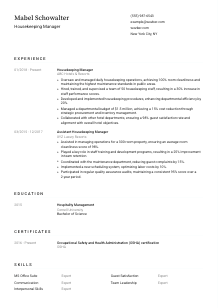
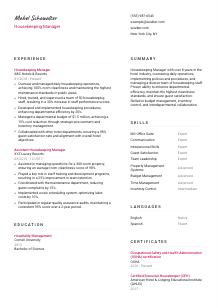
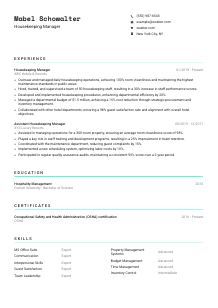
Mastering tidiness, but your resume appears disheveled? Navigating cluttered corridors, check out this Housekeeping Manager resume example, created with Wozber free resume builder. Learn how to present your managerial shine to match job specifications, so your career outlook stays as spotless as your work floors!
Housekeeping managers carry one of the clearest operational standards in hospitality. Clean rooms, well-kept public spaces, safe procedures, stocked supplies, and a dependable team all show up in guest scores, inspection results, and daily coordination across the property. Your resume should make that operating control visible, not bury it under generic management language.
A tailored resume helps hiring teams quickly see whether your background matches the scale and discipline of their housekeeping operation, especially when they scan for staffing leadership, cleanliness standards, budget control, and OSHA knowledge. Wozber's free resume builder helps shape that into an ATS-friendly resume format, so the right terminology and achievements surface clearly for both screening systems and hotel decision-makers.
This section is short, but it still sets the tone. For a Housekeeping Manager, accuracy matters from the first line because the job itself depends on consistency, clear communication, and operational reliability. Keep your details clean, professional, and aligned with any stated requirements in the posting.
Use your full name in a larger, readable font so it is easy to find at a glance. In hospitality leadership roles, polished presentation matters, and a clean header immediately supports that impression.
Place "Housekeeping Manager" directly below your name if that is the role you are pursuing. Matching the posted title helps position your resume for the opening right away and avoids any ambiguity about whether your background is supervisory, operational, or front-line housekeeping.
Your contact information should be simple and error-free so a recruiter or operations leader can reach you without friction.
If the posting specifies a location, reflect it when it applies. Here, the employer asks for someone located in New York City, NY, so listing "New York City, NY" directly in your header helps remove an immediate screening question. If you are relocating, make that clear instead of leaving the employer to guess.
Include LinkedIn or a professional website only if it supports your candidacy with consistent experience, certifications, or hospitality leadership details. If it is outdated or thin, leave it off. For operations-focused roles, a clean and accurate resume matters more than a weak online profile.
Treat your personal details like the front desk handoff at the start of a shift. They should be orderly, accurate, and easy to act on. When this section is clean, hiring teams can move straight to your housekeeping leadership experience.




For Housekeeping Manager hiring, experience is where the real case gets made. Employers want to see that you have led room attendants or housekeeping teams, maintained standards under pressure, controlled supplies and labor, and worked across departments to protect the guest experience. Titles matter, but outcomes matter more.
Before editing your bullets, identify the operating demands in the job description. In this opening, those are daily housekeeping oversight, staff hiring and supervision, procedure development, budget and inventory management, and collaboration with other hotel departments. Shape your experience around those responsibilities so the match is direct instead of implied.
List your most recent position first so employers can quickly judge your current level of responsibility. For housekeeping leadership roles, recent scope matters a lot because it shows whether you are actively managing standards, staffing, inspections, and service recovery in a live hotel environment.
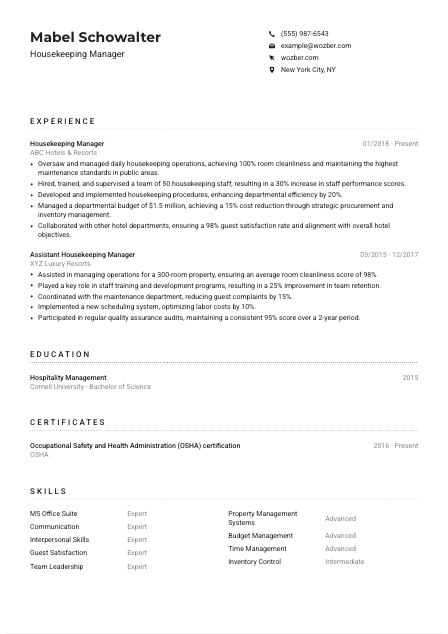
Do not stop at basic task descriptions like "managed housekeeping operations." Show what that management produced. The sample resume does this well by tying daily oversight to 100% room cleanliness, efficiency improvements, and high guest satisfaction. That kind of phrasing tells a hotel employer how you run a department, not just what sat in your job description.
Numbers give hotel operations context. Include team size, room count, audit scores, budget size, supply savings, labor efficiencies, complaint reduction, or guest satisfaction metrics when you have them. Examples such as managing a team of 50, overseeing a $1.5 million department budget, or cutting costs by 15% make your leadership scope much easier to understand.
Keep the focus on experience that strengthens your case for managing a housekeeping department. Earlier hospitality roles can stay if they show progression into supervision, quality control, scheduling, training, or cross-department coordination. If an older role adds no value to hotel operations, staff leadership, or service standards, trim it back.
Your experience section should show that you can run housekeeping as an operation, not simply participate in it. When your bullets cover standards, staffing, efficiency, and guest impact with clear metrics, employers can picture you leading the department from day one.
Education usually plays a supporting role in Housekeeping Manager hiring, but it still matters when it aligns with hospitality operations, service standards, or management training. Present it clearly, and let it reinforce your preparation for supervising people, processes, and guest-facing quality.
If the posting prefers a Bachelor's degree in Hospitality Management or a related field, make that easy to spot. When your degree matches directly, as it does in the example with a Bachelor of Science in Hospitality Management, it strengthens alignment without needing extra explanation.
List the degree, field of study, school name, and graduation year in a simple structure. Hiring teams reviewing hotel management resumes usually want to confirm the credential quickly and move back to your operating experience.
Spell out the exact degree and major rather than using vague shorthand. Hospitality Management, Hotel Administration, Business, or a related field can all be relevant, but precision helps the reader understand how closely your background connects to the role's preferred education.
If you are earlier in your career or your work history is lighter, you can include hospitality operations coursework, housekeeping administration, hotel finance, or service management projects. For experienced candidates, that detail is usually less important than your departmental results.
Academic honors, leadership roles, or projects are worth mentioning if they reflect management potential, training ability, or hospitality focus. Once you have several years of department leadership, keep this section concise and let experience carry more weight.
This section works best when it confirms your academic foundation without competing with your operational record. Clear degree details are enough for most experienced Housekeeping Manager candidates, especially when the rest of the resume already shows strong department leadership.
Certifications matter in housekeeping leadership when they connect to safety, compliance, and professional standards. They tell employers that you understand more than cleaning execution. You also understand training, risk reduction, and the procedures that keep a hotel running safely and consistently.
Put certifications tied directly to the posting near the top. In this case, OSHA knowledge and certification are specifically requested, so that credential should be prominent. It connects directly to safe chemical handling, workplace practices, and department compliance.
Choose certifications that support housekeeping management rather than listing every course you have completed. Industry-recognized credentials such as Certified Executive Housekeeper can add value because they reinforce leadership credibility, quality standards, and operational knowledge.
Show issue or validity dates when the certification is active, recent, or relevant to compliance. That helps employers see that your knowledge is current, especially for safety-related certifications or programs with renewal expectations.
Housekeeping managers often need to stay current on safety standards, staffing practices, sanitation expectations, and operational tools. A current certification section shows you continue to develop in the areas that affect inspections, training quality, and day-to-day department control.
Well-chosen certifications strengthen your resume when they connect clearly to hotel housekeeping leadership. Safety credentials and respected hospitality certifications can sharpen your profile, especially when they match the employer's stated requirements.
A Housekeeping Manager skills section should read like the toolkit behind a well-run operation. Focus on the skills that support staffing, property coordination, quality control, reporting, and guest satisfaction. Skip broad filler and choose capabilities you can back up with your work history.
Start with the specific capabilities the employer called out. For this role, that includes property management systems, MS Office Suite, communication, interpersonal skills, and OSHA-related knowledge. When those skills accurately reflect your background, using the same language helps both ATS screening and human review.
Housekeeping managers need both operational tools and people leadership. Include technical skills such as property management systems, inventory control, scheduling, and reporting, alongside management strengths like training, coaching, conflict resolution, and cross-department collaboration.
Do not overload this section with every skill you have used in hospitality. Prioritize the abilities most relevant to running a housekeeping department. The example resume handles this well by centering on guest satisfaction, team leadership, budget management, and property systems instead of generic catchall terms.
The best skill list reinforces the story your bullets already tell. When your resume shows both the systems and leadership side of housekeeping management, employers can quickly see how you would handle the pace and standards of the property.
Language ability can add real value in hospitality, especially in hotels with diverse staff and guests. For Housekeeping Managers, it matters most when it supports written communication, staff direction, training clarity, and smoother service across the property.
If the posting requires English, list it prominently and use an honest proficiency level. This role specifically asks for effective written English, so your resume should make that qualification easy to confirm.
After the required language, include any additional languages that improve communication with staff or guests. In many hotel settings, a second language can help with training, shift coordination, and issue resolution during busy operations.
Use clear labels such as Native, Fluent, Conversational, or Basic. Avoid overstating fluency. Housekeeping leadership depends on clear instructions and dependable communication, so honesty here matters.
Language value depends on the setting. In large urban hotels or multicultural teams, multilingual communication can be especially useful for staff supervision and guest interaction. That does not make extra languages mandatory, but it can strengthen your profile when relevant.
A language section carries more weight when it supports real hotel work. If Spanish or another language has helped you train team members, communicate standards, or improve service coordination, make sure the rest of your resume reflects that broader management capability.
For Housekeeping Manager roles, languages are most useful when they strengthen training, supervision, and guest service. Keep this section factual and relevant, and let it complement the operational story in the rest of your resume.
Your summary should quickly establish the level of housekeeping leadership you bring. In a few lines, show your experience level, the kind of operation you have managed, and the results you are known for. Save generic traits for later, or cut them entirely.
Read the posting closely before writing this section. For a Housekeeping Manager role like this one, the summary should reflect department oversight, team supervision, procedural improvement, budget awareness, and collaboration with other hotel functions. Build from those priorities instead of writing a one-size-fits-all hospitality intro.
Start with a direct statement of who you are professionally. The example summary does this effectively by leading with years in the hotel industry and a Housekeeping Manager identity. That gives immediate context before moving into results and strengths.
Use the next sentence to highlight your most relevant strengths and outcomes. Mention areas such as cleanliness standards, team leadership, efficiency improvements, guest satisfaction, budget management, or inventory control, depending on what your background genuinely supports.
Aim for a concise paragraph, usually three to five lines. Hotel hiring teams should be able to understand your leadership level and operational strengths before they even reach the experience section. Tight writing works better than a long overview full of repeated claims.
A strong summary gives a fast, credible picture of how you manage housekeeping operations. When it highlights experience, standards, and results in clear language, it prepares the reader to see the rest of the resume through the lens of proven hotel leadership.
When each section reflects the actual work of a Housekeeping Manager, your resume becomes much easier to trust. Hiring teams can see whether you have managed staff, protected cleanliness standards, handled budgets and supplies, and worked effectively with maintenance, front office, and other departments.
Use Wozber to tighten that alignment through ATS optimization, stronger job-specific phrasing, and a polished ATS-compliant resume that is easy to review. The finished document should make one thing clear right away: you know how to run a housekeeping department that supports both guest satisfaction and hotel performance.




