



Use Wozber and land your dream job
Create Resume
No registration required
Sweeping and scrubbing, but your resume seems grubby? Polish it with this Custodian resume example, created with Wozber free resume builder. Learn how to shine a light on your cleaning prowess in a way that matches job specs, leading your career path to the cleanest of horizons!
Custodian work is judged in the day-to-day details. Clean floors, sanitary restrooms, safe common areas, stocked supplies, and quick reporting when something is broken or hazardous. A resume for this field should make those habits visible right away. Hiring teams want to see that you can keep a facility clean, work safely with equipment and chemical solutions, and stay dependable when routines change across shifts, rooms, or building needs.
A tailored resume changes how quickly that reliability comes across, especially when an ATS scans for cleaning tasks, safety language, and experience depth. Wozber's free resume builder helps organize that language into an ATS-compliant resume that reflects the actual work you do, so the hiring team can quickly recognize your ability to maintain a clean, hazard-free environment.
For a Custodian, the header needs to answer practical questions immediately. Can this person be reached easily, are they local if the job requires it, and does the job title match the work they want? Keep this section clean, direct, and easy to confirm at a glance.
Use your full name in a clear, readable format at the top of the page. It should be easy to spot, just like every other operational detail on your resume. Avoid decorative styling that distracts from the content.
Place "Custodian" directly under your name if that is the role you are applying for. This helps the employer connect your resume to the opening immediately, and it supports ATS alignment when the posting uses that exact title.
Include a reliable phone number and a professional email address. If a supervisor wants to schedule an interview quickly for a facility role with shift coverage needs, your contact details should make that easy.
If the employer wants someone based in a specific area, include your city and state. In this example, listing Los Angeles, California directly supports a stated requirement and removes questions about commute or relocation.
A LinkedIn profile or professional website is optional for many custodial roles. Include one only if it is current and reinforces your work history, certifications, or facility experience. If the link adds no useful information, leave it off rather than sending hiring teams to an unfinished profile.
This section does not need personality copy or extra detail. It needs to confirm who you are, how to reach you, and whether you match straightforward requirements that can affect interview decisions early.




Experience is where custodial resumes earn trust. Employers want to see the type of spaces you maintained, the cleaning work you handled, how you followed safety practices, and whether you were dependable with routines, supplies, and reporting. Vague lines about being hardworking do not carry much weight here. Specific tasks and outcomes do.
Start by marking the cleaning and maintenance duties named in the job description. For this role, that includes sweeping, mopping, dusting, vacuuming, sanitizing trash receptacles, managing supply inventory, reporting safety issues, and coordinating cleaning schedules. Those should guide the language in your bullet points so your experience matches the work being hired for.
Put your most recent custodial or facility support role first. For each position, include the employer name, your title, and dates of employment. That structure helps a hiring manager quickly follow your progression from assistant-level support to independent custodial responsibility, as shown in the example resume.
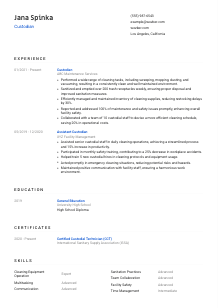
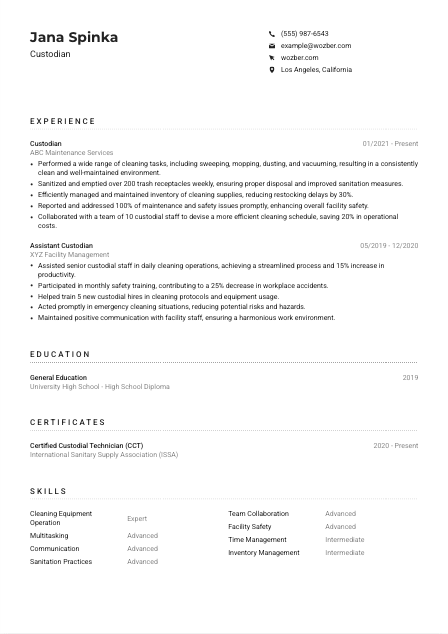
Custodial work is hands-on, so your bullets should reflect what you maintained, improved, or prevented. Instead of writing "responsible for cleaning," write what you cleaned, how often, and what result followed. The sample resume does this well by tying sanitation work to improved cleanliness, supply tracking to fewer restocking delays, and schedule collaboration to lower operating costs.
Quantifying results helps employers picture your workload and consistency. Good metrics for custodial resumes include number of rooms or receptacles serviced, cleaning frequency, stock delays reduced, accident reduction, inspection results, response times, or team size. Numbers such as sanitizing over 200 trash receptacles weekly or reducing restocking delays by 30% feel credible because they match how custodial work is managed.
Prioritize bullets that show cleaning operations, safe equipment use, teamwork, time management, sanitation, and issue reporting. If an older role includes unrelated tasks, keep only the parts that transfer well to facility upkeep or team coordination. This keeps attention on the work that matters most for a Custodian opening.
The best experience sections show that you can keep a building clean, stocked, and safe without constant supervision. When your bullets reflect actual cleaning routines, safety awareness, and reliable follow-through, the hiring case becomes much easier to make.
Education usually plays a supporting role on a Custodian resume, but it still needs to be accurate and easy to verify. When the posting asks for a high school diploma or equivalent, your resume should show that requirement plainly without making the reader search for it.
If the employer asks for a high school diploma or equivalent, list that credential clearly. For this opening, that requirement is explicit, so your education section should confirm it without extra wording or explanation.
Include the school name, diploma or degree, field if relevant, and graduation year or date. Custodial hiring rarely depends on elaborate academic detail, so clean formatting works best here.
If your highest relevant education is a High School Diploma, place it plainly in the section rather than burying it under unrelated coursework. The example resume handles this well by listing the diploma in a simple, readable format that directly matches the job requirement.
If you completed coursework or employer training in chemical handling, sanitation procedures, workplace safety, or facility maintenance, include it when it strengthens your fit. These details are especially useful when they connect to safe equipment use and hazard prevention.
Specialized training, workshops, or related achievements can support your candidacy even if they are not formal degrees. Safety instruction, cleaning protocol training, or custodial certifications can show that you take standards seriously and stay current with workplace practices.
This section does not need to be long. It needs to confirm the required credential and, where relevant, reinforce that you understand the safety and procedure side of custodial work.
Certifications matter most when they show practical custodial knowledge. Hiring teams pay attention to credentials that connect to sanitation, equipment handling, chemical safety, or workplace procedures because those areas affect daily performance and facility risk.
Choose certifications that reflect the real demands of the job. A credential such as Certified Custodial Technician supports your case because it points to recognized training in cleaning methods and facility standards, even when the posting does not require a certification by name.
List certificates that strengthen your fit for the target role, not every course you have ever taken. Safety, sanitation, equipment operation, and related facility credentials are more useful than general certificates with no connection to the work.
Show the issue date or active range, especially for certificates that need renewal or reflect current compliance. Recent or active credentials help employers see that your training is up to date.
Cleaning standards, safety expectations, and approved chemical practices can change over time. Ongoing training helps you stay effective on the job and gives your resume a practical edge, especially if you are applying to schools, healthcare sites, offices, or multi-use facilities with stricter procedures.
The right certificate tells an employer that you understand more than the basic tasks. It shows training in the methods and safety standards that keep a facility clean, compliant, and low-risk.
The skills section should read like a realistic snapshot of how you operate on the job. Focus on abilities that affect cleaning quality, safety, pace, and coordination with other staff. Generic soft skills without operational context are easy to overlook.
Start with the skills the employer names. Here, that includes cleaning equipment use, chemical handling, multitasking, time management, communication, teamwork, and safety protocols. Those are the terms most likely to matter in both ATS screening and human review.
List the skills you genuinely use and prioritize the ones central to the opening. The sample resume does this effectively by including Cleaning Equipment Operation, Sanitation Practices, Facility Safety, Inventory Management, and Team Collaboration, all of which map clearly to the job description.
Do not overcrowd this section with broad claims. Choose a concise set of skills that support the responsibilities in your experience section. When the skills, bullets, and summary all reinforce the same strengths, your resume feels consistent and credible.
A useful skills section helps the reader imagine you handling cleaning routines, working safely with supplies and equipment, and communicating issues before they become bigger problems. That is what makes the list matter.
Language matters in custodial work because the job involves following safety instructions, reading labels, understanding procedures, and communicating with supervisors or coworkers about schedules and hazards. This section should reflect those practical demands, not just add extra information for its own sake.
If the posting requires English, make that visible on your resume. In this job description, the employer specifically asks for someone who can understand and speak English, so your proficiency should be clearly stated.
List languages in order of job relevance. When English is required for instructions, signage, reporting, and coordination with staff, it should appear first with an accurate proficiency level.
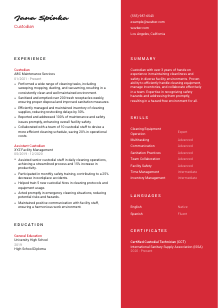
Extra language ability can be useful in facilities with diverse teams, tenants, visitors, or vendors. A second language is not always required, but it can support smoother communication in day-to-day operations. In the example resume, Spanish adds practical value in a large urban work environment.
Use clear levels such as Native, Fluent, Intermediate, or Basic. Honest language ratings matter because they affect real workplace communication, especially when discussing safety issues, cleaning requests, or procedure changes.
For custodial roles, language skills are most useful when they help you follow instructions, report maintenance concerns, and work well with staff across shifts or departments. Frame this section around communication on the job, not around general versatility alone.
When this section is handled well, it shows that you can understand directions, communicate concerns, and work smoothly with others in the facility. That is the real hiring value.
Your summary should quickly tell the employer what kind of Custodian you are. Focus on experience level, the type of work you handle well, and the operational strengths that matter most in facility cleaning. Keep it specific enough to feel real and short enough to read in seconds.
Read the posting and identify the few requirements that define success in the role. For a Custodian, that often means routine cleaning, safe handling of equipment and chemicals, time management, teamwork, and hazard awareness. Those points should anchor your opening lines.
Lead with your title and years of relevant experience. A line such as "Custodian with over 3 years of hands-on experience" works because it gives immediate context and positions you within the field before you move into specifics.
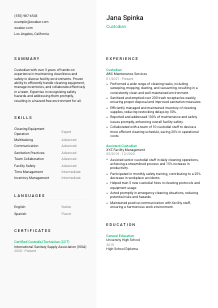
Use the next lines to highlight the capabilities most relevant to the opening. In this case, safe cleaning practices, inventory awareness, communication with staff, and prompt reporting of maintenance or safety issues all align well with the job description. The sample summary handles this by focusing on cleanliness, safety, collaboration, and hazard recognition.
Aim for a short paragraph of 3 to 5 lines. Skip broad adjectives and use role-specific language instead. A concise summary with terms like sanitation, cleaning equipment, hazard-free environment, and inventory management will do more for a custodial resume than generic claims about passion or dedication.
A sharp summary gives the employer an immediate read on your experience, your safety mindset, and the kind of facility support you can provide from day one. That sets up the rest of the resume well.
A Custodian resume works best when it reflects the real job. Show the cleaning tasks you handle, the safety standards you follow, the supplies and equipment you manage, and the way you communicate maintenance or hazard issues. When those details are specific and aligned with the posting, your experience becomes much easier to trust.
Wozber's free resume builder can help you turn that experience into a clean, ATS-friendly resume format, and Wozber's ATS resume scanner can highlight missing requirements, improve ATS optimization, and strengthen alignment section by section. The final result should make one thing clear fast: you can keep the facility clean, safe, and running smoothly.




