



Use Wozber and land your dream job
Create Resume
No registration required
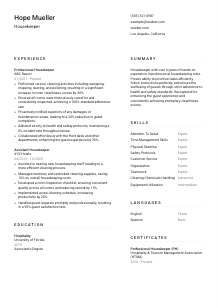
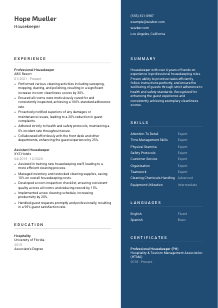
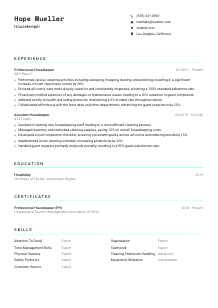
Keeping houses spotless, but feel your resume's a bit dusty? Brush up with this Housekeeper resume example, made with Wozber free resume builder. It shows how easily you can present your cleaning skills to match job requirements, ensuring your career shines as bright as a freshly scrubbed surface!
Housekeeping work is judged in the room long before anyone asks how you did it. Cleanliness standards, turnaround speed, safe chemical handling, and the ability to catch maintenance issues all shape whether guests feel comfortable and operations stay on track. Your resume should reflect that same standard of execution by showing how you maintain quality, follow procedures, and keep service consistent across every shift.
When housekeeping resumes are tailored well, hiring teams can quickly distinguish someone who has simply cleaned spaces from someone who can work to inspection standards, coordinate with front desk staff, and keep pace during busy service windows. Wozber's free resume builder helps you align your wording with the posting and build an ATS-compliant resume that clearly shows your cleaning scope, safety habits, and guest-support experience. That clarity matters when the role depends on dependable room readiness every day.
For housekeeping roles, the top of the resume should feel orderly and practical. This section is short, but it still does important work by showing basic professionalism, clear contact details, and any location requirement the employer has named.
Place your full name at the top in a clear, readable format. Keep it simple and professional. Housekeeping hiring often moves quickly, and your resume should make the basics easy to read at a glance.
Add the job title directly under your name if it matches the role you are applying for. Using "Housekeeper" immediately connects your resume to the opening and helps reinforce relevance in both ATS searches and human review.
Include a reliable phone number and a professional email address. Avoid outdated or casual email handles. In jobs where shifts, interviews, and trial days may be scheduled quickly, accurate contact information matters more than extra personal details.
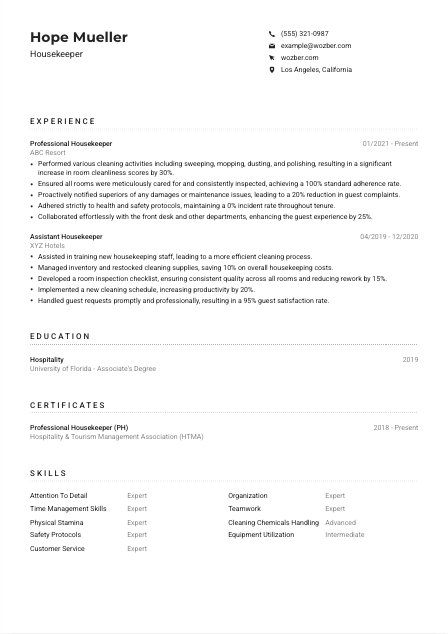
If the employer specifies a city or region, include your location clearly. In this example, listing Los Angeles, California helps answer a stated requirement right away. If you are relocating, note that plainly instead of leaving the employer to guess.
A LinkedIn profile or personal website is optional for many housekeeping roles. Include one only if it supports your application with consistent work history, hospitality experience, or recommendations. If you add it, make sure the job titles and dates match your resume exactly.
This section should remove friction, not add it. Clear contact details and a location match help the hiring team move quickly to what matters next: your cleaning experience, reliability, and ability to work to standard.




Experience usually carries the most weight on a housekeeper resume because it shows how you work under real room standards, real time pressure, and real guest expectations. Focus less on broad descriptions and more on the tasks, results, and service habits that prove you can handle the pace.
Start with roles that show direct housekeeping work, room care, inspections, replenishment, sanitation routines, or hospitality support. If the employer asks for at least 2 years of professional housekeeping experience, make that timeline easy to see. In the example, the progression from Assistant Housekeeper to Professional Housekeeper makes the required experience level obvious.
For every role, include job title, employer, and dates in a consistent format. Recent work should come first. Clean structure matters here because hiring managers often scan for property type, length of service, and whether your background comes from hotels, resorts, private homes, or commercial settings.
Housekeeping work is hands-on, but that does not mean your bullets should read like a generic task list. Show what your work improved. Strong examples include room cleanliness scores, inspection pass rates, faster turnover, fewer guest complaints, better supply control, or stronger productivity across shifts. The sample resume does this well with results like a 30% increase in cleanliness scores and a 20% reduction in guest complaints.
Employers do not only want someone who can clean. They also need someone who handles chemicals safely, reports damages or deficiencies promptly, and works smoothly with front desk teams or supervisors. Bullets about zero safety incidents, maintenance reporting, or guest-request follow-up show that you understand the operational side of housekeeping.
Remove accomplishments that do not support your target role. Prioritize points that show inspection standards, efficiency, stamina, guest support, teamwork, and consistency. Even if you have broader hospitality experience, the strongest bullets will still come back to room readiness, cleanliness quality, and dependable execution.
A hiring manager should be able to picture your workday from this section: how you cleaned, what standards you met, how you handled issues, and what improved because of your work. That is the kind of experience record that stands out in housekeeping hiring.
Education is usually secondary to experience in housekeeping, but it can still strengthen your resume when it connects to hospitality, sanitation, customer service, or workplace safety. Keep it concise and relevant so it supports your practical background without competing with it.
List your diploma, GED, associate degree, or higher credential in a simple format. Even when a posting does not require formal education, including it shows completion, consistency, and basic professional background.
Use a straightforward structure with degree, school, field of study if relevant, and graduation year. For a housekeeping resume, clean formatting matters more than a long academic description. The sample entry, an Associate's Degree in Hospitality, is a good example of brief and useful presentation.
Coursework or degrees in hospitality, hotel operations, sanitation, or guest services can reinforce your understanding of service environments. This is especially useful if your work history is shorter or if you are moving into housekeeping from another service role.
If you are early in your career, a few targeted course names can add context. Safety procedures, facility operations, housekeeping management, or customer service training are more useful here than unrelated classes.
Honors, scholarships, or campus activities are optional. Include them only if they add something meaningful, such as leadership, reliability, or hospitality involvement. Keep the focus on information that supports your ability to work in a service-driven, standards-based environment.
For most housekeeping applications, education should support the story rather than lead it. A short, relevant entry is enough to round out your background and keep attention on your work performance.
Certifications are not always required for housekeeping jobs, but the right one can reinforce your training in cleaning standards, sanitation, or hospitality operations. They are especially helpful when they connect directly to safety, procedures, or service quality.
List credentials that relate to housekeeping, cleaning procedures, hospitality service, infection control, or workplace safety. A certification such as Professional Housekeeper fits naturally because it supports the kind of structured cleaning and standards-driven work employers expect.
A short list of role-related certificates is better than filling space with unrelated training. Employers should be able to see right away that the credential adds practical value to room care, sanitation, or guest service.
Show the issue date and, if relevant, the renewal period. This is useful for certificates tied to current standards or ongoing training. In the sample resume, the active date range helps show the credential is still current.
Cleaning methods, safety expectations, and sanitation protocols can change over time, especially in hospitality settings. Adding recent certification activity shows that you stay current with procedures and take structured training seriously.
Certifications work best when they reinforce the practical demands of the job: safe cleaning, consistent standards, and dependable service. If a credential helps prove that, it deserves a place on the resume.
A housekeeping skills section should read like the toolset you actually use on the job. That includes physical and procedural strengths such as time management, safe chemical use, inspection awareness, and teamwork with other departments.
Start with the language used in the job ad. If it asks for attention to detail, time management, physical stamina, safe handling of cleaning chemicals, and the ability to follow instructions, those should appear on your resume when they match your experience. This improves both relevance and ATS alignment.
Balance operational skills such as mopping, dusting, polishing, equipment use, and safety protocols with workplace skills like organization, teamwork, and customer service. Housekeeping often sits close to the guest experience, so both types matter.
If your skills list is long, group related abilities together or order them by importance to the role. The example combines detail orientation, stamina, safety protocols, customer service, and chemical handling, which gives a fuller picture of day-to-day capability without becoming cluttered.
Every skill listed here should show up somewhere else in your resume through experience, training, or measurable results. That consistency makes your qualifications easier to trust and easier to shortlist.
Language ability can matter in housekeeping because the work often involves guest requests, supervisor instructions, safety communication, and coordination with front desk or maintenance teams. Present languages clearly, with honest proficiency levels.
If the posting states that English fluency is required, list English at the top with an accurate proficiency level. That answers a non-negotiable requirement immediately and helps avoid unnecessary screening delays.
Additional languages can strengthen your application in hotels, resorts, and large service environments where staff and guests may come from different backgrounds. Even basic or conversational ability can be worth listing if it is accurate and relevant to the workplace.
Use clear labels such as Fluent, Conversational, Basic, or Native. Avoid overstating what you can do. In housekeeping, misjudging your language level can create problems with instructions, guest communication, or safety procedures.
Extra languages are especially useful when the role involves guest interaction, handling service requests, or working in multilingual teams. Spanish, for example, may be valuable in some hospitality settings, but it should be presented as an added strength rather than a substitute for required English fluency.
You do not need a long explanation here. A simple list with accurate proficiency gives hiring teams the information they need and keeps the focus on how you can communicate on the job.
For housekeeping roles, language skills are practical, not decorative. List them clearly so employers can understand how well you can follow instructions, support guests, and work smoothly with the team.
Your summary should sound like someone who can step into a cleaning schedule, maintain room standards, and support the guest experience from day one. Keep it brief, but make sure it reflects the parts of housekeeping work that employers actually prioritize.
Read the posting closely before writing your summary. If the role emphasizes detail, time management, stamina, safe chemical use, and coordination with other departments, those are the themes your opening lines should reflect.
Open with your years of relevant experience and the type of environment you have worked in, such as hotels, resorts, private residences, or commercial properties. The sample summary starts well by establishing more than 4 years of hands-on housekeeping experience right away.
Choose strengths that matter in daily operations, such as maintaining inspection-ready rooms, following health and safety procedures, prioritizing cleaning tasks efficiently, or supporting guest satisfaction through dependable service. Make these strengths specific enough to feel earned.
Three to five lines is usually enough. Use direct language instead of broad claims. A hiring manager should finish the summary with a clear sense of your experience, your working style, and the standards you are used to meeting.
A well-written summary gives immediate context for the rest of your resume. For housekeeping, that means making your service environment, consistency, and standards-driven work clear in just a few lines.
A housekeeper resume works best when it is as organized and dependable as the work itself. Use clear section structure, mirror the posting's language where it matches your real experience, and show results through cleanliness scores, inspection performance, guest satisfaction, safety records, or efficiency gains.
Wozber's AI resume builder can help you tailor phrasing, surface missing requirements, and strengthen ATS optimization while keeping your resume in an ATS-friendly resume format. Pair that with careful editing, and your application will make it much easier for employers to judge whether you can keep rooms ready, report issues promptly, and support a smooth guest experience from the first shift.




