



Use Wozber and land your dream job
Create Resume
No registration required
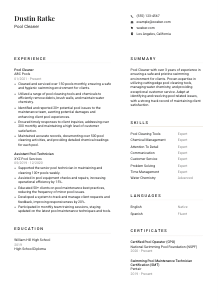
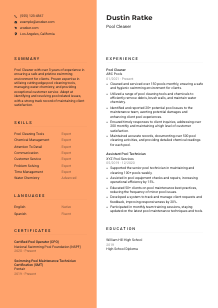
Keeping crystal-clear waters spotless, but your resume feels murky? Filter through this Pool Cleaner resume example, created with Wozber free resume builder. Learn how to bring your maintenance and sanitization skills to the surface and make waves with hiring managers, ensuring your career path always makes a splash!
Pool cleaning is hands-on maintenance work where small misses become visible fast. Cloudy water, unbalanced chemistry, a neglected skimmer basket, or an unchecked pump can turn into a safety issue, equipment damage, or an unhappy client. Your resume should make that practical responsibility clear by showing that you maintain clean pools, stable water conditions, and dependable service routes.
A tailored resume helps separate general maintenance experience from actual pool service experience. When your job title, water chemistry work, equipment checks, certification, and client-facing responsibilities match the posting in an ATS-friendly way, hiring teams can quickly see that you understand the daily work. Wozber's free resume builder helps organize that content into an ATS-compliant resume that surfaces the details that matter first, from chemical readings to customer communication.
Pool service employers usually start with simple checks. Can they reach you quickly, are you local enough to cover the route, and does your resume immediately show that you work in pool maintenance rather than general cleaning? Keep this section clean, direct, and aligned with the job posting.
Use your full name in a clear font that stands out from the rest of the page. This section does not need decoration. It needs quick readability, especially when a manager is scanning several resumes for field service candidates.
Place the role title directly under your name when you are applying for a specific opening. "Pool Cleaner" works well here because it immediately aligns your resume with the position and avoids any doubt about whether your background is in janitorial work, landscaping, or another maintenance trade.
Include a current phone number and a professional email address you check regularly. Pool service hiring often moves quickly, especially when routes need coverage, so one typo in your phone number can cost you an interview.
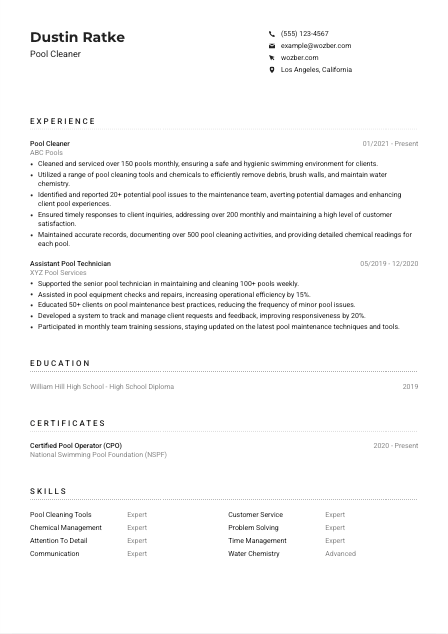
If the employer wants someone based in a specific area, include your city and state in this section. In the example, listing Los Angeles, California directly supports the local requirement. For other applications, tailor this only when location affects scheduling, travel time, or route availability.
A website or LinkedIn profile is optional for this role. Add it only if it is current and supports your experience, such as showing certifications, work history, or service business details. If it is sparse or outdated, leave it off and keep the section focused.
Your personal details should answer the basic operational questions right away: who you are, what role you want, how to contact you, and whether you meet any location requirement tied to the route.




This is where a pool cleaner resume earns credibility. Employers want to see the work itself: cleaning routines, water testing, chemical balancing, equipment checks, recordkeeping, and how you handled client communication while staying on schedule.
Before rewriting your experience, mark the duties that define the job. For pool cleaning roles, that often includes debris removal, brushing walls, emptying skimmer baskets, adjusting chemicals, spotting equipment problems, and responding to client concerns. Those are the tasks your bullets should reflect if you have done them.
Start with your latest position and work backward. For each role, include job title, company name, and dates. If your titles vary, such as "Pool Cleaner," "Pool Technician," or "Assistant Pool Technician," keep the wording accurate but make sure the bullets clarify your actual pool service responsibilities.
Do not stop at "responsible for pool cleaning." Show the scope and result of the work. The example does this well with details like servicing more than 150 pools monthly, maintaining water chemistry, and reporting more than 20 potential issues before they became larger problems. That tells an employer you can handle routine service and catch trouble early.
Metrics matter here because they show pace and reliability. Useful numbers include pools serviced per week or month, response volume, issue reduction, maintenance efficiency, or recordkeeping volume. Even simple figures like "documented chemical readings for 500+ service visits" make your work more concrete than vague claims about quality.
Prioritize pool cleaning, maintenance, or technician experience. If you include other roles, connect them to route work, customer service, equipment handling, or physical outdoor work. The hiring manager should spend most of their time reading about pool care, water quality, and client-facing service, not side jobs that do not support the target role.
Your experience section should show that you can maintain pools consistently, manage chemistry safely, notice equipment or surface issues early, and handle clients professionally while keeping records straight.
Education is usually a supporting section for pool cleaning roles, but it still matters when it confirms your baseline qualifications and any training connected to water care, safety, or service work. Keep it simple and relevant.
If the employer does not ask for advanced schooling, list your highest completed education plainly. A high school diploma is often enough for this kind of role, as long as the rest of the resume shows hands-on pool maintenance experience and the right certification.
Include the school name, credential, and graduation year or date. This section should be easy to scan. For field roles like pool service, hiring teams rarely want extra detail unless your coursework connects directly to water systems, safety, chemistry, or technical maintenance.
If you completed classes in chemistry, facility maintenance, environmental health, or customer service, you can mention them when they strengthen your pool service profile. Keep the connection practical, such as understanding water balance, safe chemical handling, or routine maintenance procedures.
Clubs, projects, or extracurriculars belong here only if they support the role. Something tied to science, facilities, athletics, or service work can help early-career candidates show responsibility and hands-on involvement. If it is not clearly relevant, leave it out.
Short workshops or local courses in water treatment, safety practices, or customer service can appear here if they are not formal enough for the certificates section. Keep the focus on training that improves pool cleaning work, compliance, or client communication.
For this role, education should quietly support the main story: you have the basic schooling, the right training where relevant, and the hands-on experience to maintain pools safely and reliably.
Certifications carry real weight in pool service because they show you understand safe operations, water treatment standards, and the compliance side of the work. When a posting names a required credential, this section becomes one of the first things reviewed.
Start with any credential the employer specifically asks for. Here, a valid Certified Pool Operator credential or equivalent state-specific certification should appear at the top so there is no doubt that you meet a key requirement.
Prioritize credentials tied to pool operation, water chemistry, equipment care, or safety. The example includes both CPO and a pool maintenance technician certification, which reinforces hands-on credibility. General certifications can stay secondary unless they directly support the job.
Include the issue date or validity period so employers can tell whether your certification is active. For roles involving chemical handling and pool safety, outdated credentials create unnecessary questions, while current ones show that your training is recent enough to trust.
Pool care methods, equipment, and local health expectations can change, so recent training is worth mentioning. If you have completed refresher courses on water testing, chemical application, filtration systems, or safety procedures, include them when they strengthen your profile.
When this section is handled well, it tells an employer that you are qualified to work around pool systems and chemicals with the level of training the job requires.
A pool cleaner skills section should read like a working toolkit, not a generic list of positive traits. The best mix combines technical pool care skills with the client-facing abilities needed for route service work.
Start with the technical and service skills that show up in pool cleaning jobs: pool cleaning tools, chemical handling, water chemistry, equipment checks, issue spotting, customer communication, and recordkeeping. These are more useful than broad terms that could belong on any resume.
This role usually requires both. You may be testing chlorine and pH levels one hour and answering a homeowner's concern the next. A good list might combine water chemistry, chemical management, and pool equipment familiarity with communication, customer service, time management, and problem solving.
Keep the section focused. If a skill does not help you clean pools, maintain safe water, manage a route, or serve clients well, it probably does not belong. The example stays close to the work by listing items such as pool cleaning tools, water chemistry, attention to detail, and customer service.
A focused skills section should make it obvious that you can handle both the technical side of pool maintenance and the service expectations that come with working on client properties.
Language ability matters in pool service when it affects safety, client communication, and day-to-day route work. If a posting names a required language, make that easy to find.
Check the posting for explicit language expectations and list those first. In this case, English fluency is essential, so it should appear clearly with an honest proficiency level. That tells the employer you can understand instructions, discuss service issues, and document visits accurately.
Order languages by relevance to the job, not by preference. If English is required, it belongs first. If you also speak another language commonly used with local clients, that can be a practical advantage in service roles where clear communication affects trust and repeat business.
Extra languages are worth listing when they help you communicate with a broader customer base. In some markets, bilingual ability can make day-to-day interactions smoother, especially when explaining service notes, chemical concerns, or scheduling changes.
Be specific about your level, whether that is native, fluent, conversational, or intermediate. Avoid overstating your ability. In customer-facing maintenance work, inaccurate language claims become obvious quickly when you need to answer questions or explain pool conditions.
List only languages you can actually use in a work setting. The value here is straightforward communication, whether that means understanding safety instructions, recording service details, or speaking clearly with homeowners and property managers.
For a pool cleaner, language skills matter when they help you explain service work clearly, respond to concerns, and keep communication smooth at each property.
The summary should quickly tell an employer whether you already work at the level the job requires. For pool cleaning roles, that means experience with routine service, water chemistry, equipment awareness, and dependable client interaction.
Open with your job title and years of relevant experience. If you have 1+ year in pool cleaning or maintenance, say so plainly. This immediately answers one of the first screening questions without making the reader search through the page.
Use the next line to cover the technical side of your background. Mention the areas that are central to the job, such as pool cleaning, chemical balancing, water testing, equipment monitoring, or service recordkeeping. Keep it tied to work you can support in your experience section.
A strong summary can mention issue detection, client satisfaction, route volume, or dependable maintenance standards. The example summary works because it pairs technical ability with customer service and problem spotting, which are both central to pool route work.
Aim for three to five lines. That is enough room to establish your experience, your technical focus, and your approach to service without repeating your entire work history. Save the deeper detail for your bullet points.
A good summary should tell the reader, in a few lines, that you know how to keep pools clean, water balanced, equipment watched, and clients informed.
When your resume shows real pool service work, current certification, local availability where required, and clear results from your route or maintenance work, the hiring decision becomes easier. The employer can quickly see whether you can handle cleaning routines, water chemistry, equipment checks, and customer communication.
Use Wozber to shape that experience into an ATS-friendly resume format, strengthen wording with job-specific terminology, and check alignment with the posting through ATS optimization tools. The final version should make one thing clear right away: you are ready to maintain pools safely, consistently, and professionally.




