



Use Wozber and land your dream job
Create Resume
No registration required
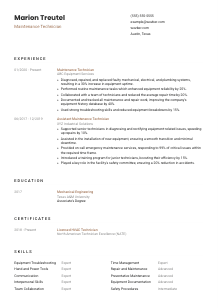
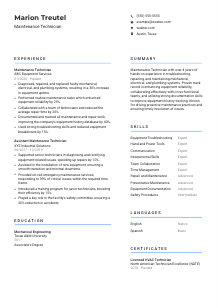
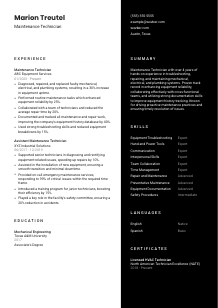
Keeping things in top shape, but your resume feels a bit rusty? Buff it up with this Maintenance Technician resume example, created with Wozber free resume builder. Learn how to showcase your repair prowess to match job specifications, putting your maintenance career in prime condition!
Maintenance technicians are trusted to keep equipment running, respond fast when systems fail, and prevent small issues from turning into production delays, safety risks, or tenant complaints. A resume for this work needs to show practical range, from troubleshooting mechanical and electrical faults to completing routine preventive maintenance and documenting what was done.
When that background is tailored to the opening, the hiring team can quickly see whether you match the maintenance environment they need, and an ATS-compliant resume is more likely to surface the right terms for repair work, PM tasks, and service documentation. Wozber's free resume builder helps organize that language cleanly so your resume reads clearly in ATS screening and makes your hands-on maintenance record easy to judge.
Maintenance hiring often moves quickly, especially when a team needs dependable coverage for scheduled upkeep, urgent repairs, and on-site support. Your personal details should make it easy to contact you, confirm your target role, and see any location requirement that matters for the opening.
Use your full name at the top in a clean, readable format. Keep it more prominent than the body text so the resume header is easy to scan on a phone, in a PDF, or in an ATS preview.
Use the exact job title "Maintenance Technician" if that is the role you are pursuing. This creates immediate alignment and helps separate you from adjacent profiles such as facilities assistant, service technician, or mechanic when the employer is screening for maintenance-specific experience.
Include one phone number and a professional email address you check regularly. In maintenance hiring, interviews can be scheduled fast to cover shift gaps or urgent operational needs, so make sure every contact detail works the first time.
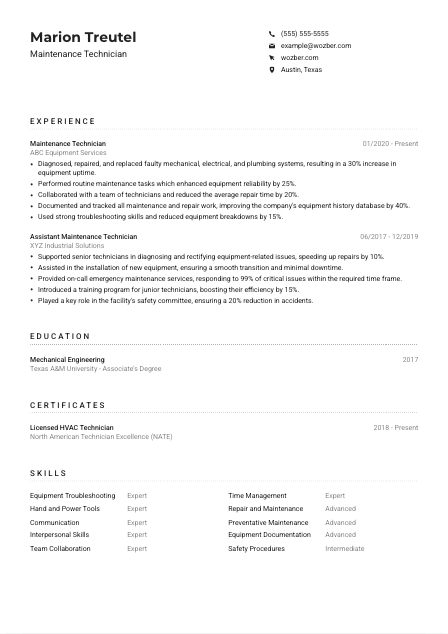
If the posting requires you to be in a certain city or open to relocation, reflect that clearly in this section. In the example, listing Austin, Texas supports a stated location requirement and prevents unnecessary questions about availability for on-site work.
Include LinkedIn or a professional site only if it supports your application with consistent work history, certifications, or technical background. A maintenance resume does not need a portfolio unless you have something useful to show, such as facilities projects, trade credentials, or equipment-focused work history.
This section should answer the practical basics at a glance: who you are, what role you do, how to reach you, and whether you meet any location expectation tied to the job.




This is where hiring managers look for proof that you can keep systems operating, diagnose faults efficiently, and work safely under real service conditions. Your bullets should show the equipment you handled, the maintenance work you performed, and the operating results you improved.
Read the responsibilities closely and build bullets around the same kind of work. For a maintenance technician, that usually means preventive maintenance, troubleshooting, repair, replacement of worn components, work order response, and maintenance documentation. In the example, the strongest bullets map directly to those areas by covering mechanical, electrical, and plumbing repairs, routine upkeep, and tracking completed work.
List jobs in reverse chronological order with your title, employer, and dates. That straightforward structure matters in maintenance hiring because reviewers want to quickly understand how recently you worked in the field, how your responsibilities progressed, and whether you have the 3+ years of experience many openings request.
Do not stop at "performed maintenance" or "handled repairs." Show what your work changed. Good maintenance bullets mention equipment reliability, downtime reduction, response time, work order completion, safety outcomes, or service continuity. The example does this well with statements like increasing equipment uptime by 30% and improving reliability by 25%.
Numbers are especially persuasive in this field when they reflect operational performance. Use measures such as uptime, mean repair time, preventive maintenance completion, breakdown reduction, safety incidents, response compliance, or documentation accuracy. The sample's 20% faster repair time and 99% emergency response rate are useful models because they describe how maintenance performance is commonly judged.
A plant, apartment community, hospital, hotel, or commercial facility may all hire maintenance technicians, but they do not emphasize the same systems. Keep bullets that match the opening's environment and trim the rest. If the employer stresses troubleshooting equipment and documenting repairs, make those items visible before less relevant tasks.
Your experience section should show that you can diagnose issues, complete repairs safely, handle preventive maintenance consistently, and keep operations moving with clear documentation and solid teamwork.
Hands-on maintenance experience usually carries the most weight, but education still helps establish your technical base. Present it clearly, especially when the posting asks for a high school diploma, equivalent training, or a related technical program.
If the job asks for a high school diploma or equivalent, make sure your education section clearly covers that baseline. If you also have a degree or technical training beyond that, include it because it adds depth to your mechanical or systems knowledge.
List the school, credential, field of study, and graduation year or date. Maintenance resumes benefit from simple formatting because reviewers are usually moving quickly between experience, certifications, and skills rather than looking for elaborate academic detail.
Mechanical engineering, industrial maintenance, HVAC, electrical technology, plumbing, and related trade programs all strengthen your profile when they match your actual experience. In the example, an Associate's Degree in Mechanical Engineering supports the candidate's troubleshooting and repair background without replacing the need for field experience.
If you are early in your career, selected coursework can help fill in technical context. Focus on subjects that relate to maintenance work, such as electrical systems, fluid power, motors, building systems, safety practices, or preventive maintenance. Skip general classes that do not support the role.
For experienced maintenance technicians, education should confirm your technical foundation rather than dominate the page. Keep the section concise and let your repair history, equipment knowledge, and maintenance results carry the main argument.
This section should quietly reinforce that you have the training base for the work, whether that comes from a diploma, trade program, associate degree, or other relevant technical study.
Certifications matter most when they connect directly to the systems you maintain. They can help tip the decision when an employer needs added confidence in your HVAC, electrical, plumbing, or safety knowledge.
If a job mentions HVAC, Electrical, or Plumbing certification as a plus, move any matching credential into clear view. This helps the hiring team connect your trade knowledge to the systems they need serviced, even when certification is preferred rather than required.
Choose certifications that strengthen your maintenance profile instead of listing every course or badge you have earned. Licenses and technical credentials tied to equipment repair, building systems, safety, or regulated trade work carry more weight than generic training.
Many trade credentials need renewal or continuing education. Add the issue date and, when relevant, the current validity period so employers can see that the qualification is active. The example's HVAC credential works well because it shows both the specialization and that it remains current.
Maintenance work changes with the site and equipment mix. If you are moving toward more HVAC-heavy, electrical, or plumbing-intensive roles, updated certifications can strengthen your profile and open access to broader maintenance scope or higher-responsibility assignments.
Well-chosen certifications tell employers where your technical depth sits and which systems you are prepared to maintain, troubleshoot, or repair with greater confidence.
A maintenance skills section should read like a practical toolkit, not a generic list. The best version balances technical abilities, safe work habits, and the communication skills needed to coordinate repairs, updates, and service requests.
Start with the language used in the posting. If it asks for equipment troubleshooting, repair, preventive maintenance, hand and power tool use, and communication skills, those belong near the top if they match your background. That is more effective than adding broad filler terms that do not tell anyone what you can fix or maintain.
Prioritize capabilities tied to daily maintenance output, such as diagnosing faults, replacing worn components, completing PM routines, reading manuals or schematics, documenting service activity, and following safety procedures. In the example, the strongest skills are the ones directly tied to troubleshooting, repair and maintenance, preventative maintenance, and equipment documentation.
Keep the list easy to scan and weighted toward the work itself. You can separate technical skills from workplace skills if that helps, but the final mix should still reflect the role. For maintenance technicians, teamwork and communication matter because repairs often involve operators, supervisors, tenants, or other technicians, yet those skills should support, not overshadow, your technical capability.
Anyone reading this section should immediately understand the systems you can troubleshoot, the maintenance work you can perform, and the reliability you bring to day-to-day operations.
In maintenance roles, language ability matters most when it affects work orders, safety instructions, technician handoffs, tenant communication, or written updates in a tracking system. List languages in a way that reflects how you actually use them on the job.
If the job asks for English for business communication, list English clearly with an honest proficiency level. That requirement usually connects to documenting repairs, reading instructions, updating supervisors, and communicating issues accurately during service calls.
Place your strongest language first, then list any others in descending proficiency. This keeps the section easy to scan and shows immediately how you can communicate in the workplace.
Extra languages can help in environments where you work with diverse crews, residents, vendors, or customers. They are a plus when they support smoother service communication, even if they are not a core hiring requirement.
Use realistic levels such as native, fluent, professional, conversational, or basic. Overstating language ability can create problems in settings where maintenance instructions, safety procedures, or service explanations need to be clearly understood.
Only give this section space if language ability affects the role in a practical way. In some maintenance settings, that means business English for documentation and shift communication. In others, an additional language may help with resident requests, vendor coordination, or bilingual teams.
This section should make it easier to see how you communicate on the job, especially when the role involves written maintenance records, team coordination, or direct service communication.
Your summary should sound like someone who has spent time solving equipment problems, not like a string of resume buzzwords. In a few lines, show your years of experience, your technical coverage, and the maintenance outcomes you are known for delivering.
Start with your title and years of experience so the reader can place you immediately. A line such as "Maintenance Technician with over 4 years of hands-on experience" works because it quickly covers role identity and level, which matters when the job asks for a minimum experience threshold.
Follow with the types of equipment or systems you maintain, troubleshoot, and repair. Mechanical, electrical, and plumbing coverage is especially relevant when those systems appear in the posting, and it tells the employer you can work across common maintenance demands rather than in only one narrow area.
Choose two or three details that reflect the opening, such as preventive maintenance, timely issue resolution, documentation, teamwork, or communication with other departments. The example summary is effective because it ties technical repair work to equipment reliability, cross-functional collaboration, and maintenance tracking.
Aim for a short paragraph of three to four sentences. Every line should add hiring value by clarifying your maintenance scope, reliability, and work results. Avoid generic claims and use wording that sounds grounded in service calls, PM schedules, repairs, and uptime.
By the time someone finishes this section, they should understand your experience level, the systems you maintain, and the kind of maintenance performance they can expect from you.
A maintenance technician resume works best when it makes your repair scope, preventive maintenance habits, documentation discipline, and response reliability easy to see. Keep your wording close to the job description where it reflects real experience, and make sure your bullets show operational results such as uptime, faster repairs, safer work, or fewer breakdowns.
Wozber's free resume builder gives you a clean ATS-friendly resume format for organizing that experience, and its ATS resume scanner can help you spot missing role terms, tighten alignment, and strengthen section-by-section ATS optimization. The finished resume should make one thing clear right away: you can keep equipment running and handle maintenance issues with confidence.




