



Use Wozber and land your dream job
Create Resume
No registration required
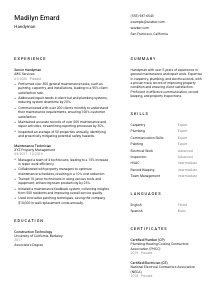
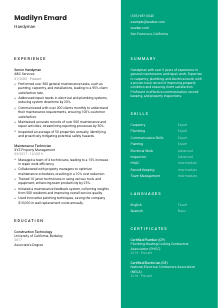
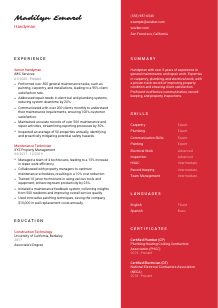
Nailing jobs, but your resume feels loose? Check out this Handyman resume example, created with Wozber free resume builder. It shows how to tighten up your all-around skills for specific job requirements, making sure your career fits as snugly as a perfectly fixed hinge!
Handyman work gets evaluated in the real world by what gets fixed, how safely it gets fixed, and whether tenants, homeowners, or property managers trust you to handle the next issue without friction. A resume for this field needs to show practical range across maintenance tasks, sound judgment around electrical, plumbing, or HVAC concerns, and a steady record of completing work that keeps properties functional.
Screening often moves quickly because many applicants can claim
For handyman roles, the contact section does more than identify you. It confirms basic hiring requirements that can affect whether your application moves forward, including job title alignment, location, and a reliable way to reach you for service-based work.
Put your name at the top in a clean, easy-to-read format. Hiring teams and property managers often review resumes fast, so your header should be simple, legible, and immediately identifiable without decorative styling.
Place
Add a phone number you answer regularly and a professional email address. For handyman roles, missed calls can mean missed interviews or trial shifts, so accuracy matters more than flair. If you include a website or profile, make sure it supports your trade background with project photos, service history, or related experience.
If the employer wants someone based in a specific city, include that in your header. In the example, listing San Francisco, California directly supports the stated location requirement and removes doubt about availability for local property visits or short-notice repair calls.
A LinkedIn page is optional for many hands-on trade roles, but it can help if it reinforces your maintenance background, certifications, or property work. Skip empty or outdated profiles. Every link should strengthen the picture of someone ready to handle repair requests, inspections, and client communication.
This section should confirm that you are reachable, local if required, and applying for the right kind of work. When those basics are clean, the reader can move straight to your maintenance experience.




This is where a handyman resume earns attention. Employers want to see the kinds of properties you supported, the systems you worked on, the volume of maintenance handled, and whether your work improved safety, response time, tenant satisfaction, or repair efficiency.
Start by marking the responsibilities that appear most often in the description. For handyman roles, that usually includes general maintenance, repairs across multiple systems, inspections, client communication, and record-keeping. Then shape your bullets so those priorities are visible in your own work history, using the same terminology where it reflects real experience.
Show your most recent work first, with title, company, and dates. If your title was Maintenance Technician, Facilities Technician, or Senior Handyman, keep the original title and let the bullets clarify the overlap. This helps hiring teams see both progression and hands-on trade scope.
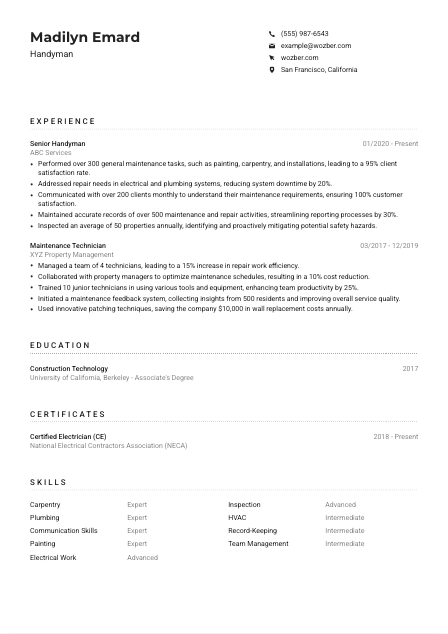
Your strongest bullets should show what you repaired, installed, inspected, or improved. The example does this well by pairing broad maintenance work with outcomes, such as completing over 300 tasks and reaching a 95% client satisfaction rate. That tells the reader both what kind of work was done and how well it was received.
Quantify volume, turnaround, savings, downtime reduction, client load, or safety activity when you can. Useful measures in this field include number of service requests handled, properties inspected, work orders closed, repeat issues reduced, or maintenance records completed. The sample's figures around system downtime, reporting efficiency, and annual property inspections are strong models because they reflect how maintenance performance is actually tracked.
Keep space for experience that strengthens your case for repair and maintenance work. Side jobs or unrelated roles only belong if they show transferable value such as customer service, scheduling, team supervision, or tool use. Most of the section should stay focused on property upkeep, troubleshooting, installations, and repair execution.
A handyman resume reads best when the experience section shows real repair volume, cross-trade ability, and dependable follow-through. After reading these bullets, an employer should already picture you handling service calls, inspections, and routine maintenance without heavy supervision.
Education is usually not the deciding factor for handyman hiring, but it still matters. It confirms baseline requirements and can strengthen your profile when it relates to construction, building systems, maintenance, or technical training.
If the posting asks for a high school diploma or equivalent, make sure that requirement is easy to find. When you have additional training or a trade-related degree, list it clearly so the employer sees both compliance and added value.
Include the school, degree or diploma, field of study if relevant, and graduation year. Trade hiring rarely needs a long academic section, so clarity matters more than detail.
Relevant education can help when your work spans carpentry, repairs, and building systems. In the example, an Associate's Degree in Construction Technology supports the candidate's practical background and gives added context for maintenance knowledge beyond the minimum requirement.
If you have limited job history, relevant classes can fill useful space. Topics such as basic electrical systems, plumbing fundamentals, carpentry, safety procedures, blueprint reading, or building maintenance can strengthen your resume when they connect directly to the work you want.
You do not need to turn this into a school transcript. Once you have solid field experience, keep education concise unless a course, program, or training credential directly supports the role.
For handyman positions, education should quickly confirm your foundation and then get out of the way. If it supports your maintenance background or technical range, it has done its job.
Certifications carry real weight when a handyman role touches regulated work or higher-risk systems. They help employers trust your ability to handle electrical, plumbing, safety-sensitive, or trade-adjacent tasks with the right level of training.
Some handyman jobs only prefer certifications, while others strongly value them when the work includes electrical, plumbing, or carpentry tasks. If the description mentions certifications
List certifications that match the actual repair scope of the role. Electrical and plumbing credentials stand out when the job includes diagnosing issues in those systems. The sample's Certified Electrician and Certified Plumber entries work well because they reinforce duties already shown in the experience section.
Show issue dates or active periods, especially for credentials that need renewal or current standing. This is useful in maintenance hiring because it tells the employer your qualification is current enough to rely on for field work.
If your work is expanding into new systems or larger property portfolios, updated certifications can widen the kind of jobs you qualify for. Safety training, appliance repair, HVAC basics, or specialized installation credentials can all strengthen your profile when they match the work you actually perform.
For a handyman, certifications are most valuable when they reinforce real job duties. They should make your repair range more credible, especially in areas where employers want extra confidence before assigning work.
A handyman skills section should reflect the kind of work employers need covered day to day. That usually means a mix of practical repair abilities, system knowledge, inspection awareness, and the client-facing communication needed to work inside occupied homes or managed properties.
Pull skills directly from the posting where they match your background. For this kind of role, that may include general maintenance, carpentry, painting, wall patching, installations, electrical repair, plumbing, HVAC awareness, tool proficiency, record-keeping, and communication. Using the employer's wording helps with ATS optimization and makes your experience easier to match on first review.
Do not list only technical tasks. Handyman work often involves speaking with residents, understanding service requests, explaining what was repaired, and documenting follow-up needs. A skills list that combines carpentry or electrical work with communication and inspection ability reflects the full job more accurately. The example handles this balance well with both technical trades and customer-facing skills.
Keep the list focused on the actual maintenance scope. Lead with the abilities most central to the role rather than filling space with every tool or trait you can name. If the posting leans heavily toward residential repairs and client communication, those should appear before less relevant skills.
The best handyman skills sections feel grounded in real work orders. They show that you can handle tools, diagnose common issues, communicate clearly, and keep maintenance moving.
Language skills matter in handyman work because the job depends on clear communication with clients, tenants, supervisors, and vendors. Misunderstood instructions can lead to repeat visits, delayed repairs, or avoidable safety issues.
If the posting requires English proficiency, list English clearly with an accurate level. That matters in maintenance work because you may need to explain repairs, log issues correctly, read instructions, and understand safety guidance on site.
Additional languages can be useful, especially in customer-facing property work. In the example, Spanish is listed as a basic skill, which can be a practical asset in some neighborhoods or service environments. Treat extra languages as added value, not a substitute for the required one.
Choose straightforward levels such as Fluent, Intermediate, or Basic. Avoid vague descriptions. Hiring teams need a quick, realistic sense of whether you can manage client conversations, follow work instructions, or handle simple service interactions in another language.
For handymen, language ability matters most when it improves service. It can help you understand a repair request faster, reduce confusion in occupied properties, and build trust during home visits or resident interactions.
If your jobs regularly involve homeowners, tenants, or front-line service calls, stronger language skills can make your work smoother and more valuable. Even modest improvement in a second language can help with scheduling, problem explanation, and customer comfort.
This section should support the communication side of the job. For handyman roles, that means helping employers see that you can understand requests, explain repairs, and work well with the people on site.
Your summary should quickly establish the kind of handyman you are. Employers want a short read on your maintenance background, your strongest repair areas, and the kind of properties or service environment you are ready to support.
Before writing, identify the two or three needs that show up most clearly in the posting. For handyman openings, that often means broad maintenance ability, repair work across several systems, client communication, and safe property upkeep. Build your summary around those points instead of trying to mention everything.
Start with your title and years of experience, then name your most relevant maintenance strengths. A line such as
A good summary includes one or two concrete outcomes that show reliability. The example uses client satisfaction, reduced downtime, and inspection work to support its claims. Those details work because they match common handyman priorities: completed repairs, functioning systems, and satisfied clients.
Aim for three to five lines with direct wording. This section should give a hiring manager a fast sense of your maintenance range and professional value, then push them toward the experience section for detail.
A strong handyman summary is brief, specific, and grounded in real maintenance work. It should leave no doubt about your repair range, your reliability with clients, and the kind of support you can provide from day one.
A handyman resume works when it makes your repair scope, system knowledge, and customer-facing reliability easy to understand at a glance. Every section should support that picture, from local availability and certifications to work-order volume, inspections, and measurable maintenance results.
Wozber's free resume builder helps you organize that experience into an ATS-compliant resume, and its ATS resume scanner can help you align your wording with the posting so key maintenance skills, certifications, and service outcomes are easier to surface. The final read should make it clear that you can step into the property, handle the repair list, and keep the work moving safely.




