



Use Wozber and land your dream job
Create Resume
No registration required
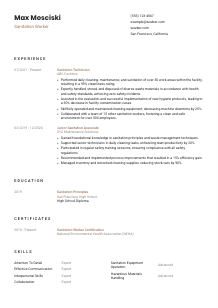
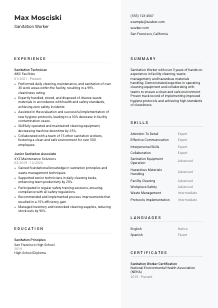
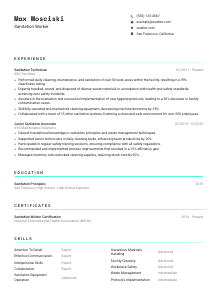
Sweeping streets, but your resume collects dust? Check out this Sanitation Worker resume example, created with Wozber free resume builder. Learn how to showcase your tidiness talents to match job expectations, paving a spotless career path forward!
Sanitation work is judged in the real world by consistency. Teams rely on workers who can clean thoroughly on schedule, follow disposal procedures without shortcuts, and keep shared spaces safe when the pace picks up. Your resume needs to show that same discipline. Hiring managers want to see proof that you can maintain standards, handle waste correctly, and support hygiene protocols without creating risk for the facility.
A tailored resume helps separate general cleaning experience from sanitation work that involves compliance, contamination control, and equipment handling. Using Wozber's free resume builder to align your wording with the posting and produce an ATS-compliant resume makes those details easier to surface early, especially when the employer is scanning for sanitation experience, hazardous material handling, and day-to-day facility upkeep. That should be clear before anyone reaches the interview stage.
This section is simple, but it still carries screening value. For sanitation roles, personal details mainly need to remove friction. If the employer has location, communication, or language expectations, your header should settle those points quickly so the hiring team can move straight to your work history and safety experience.
Use your full name in a clean, readable format at the top of the page. Sanitation hiring is practical and fast-moving, so avoid decorative styling. A clear header looks professional and keeps the focus on your experience with cleaning routines, waste handling, and facility safety.
Use the same job title as the role you are applying for when it accurately reflects your background. If the posting says "Sanitation Worker," place that directly under your name. This helps frame the rest of the resume around sanitation duties rather than broader janitorial or maintenance work.
Some sanitation jobs have immediate scheduling or on-site availability requirements. Here, the employer specifically wants someone located in San Francisco, California, so showing that in your personal details removes an obvious screening question. Treat this as a posting-specific adjustment, not a rule for every sanitation resume.
A LinkedIn profile can be useful if it reflects the same job titles, dates, certifications, and sanitation-related experience shown on your resume. You usually do not need a personal website for this field unless it supports training, safety credentials, or related facility operations experience.
Your personal details should confirm that you are reachable, professionally presented, and available for the role as posted. Once that is clear, the hiring team can focus on what matters most in sanitation hiring: safe work habits, reliability, and relevant hands-on experience.




For a Sanitation Worker, the experience section does the heavy lifting. Employers want to know what environments you maintained, what procedures you followed, what equipment you used, and whether your work helped keep the facility compliant and safe. Generic lines about being hardworking will not carry much weight here. Specific sanitation tasks and measurable results will.
Before writing bullets, identify the operating duties in the job ad. Here, the important themes are daily cleaning and sanitation, hazardous or regulated waste handling, hygiene protocol support, equipment operation, and teamwork. Those should shape the language of your experience section so your background reads as directly relevant to sanitation operations rather than general labor.
Start with your most recent role and include job title, employer, and dates. If your title was broader, such as "Sanitation Technician" or "Junior Sanitation Associate," that still works well because it gives the employer a clear progression within sanitation work. Keep the format simple so the reader can move quickly from role to role and compare your responsibilities over time.
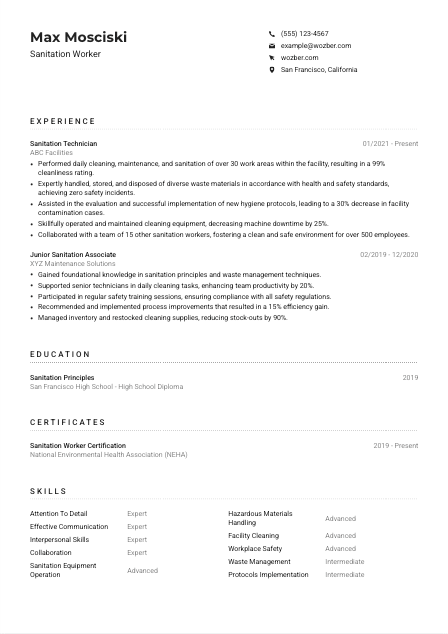
Write bullets that show what you cleaned, handled, maintained, or improved, then add the operational result. The sample resume does this well by pairing sanitation tasks with outcomes such as a 99% cleanliness rating, zero safety incidents, and a 30% drop in contamination cases. That kind of phrasing shows both execution and the effect of your work on facility standards.
Numbers help hiring teams understand scale. Include details like the number of work areas cleaned, team size, employee population supported, inspection scores, safety incident reductions, machine downtime improvements, or supply efficiency gains. In sanitation roles, those metrics make your contribution easier to understand than general claims about being thorough or dependable.
Keep the section centered on cleaning schedules, sanitation routines, waste disposal, contamination prevention, equipment upkeep, safety compliance, and coordination with staff. If an older bullet does not reinforce one of those themes, trim it or rewrite it. The goal is a work history that clearly supports the employer's day-to-day needs.
A hiring manager should be able to scan your experience section and picture you handling real sanitation responsibilities from day one. When your bullets show scope, procedure, and results, your resume reads like someone who can maintain a safe facility, not someone hoping to grow into the basics.
Education usually plays a supporting role in sanitation hiring, but it still needs to be accurate and easy to verify. Most employers are checking for the stated minimum, then moving on to your work history, safety knowledge, and practical experience. Keep this section clean and honest, with any relevant detail that adds context without overbuilding it.
If the posting asks for a high school diploma or GED equivalent, make that visible right away. This job does. List the credential plainly so the employer can confirm you meet the requirement without searching through the resume.
Include the credential, school name, and graduation year or completion date. Sanitation employers are not looking for elaborate academic presentation here. They want a clean record that confirms your baseline education and lets the resume move quickly back to operational experience.
If you completed coursework tied to sanitation, workplace safety, environmental health, or facility maintenance, you can include it briefly. In the sample resume, "Sanitation Principles" adds useful context because it connects the education entry to the field rather than leaving it completely generic.
Short courses in OSHA-related safety, hazardous materials awareness, infection prevention, equipment operation, or chemical handling can strengthen this section if they are not better placed under certifications. Use education to support the kind of procedural discipline the role requires.
Awards, clubs, or school activities are only worth keeping if they connect to safety, teamwork, or facility operations and you need them to support a thin early-career resume. For most candidates with 2+ years of sanitation experience, the cleaner choice is a brief education section and a stronger experience section.
Education should confirm the baseline and support your credibility without distracting from the main hiring criteria. For most sanitation jobs, experience with cleaning standards, waste procedures, and safe equipment use will matter more.
Certifications carry real value in sanitation because they point to training in procedures that affect health, safety, and contamination control. If a posting asks for a Sanitation Worker Certification or mentions hazardous material handling, use this section to show that your knowledge is formal as well as practical.
When a job posting mentions a Sanitation Worker Certification, include it prominently if you have it. That direct match tells the employer you already meet a stated preference or requirement. In this case, the sample resume lists the certification clearly instead of leaving the employer to assume equivalent training.
List certificates connected to sanitation procedures, health standards, hazardous materials handling, cleaning chemical safety, or equipment use. These are more relevant than broad professional development courses because they map directly to the responsibilities of maintaining a clean and compliant facility.
Include the issue date and, if relevant, the renewal period or active status. Sanitation methods, safety standards, and facility protocols can change, so recent certification dates help show that your training is current enough to support present-day procedures.
If you are renewing a certification or completing additional training in sanitation, safety, or waste handling, mention that. It shows that you stay current with regulated practices and do not treat sanitation knowledge as static.
In sanitation hiring, certifications help confirm that you understand the procedures behind the work, especially when health standards and hazardous materials are involved. They are most useful when they connect directly to the tasks the employer needs covered.
The best skills sections for sanitation roles are practical. They reflect the tasks you perform, the standards you follow, and the way you work with others in active facilities. A short, targeted list is more effective than a long inventory of generic strengths.
Review the posting for skills tied to execution. Here, that includes attention to detail, safe disposal procedures, communication, interpersonal skills, and the ability to work in a fast-paced environment. Add the technical side as well, such as sanitation equipment operation, waste management, and hygiene protocol support.
If you genuinely have the skill, use the same wording the employer uses. That helps both ATS matching and human review. For example, "hazardous materials handling" and "workplace safety" are stronger than vague phrases like "responsible worker" because they point to specific sanitation responsibilities.
Group your skills around sanitation work instead of mixing in every ability you have ever used. The sample resume balances hard skills like facility cleaning and sanitation equipment operation with soft skills like collaboration and communication. That mix works because it reflects how sanitation teams actually operate on the floor.
Your skills section should read like the toolkit of someone who can step into a sanitation routine, follow protocol, and work well with the rest of the facility team. Relevance matters more than volume here.
Language skills matter in sanitation roles when instructions, safety procedures, and team coordination need to be understood clearly. If the job posting names a required language, make that visible. Any additional language can also help in workplaces where teams are diverse and communication happens across shifts or departments.
This posting specifies English proficiency, so list English clearly with an accurate level. For sanitation work, that matters because safety instructions, disposal procedures, and equipment guidance often need to be followed precisely.
If you also speak another language used in your local workforce or facility environment, include it. In the sample resume, Spanish adds useful context because it may support collaboration across teams, though it is an added advantage rather than a universal requirement for sanitation roles.
Choose levels such as Native, Fluent, Intermediate, or Basic and keep them accurate. Overstating language ability can create problems fast in a role where misunderstandings around chemicals, waste handling, or cleaning instructions can affect safety.
Sanitation workers often coordinate with supervisors, maintenance staff, production teams, or other cleaning personnel. If your language skills help you receive instructions, report issues, or work smoothly across departments, they are worth listing.
Languages are useful, but they should not crowd out core qualifications like sanitation experience, safe disposal practices, or equipment operation. Include them as added value, especially when they improve day-to-day teamwork.
For sanitation hiring, language skills are most persuasive when they support safe work, clear instructions, and reliable coordination with others in the facility. Keep the section concise and relevant to that reality.
Your summary sits near the top of the resume, so it should quickly establish what kind of sanitation worker you are. Focus on years of experience, core sanitation strengths, and one or two concrete results or areas of expertise that match the role. Avoid broad claims that could belong to any manual labor job.
Start with your title and years of relevant experience. That immediately frames you as someone with direct exposure to sanitation routines, cleaning standards, waste handling, or facility support. A line such as "Sanitation Worker with over 3 years of hands-on experience" works because it is clear and role-specific.
Include the most relevant areas from your background, such as facility cleaning, hazardous materials handling, waste management, hygiene protocol support, or sanitation equipment operation. The sample summary works because it focuses on functions that match the job instead of relying on generic traits.
Aim for a short paragraph that can be read in seconds. A summary is most effective when it gives the hiring manager an immediate sense of your sanitation scope and reliability, then lets the experience section provide the details.
Close with a phrase that shows business or facility impact, such as maintaining high cleanliness standards, reducing contamination risk, supporting safe operations, or improving sanitation procedures. That ending helps your summary sound grounded in outcomes, not just responsibilities.
A focused summary should tell the reader, quickly and credibly, that you know how to maintain sanitary conditions, follow safety procedures, and contribute to a clean working environment. If that comes through in a few sharp lines, the rest of the resume has a strong start.
A Sanitation Worker resume works best when it shows dependable execution: cleaning routines completed thoroughly, waste handled safely, equipment maintained properly, and hygiene standards followed without lapses. Every section should reinforce that picture with concrete tasks, relevant terminology, and a few metrics that show scope or results.
Use Wozber's free resume builder to organize those details into an ATS-friendly resume template, then refine the wording with its ATS resume scanner and AI resume builder features so your experience lines up cleanly with the posting. The finished resume should make one thing easy to judge: you can keep a facility clean, compliant, and safe from the first shift.




