



Use Wozber and land your dream job
Create Resume
No registration required
Mopping and sweeping up, but your resume's in a mess? Tidy things up with this Janitor resume example, cleaned up with Wozber free resume builder. Learn how to showcase your cleaning prowess to match job requirements, paving the way for a career that's spotless and shining!
Janitorial work is judged in the building itself. Floors stay safe, restrooms stay sanitary, supplies stay stocked, and small maintenance issues get reported before they turn into bigger problems. A resume for this field needs to show that kind of dependable day-to-day execution, not just a general willingness to work hard.
Hiring teams often scan janitor resumes quickly to separate candidates who have handled real cleaning routines from those who list vague duties. Wozber's free resume builder helps you tailor that experience into an ATS-compliant resume by matching the language of the job posting and keeping the structure easy to read, so your resume clearly shows cleaning scope, equipment use, and safety awareness.
For janitorial hiring, the personal details section does one practical job first: it tells the employer how to reach you and whether you meet any immediate logistics requirements. Keep it clean, accurate, and limited to information that helps the building operations team move your application forward.
Use your full name in a clear, readable format at the top of the page. Janitorial hiring can move quickly, especially for facility, school, healthcare, or office roles, so your name should be immediately visible when a supervisor or recruiter reviews a stack of applications.
Place "Janitor" directly under your name if that is the role you are applying for. This helps the employer connect your resume to the opening right away and avoids confusion if your past titles include related labels such as Custodian, Cleaner, or Facilities Assistant.
Add a working phone number and a professional email address. Double-check both. For hourly and shift-based janitorial roles, missed calls or bounced emails can cost you an interview faster than in many office-based hiring processes.
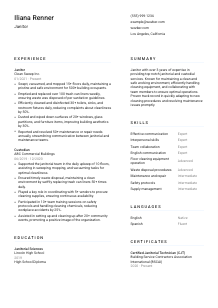
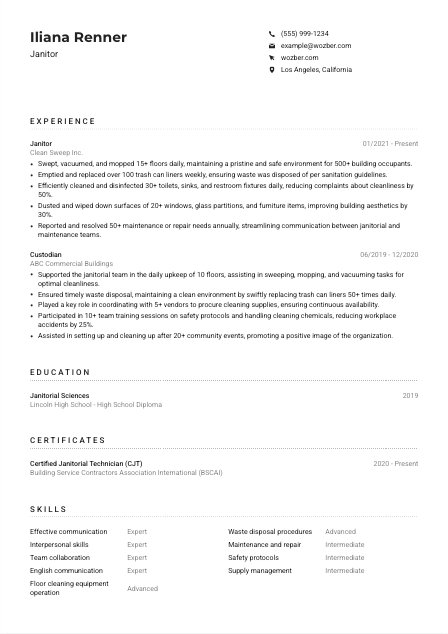
If the employer asks for local availability or relocation, include your city and state. In the example, listing Los Angeles, California directly supports a stated requirement. For other applications, use location only when it helps confirm commute, shift availability, or local eligibility.
A website or LinkedIn profile is optional for janitorial work. Include one only if it reinforces relevant information, such as steady work history, facilities experience, or endorsements tied to cleaning, custodial services, or building support. If it adds no value, leave it out and keep the section lean.
Your personal details should answer the employer's immediate practical questions without adding clutter. If someone can contact you quickly and confirm basic availability, this section has done its job.




Experience carries the most weight on a janitor resume because it shows whether you have handled recurring cleaning work, followed sanitation procedures, and kept facilities functional over time. Focus your bullets on the tasks you owned, the scale of the space, the equipment you used, and the outcomes building occupants would notice.
Start by marking the tasks that appear in the job ad, such as sweeping, vacuuming, mopping, waste disposal, restroom disinfection, surface cleaning, supply tracking, and reporting repair needs. Then mirror that language where it truthfully matches your background. This helps both the hiring manager and the ATS connect your past work to the actual cleaning routine required.
List jobs in reverse chronological order and make sure your janitorial or custodial roles come through clearly. Include employer name, title, and dates. If you have related experience under a different title, show the overlap through the bullet points, especially if you handled floor care, sanitation, equipment use, or facility upkeep.
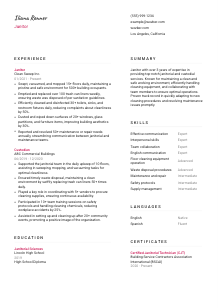
Each bullet should pair a real responsibility with a concrete outcome. Instead of writing "responsible for cleaning restrooms," show volume, frequency, or improvement. The sample does this well by noting 30+ restroom fixtures cleaned daily and a 50% drop in cleanliness complaints. That kind of detail tells an employer what level of workload you can handle.
Use metrics that make sense for janitorial work: floors cleaned per shift, trash receptacles serviced, fixtures disinfected, buildings supported, supply orders managed, or maintenance issues reported. The example's 15+ floors, 100+ liners replaced weekly, and 50+ repair needs reported annually all give hiring teams a clearer picture of pace, scope, and consistency.
Keep the section centered on cleaning standards, safety, equipment handling, teamwork, and building support. If a past duty does not help prove that you can maintain clean, safe, well-supplied spaces, shorten it or remove it. Employers filling janitor roles want to see dependable execution in routine facility work, not unrelated filler.
Your experience section should make it easy to picture you on the job: cleaning assigned areas, handling equipment properly, following sanitation rules, and keeping the facility in working order. If those points come through quickly, the section is doing real work.
Education usually plays a supporting role on a janitor resume, but it still matters when the posting asks for a high school diploma or equivalent. Present it clearly, meet the stated requirement, and avoid overbuilding the section when hands-on custodial experience carries more hiring weight.
When a posting asks for a high school diploma or equivalent, make sure that credential appears clearly in your education section. This role does exactly that, so there is no reason to bury the information or leave it implied.
List the school name, diploma or equivalent credential, and graduation year or completion date. Janitorial hiring usually does not require an elaborate education section. Clear formatting is enough to confirm you meet the baseline qualification.
Most janitor resumes will not need a specialized field listed with a high school diploma. If you do include one, make sure it reflects actual coursework or training and does not distract from your work history. In most cases, the credential itself matters more than the label attached to it.
You do not need course listings unless they support the role in a meaningful way, such as vocational training tied to facility maintenance, safety practices, or equipment handling. Keep it brief. A janitor resume earns its value from practical custodial experience first.
Awards, clubs, or school activities belong here only when they support a cleaner, safer, or more service-oriented work profile. If they do not relate to reliability, maintenance, teamwork, or facility support, leave them out and keep attention on your qualifications for the job itself.
For most janitor applications, education confirms that you meet the stated baseline and then gets out of the way. Keep it accurate, brief, and aligned with the requirement in the posting.
Certificates are optional in many janitorial roles, but they can help when they point to safe chemical handling, floor care, sanitation practices, or formal custodial training. Use this section to show added preparation, especially if the employer values equipment knowledge or structured cleaning standards.
List certifications that relate directly to janitorial or custodial services, such as floor care, sanitation procedures, cleaning techniques, or workplace safety. A credential like Certified Janitorial Technician is relevant because it supports the kind of practical facility work the role requires.
Add the issue date and, if relevant, the expiration or active range. That helps employers understand whether your training is recent enough to support current cleaning protocols, equipment use, or safety practices around chemicals.
This section should stay focused. If a certificate does not improve your case for janitorial work, remove it. Employers reviewing custodial resumes are looking for training that connects to sanitation, building upkeep, safety compliance, or maintenance support.
If you have renewed safety training or added new custodial certifications, include them to show that your methods stay current. That can matter in environments where chemical handling, floor equipment, and cleaning standards are closely monitored.
Use this section to show extra training that makes your day-to-day janitorial work stronger and safer. A short, relevant list does more than a long one filled with unrelated credentials.
The skills section should reflect how janitorial work actually gets done. That means balancing practical cleaning abilities with the communication and teamwork needed to work around building occupants, supervisors, and maintenance staff. Keep the list focused on skills you can demonstrate in your experience.
Start with the skills the employer names directly, such as handling cleaning equipment, following safety protocols, managing supplies, and communicating effectively in English. If those skills match your experience, use similar wording so the resume lines up naturally with the role and its ATS scan.
Lead with hard skills that affect daily performance, such as floor cleaning equipment operation, waste disposal procedures, restroom sanitation, chemical handling, and inventory support. These are easier for employers to connect to the actual shift responsibilities than broad phrases alone.
Group your skills so they are easy to scan and avoid padding the section with every trait you can think of. The sample's mix of equipment operation, safety protocols, supply management, communication, and team collaboration works because those skills all connect back to the posted duties and the candidate's work history.
Choose skills that help an employer picture you maintaining floors, restrooms, waste stations, supplies, and safe working conditions. If a skill cannot be backed up by real janitorial work, it does not belong here.
Language ability matters in janitorial work when the role involves speaking with supervisors, coordinating with team members, reading instructions, or responding to building occupants. Include languages only when they help clarify how you communicate on the job.
If the employer asks for English proficiency, list English first and show your actual level. This job does, so that detail should be easy to find. For janitorial work, language requirements often matter because instructions, safety labels, and communication with occupants need to be understood clearly.
Order your languages by job relevance, not personal preference. When English is required for reporting issues, receiving assignments, or following sanitation guidance, it should lead the section.
Additional languages can be useful in schools, apartment buildings, healthcare settings, and commercial properties where staff and occupants speak different languages. In the example, Spanish adds practical value because it can support smoother day-to-day communication with coworkers or tenants.
Use honest levels such as Native, Fluent, Conversational, or Basic. Overstating language ability can create problems on the job, especially when the work involves understanding safety procedures, supply instructions, or maintenance reporting.
Only include languages that help explain how you operate in real workplace settings. For janitorial roles, language skills matter most when they improve team coordination, occupant interaction, or understanding of cleaning and safety instructions.
Your language section should show whether you can communicate clearly in the environment you are applying to work in. Keep it practical and relevant to the building, team, and daily duties.
The summary gives the employer a fast read on your janitorial background before they reach the detailed bullets. Use it to establish your years of experience, the kind of facilities work you handle well, and the standards you follow around cleanliness, safety, and routine building support.
Review the posting before writing your summary so you can emphasize the right areas, whether that is floor care, restroom sanitation, waste disposal, chemical safety, or communication with building occupants. Your summary should reflect the kind of janitorial work the employer needs done every day.
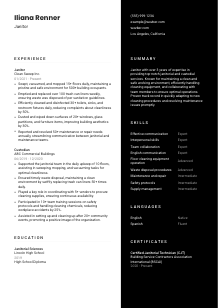
A direct opening works best here. The sample's approach, "Janitor with over 3 years of expertise in providing top-notch janitorial and custodial services," is a useful model because it immediately states role identity and experience level. You can simplify the wording further if needed, but keep those two facts front and center.
Choose strengths that connect tightly to the posting, such as maintaining clean and safe environments, operating floor equipment, following sanitation procedures, or reporting maintenance issues promptly. This gives the reader an immediate sense of how you perform on shift, not just what title you have held.
Aim for three to five lines with no filler. A janitor summary should read like a quick, accurate handoff to the rest of the resume. If every phrase points to custodial experience, cleaning standards, equipment use, or facility support, the section is doing what it should.
After reading your summary, an employer should already understand your experience level, your core janitorial strengths, and the kind of facility support you can provide. That sets up the rest of the resume to confirm the details.
Once each section is tailored, your resume should show a clear pattern of dependable custodial work: cleaning routines handled well, equipment used safely, sanitation standards followed, and maintenance issues communicated promptly.
Wozber can help you turn that experience into a sharper application with its free resume builder, ATS-friendly resume templates, and ATS resume scanner that checks alignment between your resume and the job description. The finished resume should make one thing easy to judge: you can keep the facility clean, safe, and running smoothly.