



Use Wozber and land your dream job
Create Resume
No registration required
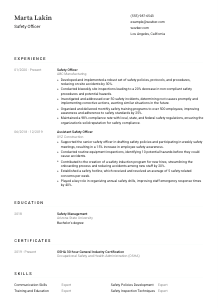
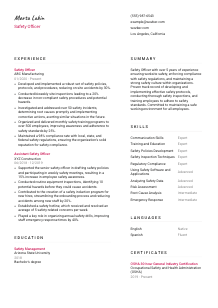
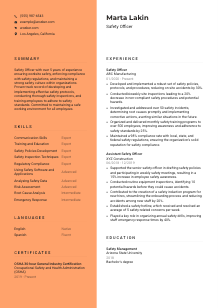
Keeping workplaces secure, but your resume feels a bit exposed? Check out this Safety Officer resume example, created with Wozber free resume builder. Learn how to align your safety savvy with job demands, ensuring your career grows as steadily as the measures you implement!
Safety Officer resumes are strongest when they show how you reduce risk in day-to-day operations, not just that you know the rules. Hiring teams want to see how you build safer sites through inspections, incident investigations, corrective actions, and training that changes employee behavior. Your resume should make that operational impact easy to spot.
When the resume is tailored well, the difference between a general compliance candidate and a true Safety Officer becomes much clearer, especially in ATS screening. Wozber's free resume builder helps you align your wording with the job ad, keep an ATS-compliant resume structure, and surface the safety work that matters most first, from hazard identification to regulatory follow-through.
This section does straightforward work. It confirms who you are, how to reach you, and whether you meet practical requirements tied to the opening. For a Safety Officer role, that can include location alignment, a clear professional title, and contact details that look professional and current.
Your name should be the most visible text on the page so the employer can identify your application quickly in a stack of resumes and ATS exports. Use a clean, readable format rather than decorative styling.
Place your role title just below your name and match it to the opening when it reflects your background. If you are applying for a Safety Officer position and have held that title or very similar safety and compliance roles, say so plainly.
Include one phone number and one professional email address that you check regularly. Safety hiring often moves through interviews, training discussions, and site scheduling quickly, so your contact information should be accurate and simple to scan.
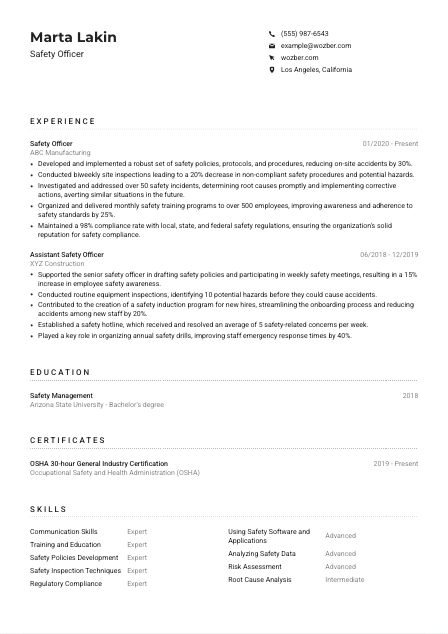
If the employer requires someone based in a certain area or open to relocation, include your city and state. In this example, listing "Los Angeles, California" supports a stated requirement and removes an avoidable question early in the review.
A LinkedIn profile or professional website can support your application if it reflects the same safety credentials, experience, and certifications shown on your resume. Make sure titles, dates, and compliance-related work are consistent across both.
Do not include details such as age, marital status, or other personal identifiers unless a local application standard specifically requires them. Keep the section focused on professional facts that support communication and role eligibility.
This top block should remove friction, not create it. When your title, contact details, and location are aligned with the posting, the employer can move straight to your safety experience.




For Safety Officer hiring, the experience section carries most of the decision-making weight. Employers look for proof that you have improved compliance, identified hazards before they escalated, investigated incidents thoroughly, and delivered training that changed what happened on the floor or on site.
Read the job description closely and line up your experience with the duties it emphasizes. For this role, that means showing work in policy development, site inspections, incident investigation, corrective actions, training delivery, and regulatory compliance. Use those themes as the backbone of your bullets rather than listing generic responsibilities.
List positions in reverse chronological order so the employer can quickly see your current level of responsibility and how your scope has grown. Include job title, employer, and dates for each role. Safety careers often progress from support or assistant positions into broader ownership of audits, inspections, and training programs, so that progression should read clearly.
Numbers matter here because they show whether your actions changed outcomes. Prioritize metrics such as incident reduction, compliance rate, inspection cadence, number of employees trained, hazards identified, or response improvements after drills. The sample resume does this well by tying policy work to a 30% drop in accidents and compliance management to a 98% rate.
Safety Officers are not only technical reviewers. They also need to educate supervisors, frontline employees, and new hires on procedures, reporting, and prevention. Include training frequency, audience size, and any measurable shift in adherence or awareness. A bullet about delivering monthly training to 500 employees says much more than "responsible for safety training."
Do not stop at saying you investigated incidents. Show what happened next. Strong bullets mention root cause analysis, corrective actions, follow-up monitoring, and prevention of repeat events. That turns your experience from reactive reporting into active risk control, which is central to this profession.
Your experience should show that you can run the practical side of safety, from inspections and investigations to training and compliance follow-up. If those outcomes are visible in your bullets, the employer can picture you in the role much faster.
Education matters in Safety Officer hiring because it shows formal grounding in occupational health, risk management, and regulatory standards. Keep the section simple, but make sure it reflects the academic qualification level the employer asked for.
If the posting asks for a bachelor's degree in Safety Management, Occupational Health and Safety, or a related field, place that credential clearly and use the exact field name where possible. In the example, "Bachelor's degree in Safety Management" aligns directly with the requirement.
List your degree, field of study, school, and graduation year or date range in a consistent order. Hiring teams reviewing multiple safety resumes often skim for qualification match first, so clear formatting helps them confirm it quickly.
Honors, awards, or high academic achievement can help if they add useful context, especially for earlier-career candidates. Keep them if they strengthen your safety profile. Leave them out if your work history already provides stronger proof of capability.
Relevant coursework can be useful when it connects directly to the target role, such as occupational risk assessment, industrial hygiene, compliance systems, or safety program management. This is especially helpful if you are early in your career or if the course work supports experience with safety software or regulation-heavy environments.
Safety standards change, and many employers value candidates who keep current with regulation updates, audit methods, and prevention practices. If you have continued education tied to OSHA topics, incident analysis, or compliance updates, include it when it reinforces your professional currency.
Your education section does not need long explanations. It needs to confirm that you have the formal foundation expected for safety and compliance work, and that foundation should connect naturally to the experience and certifications that follow.
In safety roles, certifications often carry immediate weight because they show current training in recognized standards and practices. Present them clearly, especially when the job description names a credential such as OSHA 30-hour General Industry Certification.
Lead with certifications that the employer specifically requested or that are widely recognized in safety work. For this opening, OSHA 30-hour General Industry Certification should be easy to find. If you hold additional credentials in occupational safety, emergency response, or auditing, list them after the most relevant one.
Certifications are stronger when they reflect ongoing professional development rather than a one-time milestone. Include renewals, active status, or related safety training if it strengthens your profile in compliance-heavy environments.
List the year earned and, when relevant, the validity or renewal period. That helps employers understand whether your knowledge is current, especially in areas tied to regulation, reporting requirements, and training standards.
Extra certifications can help when they support the work you want to do, such as hazard analysis, emergency preparedness, or advanced safety monitoring. Keep this section selective. The best additions are the ones that strengthen your ability to manage inspections, investigations, and compliance programs.
A well-built certifications section tells the employer that your safety knowledge is formal, current, and recognized. That matters most when the credential connects directly to the regulations, training, and compliance demands of the job.
The skills section should reflect how Safety Officers actually work. That means a mix of technical safety knowledge, compliance capability, data handling, inspection skills, and the communication needed to train employees and influence safer behavior across teams.
Start with the language used in the posting and mirror it where it matches your background. Here, safety software, safety data analysis, employee training, protocol development, and regulatory compliance are all central. Wording your skills in the same language improves relevance for both ATS matching and human review.
Put the hard skills closest to the work first. Good examples include hazard identification, risk assessment, inspection techniques, incident investigation, root cause analysis, corrective action planning, and compliance monitoring. If you use safety software or reporting systems, include that as well because the job description specifically asks for it.
Safety work succeeds through communication, training, and follow-through. Include interpersonal skills only when they are tied to real job demands such as running training sessions, coaching managers on procedure changes, writing clear reports, or handling incident conversations professionally.
Your skill list should sound like the toolkit of someone who can inspect, investigate, train, and maintain compliance. If the section reads like your actual day-to-day safety work, it is doing its job.
Language ability matters in safety because policies, training, incident instructions, and hazard reporting all depend on clear communication. Keep this section practical and relevant to the workforce and environment you expect to support.
If the job requires English fluency, list English prominently and use an honest proficiency level. For Safety Officers, this matters because reporting, training delivery, incident documentation, and regulatory communication all depend on precise language.
Extra languages can be valuable when you work with multilingual teams, contractors, or frontline staff across shifts and locations. In some environments, Spanish or another commonly used language can improve training reach and day-to-day safety communication.
Choose standard labels such as Native, Fluent, Professional Working, Intermediate, or Basic. Avoid vague wording. Employers need to know whether you can lead training, handle incident communication, or simply manage basic interaction.
Additional language skills matter most when they improve communication around procedures, emergency response, onboarding, and hazard reporting. If you include another language, think about whether it supports the kind of workforce communication common in your target roles.
Some openings involve a workforce or community where certain languages are especially useful. If that is true for the role you are targeting, move the relevant language higher and make sure the proficiency level supports the kind of interaction the job requires.
List language skills when they improve your ability to train, document, and communicate safety expectations. For this profession, usefulness matters more than variety.
Your summary should give a fast, credible picture of the kind of Safety Officer you are. In a few lines, it should cover your level of experience, your main safety strengths, and the results you have delivered in environments where compliance and prevention matter.
Start with the themes repeated in the job description and build your summary around them. For this posting, those priorities include safety policy implementation, inspections, incident investigation, training, compliance, and data-informed recommendations. Use the themes that genuinely match your background rather than trying to cover every possible safety function.
State your title or equivalent background, then include your years of experience and the type of environment you know best if it strengthens your case. Manufacturing, construction, logistics, healthcare, and other settings each carry different safety concerns, so relevant context can help here.
Choose achievements that reflect how your work improved safety outcomes. Good summary metrics include reduced incident rates, improved compliance levels, successful training coverage, or effective corrective action after investigations. The sample resume's 30% accident reduction is the kind of detail that gives the summary weight.
End with a short line that reflects how you operate, such as strengthening compliance, building a stronger reporting culture, or maintaining safer worksites through training and prevention. Keep it grounded in actual safety work rather than broad career language.
When this section is written well, it reads like a compact version of your safety record. It should tell the employer, in a few seconds, what kind of environments you have supported and what results your safety work tends to produce.
Use each section to make your safety work concrete. With Wozber's free resume builder, you can organize your experience into a clean ATS-friendly resume format that highlights compliance results, inspection work, training scope, and incident prevention clearly.
Before you apply, run a final check with Wozber's ATS resume scanner or AI resume builder tools to align your wording with the posting, strengthen ATS optimization, and surface any missing requirements. The finished resume should make it easy to judge your ability to maintain compliance, train employees effectively, and reduce workplace risk from day one.




