



Use Wozber and land your dream job
Create Resume
No registration required
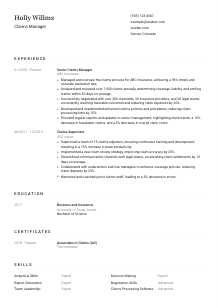
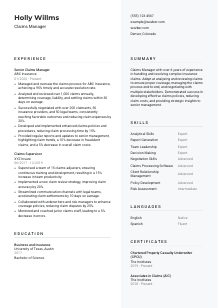
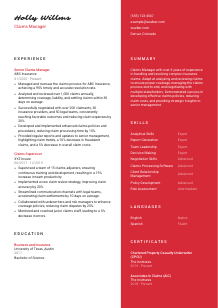
Processing insurance claims, but your resume feels like a denied appeal? Check out this Claims Manager resume example, created with Wozber free resume builder. Learn how to match your claims expertise to the job criteria, making your career track record as smooth as a settlement!
Claims managers sit where coverage language, financial exposure, and claim resolution meet. Hiring teams want to see that you can make sound decisions under pressure, move files to resolution without avoidable delay, and handle negotiations with claimants, carriers, adjusters, and legal counsel without losing control of cost or compliance.
A tailored resume helps separate true claims leadership from general insurance experience by making your authority over coverage review, settlement decisions, reporting, and process standards easy to spot. Wozber's free resume builder supports that kind of targeting while helping you produce an ATS-compliant resume that reflects the language of the role and shows where you have already managed claims outcomes at scale.
This section is brief, but it still does practical work in a Claims Manager application. It should confirm who you are, how to reach you, and whether you meet straightforward requirements such as title alignment and location, without adding clutter that distracts from your claims background.
Use your full name in a clear, readable format at the top of the page. Claims management is a credibility-driven field, and a clean header sets the tone before the reader gets into your loss analysis, settlement history, or leadership experience.
Add "Claims Manager" directly under your name when that is the role you are pursuing. It immediately frames your background around claims oversight rather than broader insurance operations, customer service, or adjusting work. If your current title is more senior or slightly different, such as Senior Claims Manager, you can still align it to the target role when the scope is comparable.
List a phone number you answer reliably and a professional email address. Claims roles often move quickly once an employer identifies someone with the right mix of policy knowledge, judgment, and negotiation skill, so make it easy for recruiters or hiring managers to reach you without friction.
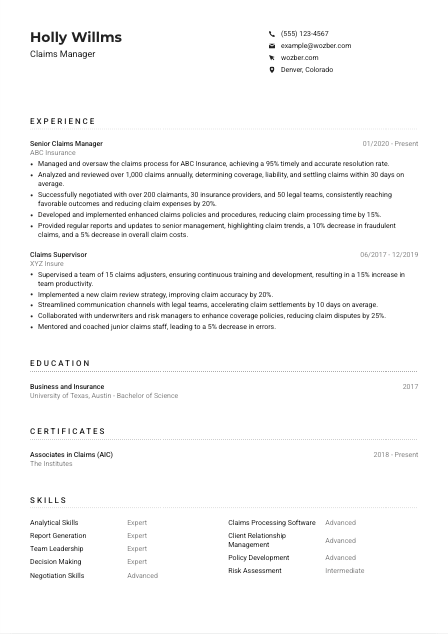
If the employer specifies a city or relocation requirement, include your city and state. In the example, listing Denver, Colorado directly addresses the posting's location requirement and removes an early question about availability. Use this only when geography matters to the opening you are targeting.
A current LinkedIn profile or professional website can reinforce your resume, especially if it reflects insurance leadership, certifications, or claim operations scope. Keep titles, dates, and credentials consistent so there is no mismatch between your resume and your digital profile.
Your personal details should confirm the basics fast and cleanly. For a Claims Manager, that means clear identity, reachable contact information, and any practical requirement, such as location, handled upfront.




Claims Manager hiring decisions are usually made in the experience section. This is where employers look for evidence that you have managed claim volume, coverage decisions, negotiations, staff, reporting, and process improvement in a real insurance environment.
Before you edit a single bullet, mark the responsibilities and qualifications that define the role. In this posting, the big themes are end-to-end claims oversight, coverage and liability review, negotiation, policy and procedure compliance, and reporting to senior management. Those themes should shape which accomplishments you lead with and which details you cut.
For every position, show the operational scope of your work. Include the employer, title, dates, and then bullets that show what you managed, improved, or resolved. For Claims Manager roles, that often means claim volume, team size, settlement timelines, loss cost control, dispute reduction, audit compliance, or reporting responsibility. The sample resume does this well by moving from claim oversight into negotiation outcomes, policy updates, and management reporting.
Quantified results carry weight when they reflect how claims teams are actually measured. Good examples include timely resolution rates, average settlement cycle time, claim cost reduction, fraud reduction, accuracy gains, team productivity, or number of claims reviewed annually. The example's 95% timely resolution rate, 1,000-plus claims reviewed, and 20% reduction in claim expenses give the reader a concrete picture of performance.
A Claims Manager resume should make it obvious that you do more than process files. Lead with bullets that show you determined coverage, assessed liability, negotiated settlements, managed escalations, or worked with legal teams on complex claims. These are the decisions that distinguish claims leadership from more junior handling or administrative support.
Employers want to see that your responsibility has grown over time. That can mean moving from supervising adjusters to running a broader claims function, taking ownership of procedure design, or reporting trends and financial impact to senior leaders. In the sample, the move from Claims Supervisor to Senior Claims Manager shows that progression clearly through team leadership, strategy changes, and broader operational results.
Your experience section should show how you handle claims decisions, people, and financial outcomes in practice. If a hiring manager can quickly see the scale of your work and the results you produced, this section is doing its job.
Education is usually a screening checkpoint for Claims Manager roles rather than the main selling point, but it still matters. It should confirm that you meet the stated degree expectation and support your foundation in insurance, business, risk, or a related discipline.
When a posting calls for a bachelor's degree in Business, Insurance, or a related field, make sure that information is easy to find. If your degree aligns directly, as in the example's Bachelor of Science in Business and Insurance, list it clearly so there is no ambiguity during screening.
Include your degree, field of study, school, and graduation year or date. Claims leadership roles do not need a decorative education section. A clean format helps reviewers confirm qualifications quickly and move on to the experience that carries more hiring weight.
If your degree title does not obviously connect to claims work, use the field or related coursework to close that gap. Business, insurance, finance, risk management, and legal studies all help frame your understanding of coverage, policy interpretation, and claim economics.
Relevant honors, coursework, or academic projects can be worth including early in your career or when they connect directly to insurance operations. For a more experienced Claims Manager, keep this selective so the section stays secondary to your performance history and industry credentials.
If you are pursuing further education tied to insurance leadership, compliance, or risk, you can note it briefly. This is especially useful when it supports movement into broader claims oversight or complements certifications such as AIC or CPCU.
Education does not need to do too much here. It simply needs to confirm that you meet the academic requirement and that your background supports the technical judgment expected in claims management.
In claims management, certifications often carry real weight because they point to deeper knowledge of policy interpretation, claims practice, and industry standards. They are especially useful when a posting names them directly or asks for the ability to obtain them.
If a posting mentions AIC, CPCU, or similar designations, move those to the top of the section. Doing this shows immediate alignment with the role and signals that your knowledge extends beyond on-the-job exposure. The example resume handles this well by listing both AIC and CPCU, which closely match the job description.
You do not need every course completion or internal training certificate on the page. Prioritize certifications that strengthen your authority in claims handling, insurance coverage, risk, compliance, or leadership. Relevance matters more than volume.
List the issuing body and the date earned, or show that the credential is current when that is the more accurate format. This helps employers understand whether your industry training is recent and maintained, especially in a field shaped by regulation, policy language, and evolving standards.
Claims leaders are often expected to keep building expertise, especially if they oversee complex lines, larger teams, or higher-value disputes. If you are working toward a named designation, mention that clearly when it is relevant to the role. It shows forward movement without overstating what you have already completed.
Relevant certifications add weight to your claims background because they show structured industry knowledge, not just tenure. Keep this section focused on credentials that support stronger judgment, stronger policy knowledge, and stronger leadership credibility.
The best Claims Manager skills sections do not read like a generic leadership list. They pull together the technical and operational abilities that drive better coverage decisions, cleaner settlements, tighter procedures, and more reliable reporting.
Pull the skills that the employer actually emphasizes and reflect them in your own wording when they are true to your background. For this role, that includes analytical ability, negotiation, knowledge of insurance policies and coverage, sound judgment, and communication. Matching the terminology helps both ATS screening and human review.
Lead with the capabilities that matter most to claims leadership, such as claims process oversight, coverage analysis, liability assessment, negotiation, reporting, team leadership, and policy development. The example resume also includes claims processing software and risk assessment, which are useful additions when they support the scope of the role.
A skill carries more weight when the experience section proves it. If you list negotiation, there should be bullets showing settlement outcomes or claim cost reductions. If you list report generation, show that you produced trend and financial impact updates for senior management. The strongest Claims Manager resumes create that link across sections instead of letting the skills list stand alone.
Choose skills that reflect actual claims operations and leadership decisions, then back them up with results. That combination makes the section credible and useful to both ATS screening and hiring review.
Language ability matters in claims work because much of the job depends on clear explanations, accurate documentation, and steady negotiation. Even when the role is not multilingual, the language section can still confirm a required communication baseline and show added value where relevant.
If the posting requires effective communication in English, list English clearly and use an honest proficiency level. That handles a stated requirement immediately and supports the communication demands of claimant discussions, coverage explanations, internal reporting, and legal coordination.
Additional languages can be useful when you work with diverse claimant populations, vendor networks, or regional markets. In the example, Spanish adds potential value because it may support smoother communication and negotiation in some claims contexts. Include extra languages when they genuinely help you operate more effectively.
Terms such as Native, Fluent, Advanced, or Intermediate are usually enough. Keep them accurate. Claims roles rely on precision in communication, so overstating language ability can create problems later in interviews or on the job.
Some employers handle local personal lines claims, while others manage broader commercial or multi-state activity. If language ability is likely to help with claimant communication, vendor coordination, or complex negotiations, it is worth keeping on the resume. If not, keep the section short and factual.
Language skills are most persuasive when they support real claims work. That might mean de-escalating difficult claimant conversations, gathering more accurate statements, or helping move settlements forward with fewer misunderstandings. Frame multilingual ability as an operational advantage, not just a personal attribute.
For Claims Manager roles, language skills matter when they improve communication, negotiation, and service across the claim lifecycle. Lead with required English proficiency, then keep any additional languages relevant to the work you want to do.
The summary sets the lens for everything that follows. In a Claims Manager resume, it should quickly establish your level of experience, your command of claims operations, and the kind of outcomes you have delivered across coverage review, negotiation, and process management.
Read the posting closely and identify what the employer most needs from the person stepping in. Here, that means claims oversight, coverage and liability analysis, negotiation, policy and procedure compliance, and reporting. Your summary should reflect that mix instead of offering a broad insurance profile.
Start with a direct line that states who you are and how long you have worked in claims or insurance. The sample summary does this well with "Claims Manager with over 6 years of experience," then immediately moves into handling and resolving complex insurance claims. That gives the reader role, seniority, and context in one sentence.
After the opening, name the capabilities that define your value. Good options include coverage analysis, settlement negotiation, claims process leadership, cost control, fraud reduction, or reporting to senior management. If possible, hint at results such as lower claim costs, faster cycle times, or stronger resolution rates to give the summary more substance.
Aim for a concise paragraph of about 3 to 5 lines. Every phrase should contribute something concrete about your claims background. Skip vague descriptors and focus on how you lead claims work, improve procedures, and influence financial outcomes.
Your summary should make it clear, within a few lines, that you understand claims from both the technical and managerial side. When it is tailored well, the rest of the resume reads as proof of that opening statement.
A Claims Manager resume works when it shows command of coverage decisions, negotiations, process discipline, reporting, and team oversight in concrete terms. Each section should help a hiring team understand how you reduce claim risk, control costs, and move cases to fair resolution.
Use Wozber's free resume builder and ATS resume scanner to align your experience with the posting, strengthen role-specific phrasing, and deliver an ATS-friendly resume format that keeps your claims leadership clear from the first scan to the final interview.




