



Use Wozber and land your dream job
Create Resume
No registration required
Keeping workplaces secure, but your resume feels exposed? Check out this Safety Manager resume example, created with Wozber free resume builder. Learn how to align your risk-wrangling skills with job specifics, keeping your safety career as sheltered as your job sites!
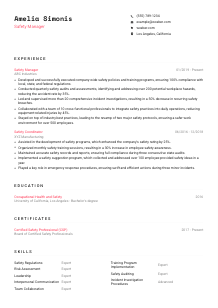
Safety Manager hiring usually turns on one practical question: have you actually built safer operations, or have you only supported the process? A resume for this field needs to show how you write policy, run audits, investigate incidents, train teams, and work with operations leaders to reduce exposure before it becomes a recordable event or regulatory issue.
That distinction gets lost fast when the resume stays generic. Wozber's free resume builder helps you align your wording with the posting, keep the layout clean for ATS optimization, and make core qualifications such as compliance leadership, hazard identification, and corrective action management easy to trace. The clearer those points are, the faster a hiring team can see your scope and judgment.
Safety roles are detail-sensitive, and your header is the first place that discipline shows. Keep it clean, accurate, and aligned with the posting so the hiring team can immediately confirm who you are, what role you are targeting, and whether you meet practical requirements such as location and availability.
Use your full name as the top line of the resume in a readable, professional format. In safety hiring, clarity matters. A crowded header or overly styled name can make the document feel less controlled than the role itself requires.
Place "Safety Manager" directly below your name if that is the position you are pursuing. This keeps your resume aligned with the job title and helps frame the rest of your experience around safety leadership, regulatory compliance, and incident prevention rather than a broader EHS support profile.
If the employer asks for a local candidate, state your city and state plainly. In this example, listing Los Angeles, California immediately answers a stated requirement and removes doubt about relocation timing or local availability for site visits, audits, and incident response.
Add LinkedIn or a professional website only if it supports your application with consistent career details, certifications, or safety project context. If your profile includes items like compliance program work, training leadership, or multi-site safety oversight, it can reinforce the story your resume is already telling.
Your personal details should quickly establish that you are reachable, professionally presented, and logistically aligned with the role. For a Safety Manager, even the header should reflect precision and readiness.




This is the section most hiring teams will read first. Safety managers are typically judged by what they changed on the ground: fewer incidents, cleaner audits, stronger training adoption, better investigations, and safer operating routines across teams and facilities.
Before writing bullets, identify the work the employer needs covered right away. For this role, that includes policy development, training programs, audits, risk assessments, incident investigations, and cross-functional safety integration. Your experience section should mirror those themes using your own real examples, not generic safety language.
List positions in reverse chronological order with job title, employer, and dates. That structure helps hiring teams quickly track your progression from coordinator or specialist work into broader ownership of compliance programs, corrective actions, and team leadership.
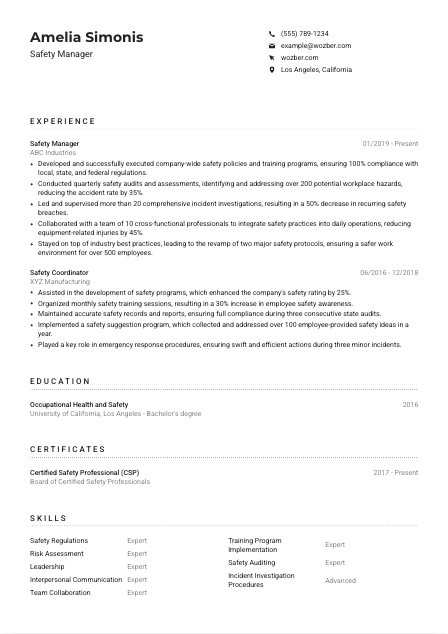
Each bullet should show what you led, what process you improved, and what changed because of it. The sample resume does this well with lines about developing company-wide safety policies, leading investigations, and integrating safety practices into daily operations. That kind of wording shows management ownership, not just participation.
Quantify results with metrics that matter in the field: hazard counts addressed, incident-rate reduction, audit results, training coverage, employee population served, recurring breach reduction, or inspection frequency. In the example, figures like a 35% accident-rate reduction and more than 20 investigations give the employer a concrete sense of operational impact.
Prioritize work that proves you can run a safety program, influence operations, and maintain compliance under real conditions. If an older bullet does not connect to audits, regulations, training, investigations, emergency response, or risk reduction, replace it with one that does.
Your experience section should show a clear pattern of safety leadership, documented improvements, and practical command of compliance work. Use Wozber's ATS resume scanner to check whether the language of your achievements matches the posting closely enough for both ATS screening and human review.
Education matters in safety hiring because it establishes your technical foundation in occupational health, environmental science, industrial safety, or a related discipline. Keep this section straightforward, but make sure it clearly supports the academic requirement in the posting.
If the posting specifies a bachelor's degree in Occupational Health and Safety, Environmental Science, or a related field, show the matching degree first and write it clearly. The sample resume does this directly with a Bachelor's degree in Occupational Health and Safety, which removes ambiguity.
List degree, field of study, school, and graduation year in a clean format. Avoid unnecessary design elements here. Education is usually scanned quickly for requirement matching, and simple formatting supports both ATS parsing and recruiter review.
If your degree title is not an exact match, help the reader connect it to the role through the field name or surrounding resume content. Degrees in environmental science, industrial hygiene, public health, or related areas can still fit when the rest of your resume shows strong safety management experience.
Early-career candidates can benefit from naming coursework such as hazard control, ergonomics, occupational law, industrial hygiene, or incident analysis. For a candidate with several years of field leadership, coursework usually matters less than audits led, policies implemented, and investigation outcomes.
Honors, research, or leadership activities are worth adding if they connect to safety practice, compliance, environmental health, or operational risk. If they do not add to your current management profile, keep the section lean.
This section should confirm that you meet the educational baseline without making the reader hunt for it. Wozber's free resume builder helps keep the layout clean and ATS-compliant while presenting your degree in a way that supports the role immediately.
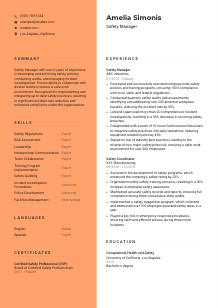
Certifications carry real weight in safety management because they show formal mastery of standards, methods, and professional practice. When a posting asks for a CSP or a comparable credential, this section moves from helpful to essential.
When the employer explicitly asks for a Certified Safety Professional or similar credential, list that certification prominently. It is a direct screening item, so do not bury it under less relevant training courses or memberships.
Focus on certifications that support regulatory knowledge, risk assessment, incident investigation, environmental health, or broader EHS oversight. In this example, the CSP is the clearest match because it aligns closely with management-level safety responsibility.
Add the issuing body and, when relevant, the active date range or renewal status. That detail helps employers confirm your credential is current and maintained, which matters in a field where standards and compliance expectations change over time.
Remove expired or low-value certificates if they distract from your strongest qualifications. Safety hiring managers care more about active, relevant credentials than long lists of outdated training completions.
A well-built certifications section should immediately reinforce your professional standing in safety management. With Wozber's ATS resume scanner, you can make sure credentials like CSP are clearly surfaced where both ATS filters and hiring managers will see them.
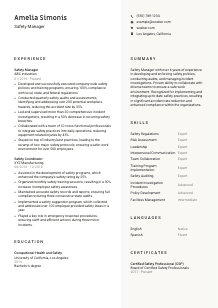
A Safety Manager skills section should read like an operating toolkit, not a generic keyword block. The right mix combines technical safety knowledge, investigation and audit capability, and the leadership skills needed to turn findings into safer daily practice.
Look beyond the title and note the actual capabilities the job requires. Here, the essentials include safety regulations, risk assessment methodologies, incident investigation procedures, training delivery, leadership, and cross-functional communication. Those are the skills to foreground.
Lead with the competencies most central to the job rather than broad workplace traits. Technical areas like safety auditing, policy development, regulatory compliance, hazard analysis, and training program implementation should usually appear before softer skills, though leadership and communication still matter in a management role.
Choose skills you can back up elsewhere in the resume. If you claim expertise in incident investigation or facilities collaboration, your experience bullets should show investigations led, corrective actions implemented, or injury reduction tied to operational changes. The sample resume handles this well by matching listed skills with measured accomplishments.
Your skills list should reinforce the capabilities already visible in your experience, certification, and summary sections. Wozber's free resume builder and ATS tools can help you align those terms with the posting while keeping the section clean and readable.
Language ability can matter more in safety work than candidates often realize. Policies, toolbox talks, emergency instructions, and incident follow-up all depend on clear communication, especially in facilities with multilingual teams.
If the posting requires English proficiency, list English clearly with an honest level. Because safety communication affects training comprehension, reporting accuracy, and emergency response, this is not a minor detail.
Extra languages can be a real advantage when they help with frontline training, hazard reporting, and day-to-day coaching. In Los Angeles, Spanish may strengthen your profile, but treat it as a useful asset unless the employer specifically requires it.
If you can communicate safety procedures, lead meetings, or explain corrective actions in another language, list it. Multilingual ability can be particularly valuable in manufacturing, construction, warehousing, and field operations.
Use clear levels such as native, fluent, intermediate, or basic. Overstating language ability becomes a problem quickly in a role where misunderstanding a procedure or emergency instruction can have serious consequences.
For safety managers, language skill is most useful when it improves training reach, incident reporting, and employee engagement around safe work practices. That is the context employers care about, not the label alone.
List languages when they strengthen your ability to deliver training, support investigations, and communicate clearly across a diverse workforce. In safety management, that can directly affect program adoption and day-to-day risk control.
Your summary should quickly establish the level of safety work you have handled and the results you are known for. In a few lines, it should tell the reader whether you bring management-level ownership of compliance programs, investigations, audits, and workforce safety improvement.
Start by identifying the priority of the role you are targeting. For this posting, the employer needs someone who can lead company-wide safety programs, maintain regulatory compliance, run investigations, and work across teams. Your summary should reflect that level of responsibility.
State your current professional identity and years of relevant experience right away. For example, a line like "Safety Manager with 6+ years of experience" immediately gives the reader a frame for your scope and seniority.
Include the capabilities that define your effectiveness, such as reducing incident rates, leading audits, strengthening training programs, or improving compliance performance. The sample summary works because it combines policy development, audits, investigations, and measurable safety improvement in a compact way.
Aim for 3 to 5 lines with direct language. Avoid broad claims about being passionate or results-driven unless the next phrase proves it with safety-specific substance such as compliance outcomes, employee population served, or operational risk reduction.
A well-written summary gives the reader an immediate sense of your management scope, technical strengths, and operational impact. With Wozber's ATS-friendly resume template and tailoring tools, you can shape those first lines so they align with the posting and make your value clear from the start.
A Safety Manager resume works when it shows control, not volume. Hiring teams want to see that you can build policy, run audits, investigate incidents, guide corrective action, and influence operations in ways that reduce risk and keep the organization compliant.
Before you send it, review every section against the posting and remove anything that does not support that story. Wozber's free resume builder can help you tighten the language, improve ATS alignment, and present your background in an ATS-friendly resume format that makes your safety leadership easy to judge.
When the resume is tailored well, the employer can quickly see that you are ready to lead the safety program from day one.




