



Use Wozber and land your dream job
Create Resume
No registration required
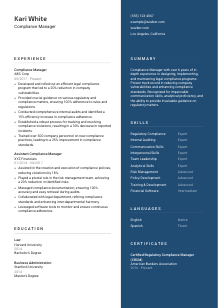
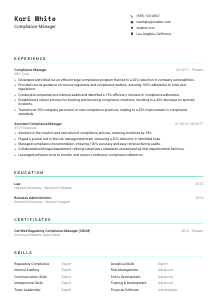
Upholding regulations, but your resume seems out of line? Check out this Compliance Manager resume example, created with the Wozber free resume builder. Learn how to clearly present your governance expertise to match job standards, ensuring your career path stays clear of infractions!
Compliance managers are trusted to catch regulatory exposure before it becomes an audit finding, enforcement issue, or reputational problem. That responsibility should come through on the resume. Hiring teams look for proof that you can build practical policies, investigate issues, guide business partners, and keep the organization aligned with changing rules across daily operations.
A tailored resume helps separate broad legal or risk experience from true compliance ownership. Using Wozber's free resume builder to shape an ATS-compliant resume around the posting's language makes it easier to surface the work that matters first, such as compliance program design, internal audits, training delivery, and regulatory guidance. That clarity is especially useful when employers need to see whether your background matches their control environment and oversight needs.
For compliance roles, the top of the resume should be clean, exact, and easy to verify. This section is straightforward, but it still carries useful signals, especially when the employer has stated location or communication requirements.
Use your full name in a larger, readable font so it anchors the document immediately. Compliance work depends on precision, and even simple presentation choices should feel orderly and controlled.
Place "Compliance Manager" directly below your name if that is the role you are targeting. Matching the job title helps frame your background correctly, especially when your past titles include nearby functions such as legal, audit, or risk management.
Include a current phone number and a professional email address, and check them carefully. In a role built around policy accuracy, documentation, and follow-through, basic contact errors create the wrong impression fast.
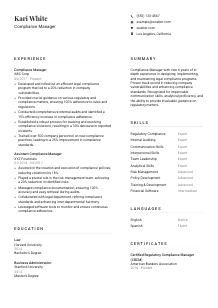
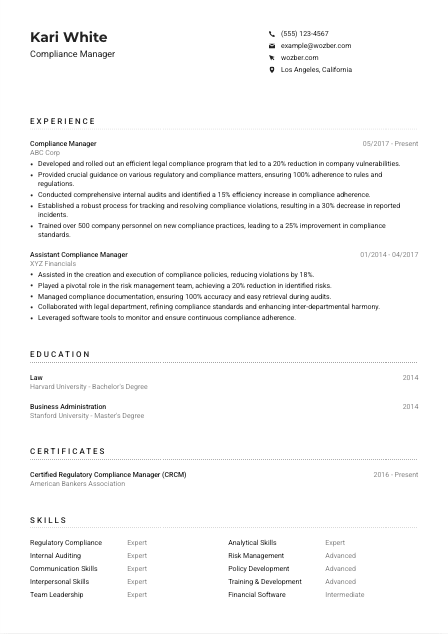
If the posting specifies a location, include your city and state in this section. Here, listing Los Angeles, California directly addresses a stated requirement and removes an early question about availability.
Add LinkedIn or a professional website if it reinforces your compliance background with consistent titles, certifications, and career dates. If you link it, make sure it reflects the same compliance scope shown on the resume, including audits, regulatory work, and training responsibilities.
Your personal details should show that you are reachable, professionally presented, and aligned with any stated practical requirements. For a compliance manager, even the basics should read as accurate and dependable.




This is the section that carries the most weight for a compliance manager. Employers want to see how you handled regulatory obligations in practice, whether through policy development, audits, issue escalation, training, investigations, or ongoing advisory work with business teams.
Pull out the core responsibilities from the job description and use them to shape your bullets. For this kind of role, that usually means compliance program development, regulatory guidance, internal auditing, violation management, and employee training. Your experience section should speak to those operating responsibilities directly, not just list general legal or administrative duties.
List each employer, title, and date range with your most recent role first. This gives hiring teams a quick view of your progression from support or analyst-level work into ownership of compliance frameworks, risk reviews, and policy enforcement.
Focus each bullet on a specific action and result. Good examples in this field include building policies, improving audit performance, reducing incidents, strengthening documentation controls, or raising training completion and adherence rates. The sample resume does this well with points such as developing a legal compliance program that reduced vulnerabilities by 20% and creating a reporting process that lowered incidents by 30%.
Numbers help employers understand scale and effectiveness. In compliance, useful metrics include reduction in violations, audit readiness, policy adoption, training reach, remediation speed, documentation accuracy, or efficiency gains in monitoring. A bullet about training 500 employees or maintaining 100% adherence tells far more than a generic statement about supporting compliance.
Keep the section focused on work that reflects regulatory knowledge, control execution, risk identification, stakeholder guidance, and program management. If a bullet does not help prove your ability to run or strengthen a compliance function, replace it with one that does.
Your experience section should show a record of turning regulations into working policies, audits, investigations, and training that reduce risk. When this section is tailored well, hiring teams can quickly understand both your compliance scope and the business impact of your decisions.
Education matters in compliance because it helps establish your grounding in legal principles, business operations, finance, or risk. It will not outweigh weak experience, but it does help confirm that you have the academic foundation to interpret rules and work across regulated processes.
If the posting asks for a bachelor's degree in Law, Business Administration, Finance, or a related field, make sure that qualification is easy to spot. When your degree aligns closely, as it does with a bachelor's in Law, it immediately checks off a core requirement.
List degree, field of study, school, and graduation year in a consistent structure. Clean formatting helps both recruiters and ATS tools read the section correctly, especially when education is one of the formal screening criteria.
If you hold an advanced degree that supports the role, include it. A master's in Business Administration, for example, can reinforce your ability to work across policy, operational risk, and business process decisions, but it should support the compliance story rather than distract from it.
Most experienced compliance managers do not need course lists. Include specific coursework only if it helps connect your background to a regulated industry, governance, financial controls, ethics, or administrative law.
Honors, research, or projects can be useful if you are earlier in your career or if they relate directly to compliance topics such as corporate governance, regulatory policy, or financial regulation. Leave them out if your professional experience already carries the stronger proof.
Your education section should confirm that your compliance judgment rests on a relevant academic base. Keep it clear, relevant, and easy to scan so it supports the rest of your regulatory and risk management experience.
Certifications carry real weight in compliance because they show current engagement with regulatory standards, ethics frameworks, and professional practice. They can also help distinguish a true compliance candidate from someone coming in more broadly from legal, audit, or operations.
When a job specifically mentions certifications such as CRCM or CCEP, move those to the top of the section. That kind of direct match matters because it shows you already speak the standards and subject matter the employer values.
Choose credentials that reinforce compliance oversight, ethics, investigations, financial regulation, audit, or risk governance. A shorter list of highly relevant certifications is stronger than a long list with weak connection to the role.
Name the certifying body and show dates clearly, especially if the certification is active. In regulated environments, current standing matters because employers may need to know whether your knowledge is up to date.
Compliance standards evolve, and so do employer expectations around training and oversight. Maintaining recognized credentials, renewing them on time, and adding relevant learning in areas like banking regulation or ethics programs shows sustained professional discipline.
This section should tell the employer that your compliance knowledge is recognized beyond job titles alone. Well-chosen certifications support credibility in policy interpretation, regulatory oversight, and ethics program leadership.
A compliance manager's skills section should read like the operating toolkit of someone who can run oversight processes, advise stakeholders, and respond to regulatory risk. That means prioritizing capabilities tied to audits, policy, investigations, reporting, training, and cross-functional communication.
Read the posting closely for direct skills and for work hidden inside the responsibilities. A request for internal audits, policy development, and guidance on regulatory issues points to capabilities such as regulatory compliance, risk assessment, control review, stakeholder communication, and training delivery.
Lead with the skills most central to the function, such as regulatory compliance, internal auditing, risk management, policy development, and investigation handling. In the sample resume, these are supported by strong communication and analytical skills, which makes sense for a role that must interpret rules and explain them clearly to the business.
Avoid turning this section into a keyword dump. Group or prioritize skills so the employer can quickly see the mix of technical compliance knowledge, program management ability, and communication strength needed to train staff, advise leaders, and monitor adherence.
Your skills should reflect how you actually run compliance work, not just the terms you have seen in job ads. When chosen well, they support the experience section and reinforce your ability to manage risk, controls, and regulatory communication.
Language matters in compliance because policies, training, investigations, and advisory work all depend on exact communication. Even when a role is not international, employers may still call out English proficiency because misunderstanding regulations or reporting language creates real risk.
If the posting states that English communication is critical, list English clearly with an honest proficiency level. For compliance managers, this is not a minor detail. Written clarity affects policy drafting, audit responses, training materials, and issue documentation.
Place English at the top of the section so it is immediately visible. Marking it as Native or Fluent, when accurate, aligns with the role's need for strong written and verbal communication across departments.
Additional languages can be useful when you support diverse teams, customer-facing operations, or multi-region business functions. Spanish, for example, may strengthen communication reach in some organizations, even when it is not a formal requirement.
Do not overstate your level. If you may need to lead training, explain policies, or document investigations in a language, your listed proficiency should reflect what you can actually do in a professional setting.
If the company works across multiple jurisdictions, business units, or employee groups, language skills can support training rollout and policy understanding. Mention them when they genuinely help you perform the compliance function more effectively.
This section should confirm that you can communicate regulations, expectations, and findings with precision. In compliance work, strong language ability supports accuracy just as much as it supports collaboration.
The summary should quickly establish the level of compliance work you own and the results you deliver. In a few lines, it should connect your years of experience to the kinds of oversight employers need, whether that is program design, audit execution, regulatory interpretation, or enterprise training.
Use the posting to decide what belongs in your opening lines. For a compliance manager, that usually means experience leading compliance programs, advising on regulations, managing audits, and reducing organizational exposure.
A direct opening such as "Compliance Manager with 6+ years of experience" gives immediate context. It works well because it places you at the right seniority level before moving into your regulatory and operational strengths.
Add measurable achievements that support your credibility, such as lowering vulnerabilities, improving adherence rates, reducing incidents, or delivering large-scale training. The sample summary works because it pairs years of experience with specific business outcomes rather than generic claims.
Aim for a compact paragraph that highlights your compliance focus without repeating the full experience section. Save detailed examples for the bullets below and use the summary to establish your regulatory scope, judgment, and value quickly.
A well-written summary gives the employer an immediate read on your compliance background, your level of ownership, and the outcomes tied to your work. It should make the rest of the resume easier to read through the lens of regulatory leadership.
A compliance manager resume should show that you can translate regulations into policies, controls, audits, investigations, and training that hold up under scrutiny. Before sending it out, check that your experience, certifications, and summary all point to the same message: you know how to reduce risk and keep operations aligned with regulatory expectations.
Wozber's AI resume builder can help tighten that alignment by matching your wording to the job description, improving ATS optimization, and highlighting missing requirements before you apply. Use it to sharpen the final draft into an ATS-friendly resume format that makes your compliance leadership easy to recognize.
When the resume is doing its job, employers can quickly see your ability to run a credible compliance program from policy through enforcement.