



Use Wozber and land your dream job
Create Resume
No registration required
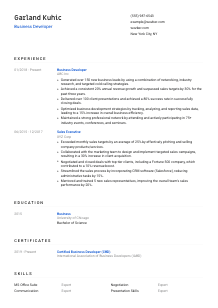
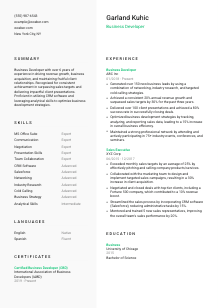
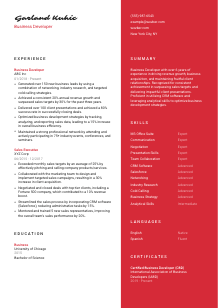
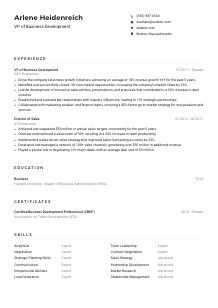
Navigating markets, but your resume isn't gaining traction? Explore this Business Developer resume example, created with Wozber free resume builder. It shows how to present your strategic vision and growth tactics in line with job requirements, positioning your career at the forefront of opportunity!
Business development work is judged in pipeline, meetings, proposals, and closed revenue. A resume for this field needs to show how you open doors, move prospects through the sales process, and turn market research, outreach, and relationship-building into measurable growth.
When that story is tailored well, hiring teams can quickly connect your background to lead generation, client-facing selling, and cross-functional delivery instead of sorting through broad sales claims. Wozber's free resume builder helps you shape that experience into an ATS-compliant resume that uses the right business development language, so your application makes your growth track record easier to recognize.
Business development hiring moves fast, and your header should immediately confirm who you are, what role you target, and whether you are reachable for client-facing work and interviews.
Place your full name at the top in a clean, easy-to-read format. Keep the styling professional rather than decorative. In a role built on credibility and first impressions, a clear header sets the right tone from the first line.
Add "Business Developer" directly beneath your name if that is the role you are pursuing. Matching the title used in the posting helps position you correctly, especially when employers are sorting candidates across business development, account management, sales, and partnership roles.
List a phone number you answer reliably and a professional email address. Since this work often involves quick outreach, follow-ups, and scheduled calls, even a small typo can cost you an interview.
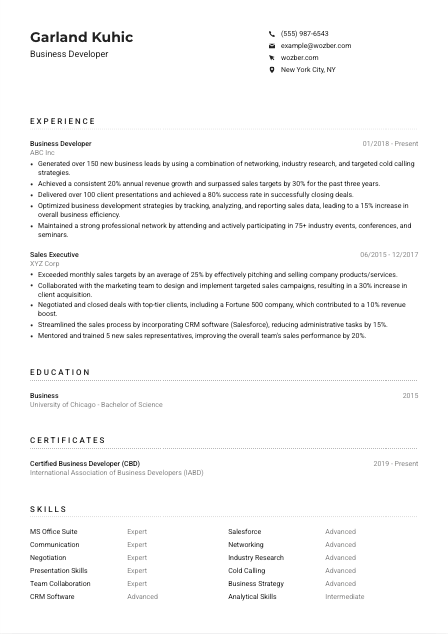
If the employer specifies a city or expects local availability, reflect that in this section. For the example opening, listing "New York City, NY" directly answers a stated requirement and removes uncertainty about relocation or commute logistics.
Add a LinkedIn profile or personal website only if it supports your candidacy with consistent titles, sales achievements, industry presence, or client-facing credibility. If you include it, make sure the content aligns with your resume and current business development focus.
This section does not need personality flourishes. It needs accuracy, professionalism, and any practical detail that keeps you in the running for a revenue-facing role.




For Business Developer roles, the experience section carries most of the decision weight. Employers want to see how you sourced opportunities, handled outreach, collaborated on delivery, and produced revenue, not just that you held a sales-related title.
Read the job description for the work that actually drives hiring decisions. Here, that includes generating new business, hitting growth targets, preparing proposals, responding to RFPs and RFIs, using CRM tools, and reporting on sales activity. Those are the themes your bullets should reflect.
List your most recent position first, then work backward with job title, company, and dates. That structure makes it easy to follow your growth from earlier sales roles into broader business development responsibility, such as moving from account selling into lead generation, presentations, and strategy work.
Each bullet should pair a business development activity with a result. Good examples include building lead pipelines through networking and cold outreach, delivering proposals that converted into deals, or partnering with internal teams to meet client expectations. The sample resume does this well by tying activities like targeted cold calling and client presentations to lead volume and close-rate success.
Revenue growth, quota attainment, new lead volume, meeting-to-close rate, proposal win rate, client acquisition, and process efficiency are all useful measures here. Numbers such as "20% annual revenue growth" or "surpassed sales targets by 30%" give hiring teams a much better read on your commercial performance than broad claims about being results-driven.
Keep bullets that strengthen your case for business development work and trim details that belong to unrelated functions. If an achievement shows negotiation, prospecting, CRM adoption, cross-team execution, or market-facing growth, keep it. If it does not help explain how you win and grow business, it can usually go.
Your experience section should show a clear pattern of sourcing opportunities, advancing deals, and contributing to growth. If a hiring manager can quickly see pipeline activity, client-facing execution, and measurable business results, this section is doing its job.
Education will rarely outweigh sales results in business development hiring, but it still matters when the employer asks for a specific academic background. Use this section to confirm that you meet the baseline and to reinforce relevant business knowledge.
When a posting asks for a bachelor's degree in Business, Marketing, or a related field, make that easy to find. If your degree aligns, state it clearly. In the example, a Bachelor of Science in Business directly supports the employer's requirement.
Include degree, field of study, school name, and graduation year or date. Keep the layout straightforward so the reader can confirm your academic background quickly without searching for the basics.
A degree in business, marketing, communications, economics, or a related area can reinforce your grounding in market analysis, buyer behavior, and commercial strategy. If your degree is less directly related, let your experience carry more of the weight and keep the education entry concise.
Relevant coursework, honors, case competitions, or student leadership can help early-career candidates, especially when they connect to sales, market research, presentations, or negotiation. For experienced candidates, these details are optional unless they add clear value.
If you completed business-focused extracurricular programs, leadership activities, or training tied to selling, entrepreneurship, or market development, they can support this section or sit naturally alongside certifications. Use them only when they reinforce your commercial direction.
For a Business Developer, education should confirm foundation and relevance without overshadowing performance. Once the degree requirement is clear, let your revenue and pipeline results take the lead.
Certifications are not mandatory in every business development search, but the right one can strengthen your profile by showing structured training in selling, client development, or commercial strategy.
Start with the job description. If no certification is required, list only those that genuinely support your work in business development. In this example, the Certified Business Developer credential adds useful role relevance even though it is not a formal requirement.
Choose certifications tied to prospecting, negotiation, account growth, CRM use, sales methodology, or market strategy. A short list of directly relevant credentials works better than a longer list of general online courses.
If a credential is active, renewed, or time-bound, include the date range. That signals current knowledge and shows that your training is not outdated, which matters when tools, buyer behavior, and go-to-market practices keep changing.
Business development rewards people who keep sharpening how they sell, present, and analyze markets. If you regularly update your training, that can help your resume, especially when you are targeting roles that expect consultative selling, enterprise outreach, or more strategic business growth responsibilities.
A certification should reinforce your ability to generate and grow business. If it adds practical credibility to your sales process, client work, or market knowledge, it belongs here.
Business development resumes need a skills section that reflects how the work is actually done. That means a mix of commercial tools, outreach methods, presentation ability, and the interpersonal strengths required to move opportunities forward.
Look beyond the label "strong communication" and identify the operating skills behind the role. This posting points to negotiation, interpersonal communication, CRM proficiency, cold calling, industry research, reporting, and collaboration. Those are the kinds of terms that belong in your skills list when they reflect your real background.
Include both technical and interpersonal capabilities. For this profession, that often means CRM platforms such as Salesforce, proposal writing, pipeline tracking, presentation delivery, networking, and sales analysis alongside negotiation and relationship management. The example resume balances those areas well instead of listing only soft skills.
Order your skills so the employer quickly sees the capabilities that match the posting. If the role emphasizes new business generation and CRM use, those should appear ahead of generic strengths. Keep the section focused enough that every listed skill supports the kind of business development work you want to do.
This section should read like the toolkit of someone who can prospect, present, negotiate, and manage pipeline activity. Prioritize the skills that connect directly to revenue generation and client development.
Language ability matters more in business development than in many back-office roles because calls, meetings, presentations, and written proposals all depend on clear communication. List languages in a way that reflects actual business fluency, not vague familiarity.
If the posting asks for clear English communication, list English first and state your level plainly. That gives the employer immediate confidence in your ability to handle calls, presentations, proposal writing, and day-to-day client communication.
Use direct labels such as Native, Fluent, Advanced, Intermediate, or Basic. For example, "English: Native" is clear and credible. Avoid exaggerated claims if you would not be comfortable using that language in a meeting or negotiation.
Additional languages can strengthen your profile, especially for roles involving diverse client bases, regional expansion, or international accounts. In the sample resume, Spanish adds practical value because it suggests broader relationship-building capacity.
Choose one rating style and use it throughout the section. Consistency makes your language abilities easier to interpret and avoids confusion about how one language level compares with another.
Not every business development role needs multiple languages, but when they align with territory coverage, customer segments, or partnership work, they can become a meaningful differentiator. Include them when they support the type of opportunities you are expected to pursue.
For a Business Developer, language skills should help explain how well you can handle outreach, relationship-building, and client communication. Lead with the language the job requires, then add others that expand your commercial reach.
Your summary should quickly explain the scale of your business development background and the kind of growth results you deliver. Think of it as a compact commercial profile, not a generic introduction.
Pull the main themes from the posting before you write. For this one, that includes new business generation, revenue growth, client presentations, CRM use, and sales analysis. Those themes should shape the language of your opening lines.
Open with your current professional identity and years of experience, such as "Business Developer with 6+ years of experience." That immediately places you in the right lane and helps the reader gauge your level.
Follow with specifics tied to commercial performance, such as exceeding sales targets, growing revenue, closing new business, or improving business development strategy through reporting and analysis. The example summary works because it combines growth, acquisition, client relationships, and CRM-backed strategy in a few lines.
Aim for three to five lines. Focus on the parts of your background that best match the role you are applying for, and avoid broad personality statements. A business development summary should sound focused, numbers-aware, and close to the market.
A strong summary gives the reader a quick read on your market experience, selling strengths, and growth record. By the time they reach your experience section, they should already understand the kind of business results you are likely to deliver.
A Business Developer resume should make three things easy to see: how you generate opportunities, how you move prospects toward signed business, and what results follow. When your sections are aligned around pipeline activity, client-facing execution, CRM fluency, and revenue outcomes, the document starts to read like a commercial track record rather than a job history.
Use Wozber to turn that track record into a sharper, ATS-friendly resume with stronger keyword alignment, cleaner structure, and faster tailoring for each opening. With the right details in place, hiring teams can quickly understand your value in growth, outreach, and deal conversion.




