



Use Wozber and land your dream job
Create Resume
No registration required
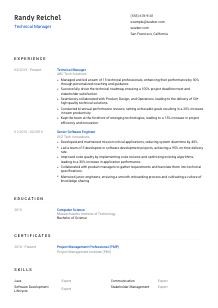
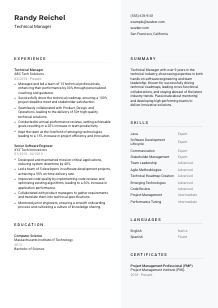
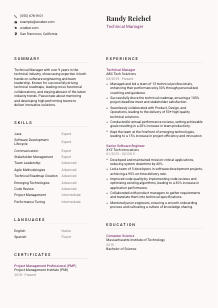
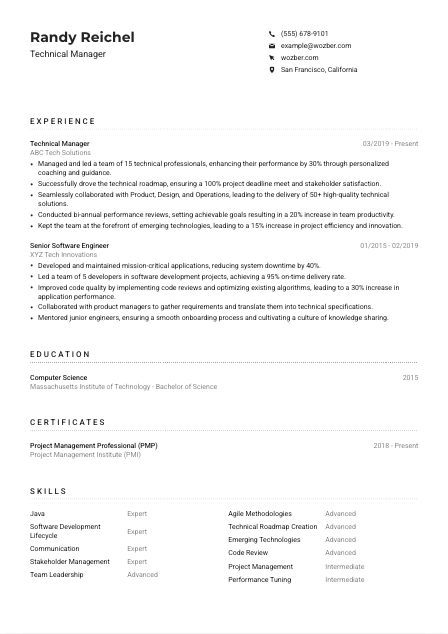
Juggling tech teams, but your resume seems to lag? Check out this Technical Manager resume example, created with Wozber free resume builder. It shows how to bring together your technical know-how and leadership skills, and move your career in step with job expectations!
Technical Manager hiring usually turns on one question fast: can you lead engineers while keeping delivery on track when priorities shift, deadlines tighten, and stakeholders want answers. Your resume needs to show that balance clearly. Hiring teams look for proof that you can guide technical work, coach people, and keep a roadmap moving without losing quality or team momentum.
A tailored resume changes how quickly that picture comes into focus. When your leadership scope, technical depth, and cross-functional delivery are phrased in the same language as the job description, an ATS-compliant resume is far more likely to surface the right experience early. Wozber's free resume builder helps organize that alignment so your management background, technical judgment, and team impact read clearly for a Technical Manager opening.
For a Technical Manager, the top of the resume should establish professional credibility without wasting space. Keep this section clean, accurate, and aligned with any practical requirement the employer has stated.
Use your full name in the most visible text on the page so the document is easy to identify in a stack of applications or an ATS record. Skip nicknames unless they are part of your professional identity.
Place "Technical Manager" below your name when that is the role you are pursuing. It immediately frames your background around team leadership, roadmap ownership, and technical decision-making instead of leaving the reader to infer your direction.
List a current phone number and a professional email address. Technical leadership roles often involve multiple interview rounds with engineering leaders, product partners, and executives, so any friction here is unnecessary and avoidable.
If the role has a location or work-authorization requirement, reflect that clearly in your personal details. In this example, listing San Francisco, California directly supports the employer's stated need for candidates based there and eligible to work there.
A LinkedIn profile or personal site can reinforce your resume when it includes leadership scope, major systems, delivery outcomes, or technical projects. Keep titles, dates, and responsibilities consistent so recruiters do not see conflicting information.
This section should confirm the basics quickly and support the role you want. For Technical Manager applications, that means clear identity, clean contact information, and any location detail the employer has specifically asked to see.




This is the section that usually decides whether a Technical Manager resume moves forward. Hiring teams want to see progression from hands-on technical work into team leadership, along with measurable delivery, coaching, and cross-functional execution.
Read the posting for the responsibilities that repeat or carry the most weight. For Technical Manager roles, that often includes managing engineers, driving a roadmap, partnering with Product and Design, running performance reviews, and improving delivery quality. Those themes should shape which accomplishments you highlight first.
List roles in reverse chronological order and make the leadership path obvious. A move from senior individual contributor work into people management, planning, and delivery oversight tells a stronger story than a flat list of technical tasks. In the example resume, the shift from Senior Software Engineer to Technical Manager helps explain both technical credibility and management readiness.
Use numbers that reflect how technical managers are evaluated: team size, delivery rate, productivity gains, uptime improvements, project volume, or efficiency improvements. "Managed a team of 15" or "delivered 50+ solutions" gives the reader real operating scope. The sample bullets work because they tie coaching, roadmap execution, and team output to measurable results.
Prioritize bullets that mirror the actual demands of the job. If the employer emphasizes roadmap ownership and stakeholder expectations, your experience should show planning, prioritization, execution, and communication across functions. If performance management matters, include reviews, goal setting, mentoring, or hiring. This is where a Technical Manager resume earns its credibility.
Earlier technical roles still matter, but the bullet selection should support your current level. Keep foundational engineering accomplishments that show code quality, system performance, mentoring, or delivery discipline, and remove lower-value detail that does not help explain your leadership range or technical judgment.
A Technical Manager resume should show more than activity. It should show the size of the team, the kind of technical work delivered, the collaboration involved, and the business or engineering results that followed.
Education matters here because many Technical Manager roles still ask for a formal technical background, especially when the manager is expected to lead engineers credibly and understand architecture, delivery tradeoffs, and development practices.
When a posting specifies a bachelor's degree in Computer Science, Engineering, or a related field, make that easy to find. If your degree matches directly, as it does in the example with a Bachelor of Science in Computer Science, that requirement is effectively checked within seconds.
Include degree, field of study, school, and graduation year in a straightforward format. Technical leadership resumes rarely need extra academic description unless a project, specialization, or advanced degree is directly relevant to the role.
If your education aligns neatly with the technical requirements, do not bury it. A clear computer science or engineering credential supports your ability to lead software teams, evaluate technical decisions, and communicate with senior engineers on substance.
Projects, research, societies, or technical extracurriculars can help if you are earlier in your leadership career or if they connect closely to the position's domain. For a more experienced Technical Manager, this section usually stays brief while experience carries the heavier load.
The more established you are, the less this section needs decoration. Honors and distinctions are fine, but after 8+ years in technical work, hiring teams care more about shipped systems, team development, and delivery outcomes than classroom accolades.
For Technical Manager roles, education should quietly reinforce that you have the technical grounding to lead engineers well. Keep it clear, credible, and proportionate to your experience level.
Certifications carry weight when they strengthen how your management approach is read. They are especially useful in Technical Manager resumes when the role touches project governance, service delivery, Agile planning, or structured operational improvement.
If the posting calls out credentials such as PMP, ITIL, or Agile or Scrum certifications, move any matching ones near the top of this section. That direct alignment matters because it supports how you manage delivery, process, and stakeholder expectations. The example resume does this well with PMP and Certified ScrumMaster.
A short list of respected, role-related certifications is stronger than a long list of loosely connected courses. Choose credentials that reinforce project leadership, Agile execution, service management, technical operations, or team management depending on the position.
Show when the certification was earned and whether it remains current. That context helps the reader understand whether the credential reflects recent practice and continued professional investment.
Technical management changes quickly as delivery methods, tooling, and team structures evolve. Updating this section with meaningful certifications can strengthen your profile when you are moving into larger team leadership, broader operational ownership, or more formal program oversight.
The best certifications on a Technical Manager resume do not sit there as decoration. They support your credibility in planning, execution, process discipline, and continuous improvement.
Technical Manager skill sections should show more than a pile of tools. The right list combines technical fluency with the management capabilities needed to lead delivery, guide engineers, and work across product-facing teams.
Start with the language in the job description, then add adjacent capabilities that naturally support the work. For this kind of role, that usually means a mix of technical stack knowledge, software delivery practices, roadmap planning, mentoring, stakeholder management, and communication.
Order matters. Lead with skills that match the role's central responsibilities, not every tool you have touched. In the example, software development lifecycle, stakeholder management, team leadership, Agile methodologies, and technical roadmap creation all support the management focus, while Java helps preserve technical credibility.
Every skill should be something you can back up with a project, team outcome, or interview example. Grouping technical, delivery, and leadership skills in a logical order helps both recruiters and hiring managers understand the range you bring without reading it as a keyword dump.
A Technical Manager should come across as someone who can talk architecture with engineers and priorities with stakeholders. Your skills section should make both sides of that picture visible.
Language ability matters more in technical management than many candidates realize. Team coaching, performance reviews, stakeholder updates, and cross-functional planning all depend on clear communication, especially when decisions need to be explained to both technical and non-technical audiences.
If the posting explicitly requires strong English communication, list English prominently and state your proficiency clearly. For a Technical Manager, this supports core responsibilities such as feedback conversations, roadmap discussions, written updates, and stakeholder management.
Extra languages can strengthen your profile when the team, customer base, or partner groups are multilingual. In the example, fluent Spanish adds useful breadth, especially in diverse technical environments or organizations with distributed collaboration.
Use straightforward labels such as Native, Fluent, Advanced, or Intermediate. Clear levels help set realistic expectations for meetings, documentation, and day-to-day team communication.
Some Technical Manager positions involve global teams, vendor relationships, or cross-region coordination. In those cases, language skills can support smoother project execution and better collaboration across time zones and functions.
Only include languages you would be comfortable using in a professional setting. Accurate language claims matter because technical managers are often expected to present updates, resolve issues, and build trust through direct communication.
For Technical Manager applications, language skills should support the broader story of clear leadership communication. List them plainly and let them strengthen your management profile where they genuinely add value.
The summary should quickly explain why your background fits the level and scope of the role. For a Technical Manager, that usually means combining hands-on technical history with people leadership, roadmap ownership, and measurable delivery results in a few focused lines.
Review the posting and identify the two or three themes the employer cares about most. Here, those themes include technical leadership experience, people management, cross-functional collaboration, and the ability to keep teams current with evolving technology. Your summary should reflect that mix instead of reading like a generic management statement.
Start with your current identity and years of relevant experience. A line such as "Technical Manager with 9+ years in software engineering and technical leadership" immediately places you at the right career stage and establishes both depth and progression.
Use the next sentence to highlight the capabilities that matter most for the role, such as driving technical roadmaps, leading cross-functional delivery, improving team performance, or mentoring engineers. The example summary works because it balances hands-on technical roots with leadership and team development.
Aim for a short paragraph that could survive first-pass screening and still hold up with an engineering leader. Avoid vague claims about passion or innovation unless they are tied to something concrete, such as delivery quality, adoption of new technologies, or stronger team performance.
When this section is doing its job, the reader understands within a few lines that you can lead technical teams, work across functions, and deliver against a roadmap. That is the frame the rest of your resume should then prove.
Your resume should now present a clear management story built on real technical depth. Before you apply, check that the document shows team size, delivery results, cross-functional collaboration, and the technical context behind your decisions, not just broad leadership language.
Use Wozber's AI resume builder to tighten wording, align your experience with the posting's terminology, and improve ATS optimization without losing specificity. An ATS-friendly resume format helps surface the right leadership, roadmap, and engineering signals early, so the hiring team can quickly judge whether you are ready to lead at the level the role requires.




