



Use Wozber and land your dream job
Create Resume
No registration required
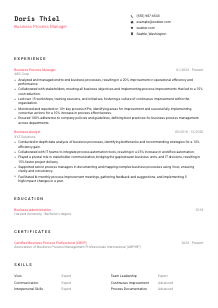
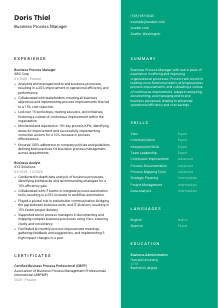
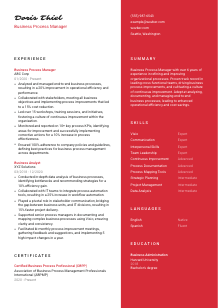
Streamlining operations, but your resume feels convoluted? Check out this Business Process Manager resume example created with Wozber free resume builder. It shows how to highlight your process prowess to match job requirements, making your career trajectory as efficient as the workflows you optimize!
Business Process Manager hiring usually comes down to one practical question: can you take a messy workflow, map it clearly, and move it toward better speed, cost, compliance, or service quality without losing stakeholder trust along the way. Resumes for this role need to make that operational impact visible, especially through process analysis, cross-functional leadership, KPI ownership, and the kind of improvements you have actually implemented.
A tailored resume changes how quickly that story comes through. When your experience uses the same language as the target role, from end-to-end process management to process documentation and workshop facilitation, Wozber's free resume builder helps you shape an ATS-compliant resume that surfaces the right terms and structure early. That makes it easier for a hiring team to see whether you can step into process improvement work and lead it with confidence.
Business Process Managers are expected to bring order, clarity, and consistency. Your contact section should reflect the same standard. Keep it clean, accurate, and aligned with any practical filters the employer has stated.
Use your full name as the most visible element in the header, with straightforward formatting that matches the rest of the resume. For a role centered on process clarity and documentation discipline, an overdesigned header sends the wrong signal. Keep it simple, readable, and professional.
Place "Business Process Manager" beneath your name if that is the role you are pursuing. This immediately positions your background around process ownership, operational improvement, and stakeholder coordination. If your recent title was slightly different, such as Business Analyst or Process Improvement Lead, this headline can still help connect your experience to the target opening.
List a reliable phone number and a professional email address, then verify both carefully. In a role where documentation errors can create reporting gaps or workflow confusion, small mistakes in your own header can undercut the precision your resume is trying to convey.
Some Business Process Manager roles are tied closely to on-site collaboration, workshops, or regional operations teams. In the example posting, Seattle, Washington is a stated requirement, so listing Seattle, Washington in the personal details removes an avoidable question early. Treat location as a tailoring move when the employer makes it relevant, not as a rule for every application.
If your LinkedIn profile or personal site expands on your process work, include it. This can be especially useful when it reinforces business transformation projects, systems work, continuous improvement initiatives, or cross-functional programs that do not fully fit on one page. Make sure the content is current and consistent with the resume.
This section should read like well-kept business documentation: accurate, easy to scan, and tailored to practical requirements that matter for the role.




This is where a Business Process Manager resume either becomes credible or stays generic. Hiring teams look for proof that you have improved real workflows, worked across functions, and tracked the results through cost, efficiency, throughput, compliance, or other operational KPIs.
Before writing bullets, identify the operating priorities in the posting. For this role, the pattern is clear: end-to-end process analysis, stakeholder collaboration, workshop leadership, KPI monitoring, and policy adherence. Those themes should shape which achievements you choose and how you describe them, so your experience reads like a direct response to the work ahead.
List jobs in reverse chronological order and make each entry easy to follow with title, company, and dates. For process-focused careers, progression matters. A move from business analysis into full process ownership tells a stronger story when the structure is clean and the growth in responsibility is obvious.
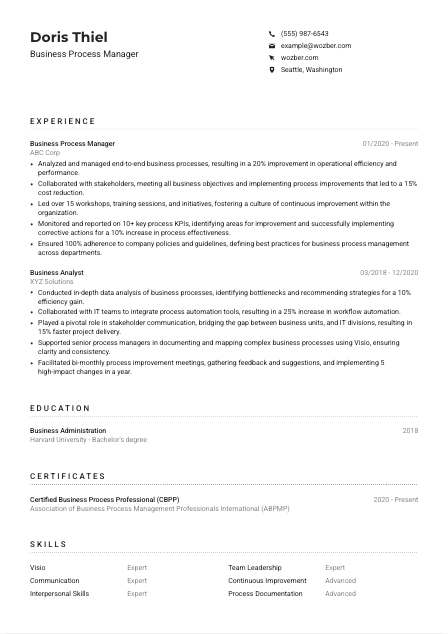
Each bullet should show what process you touched, what action you led, and what changed because of it. The sample resume does this well with lines such as improving operational efficiency by 20% and reducing costs by 15% through process improvements. That is far stronger than saying you were "responsible for process analysis" because it ties your work to business performance.
Quantify your impact with measures that make sense for the function: cycle time reduction, cost savings, efficiency gains, automation rates, training volume, process adherence, error reduction, or KPI improvement. The example's use of workshop counts, KPI ownership, and measurable efficiency gains works because those are native ways this work is evaluated.
Prioritize bullets that show process mapping, root-cause analysis, workflow redesign, stakeholder facilitation, and implementation follow-through. If you have broader project or analyst experience, keep the details that connect to business process management and trim the rest. The goal is a record of operational improvement, not a general summary of everything you have done.
Your experience should make it easy to trace how you analyze processes, align teams, and deliver measurable improvement in real operating environments.
Education matters here less as a prestige signal and more as a baseline for business, operations, and analytical thinking. Present it clearly, and let it support the more important proof in your experience section.
If the role asks for a bachelor's degree in Business Administration, Operations Management, or a related field, make that connection obvious. In the example, a Bachelor's degree in Business Administration lines up directly with the posting. When your field is adjacent, use the full degree title so the relevance is easy to understand.
List degree, field of study, school, and graduation year or date in a straightforward order. This role often sits between operations, analysis, and leadership, so there is no advantage in making the education section overly styled or hard to parse. Clear formatting also supports ATS readability.
If your degree supports work in operations, business systems, supply chain, management, or analytics, that is usually enough. You do not need to oversell it. A Business Process Manager is hired mainly on improvement work delivered in practice, but the right academic foundation still helps confirm your grounding in business operations.
Include coursework, honors, or major projects only if they strengthen your case. This is most useful for early-career applicants or career changers, especially when subjects like operations management, business analysis, statistics, process design, or information systems connect directly to the target role.
If you have completed workshops, executive programs, or formal training in Lean, Six Sigma, BPM, change management, or process automation, those can strengthen this section or support your certifications. For experienced candidates, these details help show that your process knowledge has kept evolving with the work.
Keep this section concise, relevant, and easy to verify. It should confirm the academic base behind your operational and process improvement experience.
Certifications can strengthen a Business Process Manager resume when they reinforce process improvement discipline, operational methodology, or formal BPM knowledge. They are especially useful when they add structure to experience that already shows measurable results.
Start with the posting. Some employers require specific certifications, while others simply value evidence of process improvement training or BPM expertise. The example job description does not require one, which means certificates can be used as a differentiator rather than a box to tick.
List certifications that support the work you want to do, such as CBPP, Lean, Six Sigma, Agile process improvement, or business analysis credentials where relevant. The sample resume includes Certified Business Process Professional, which fits naturally because it reinforces formal expertise in business process management rather than adding a loosely related badge.
Add the year earned and, when applicable, validity period. For methodology-based roles, timing matters because it shows whether your training reflects current practice and whether you have maintained the credential over time.
Process management now often overlaps with automation, systems implementation, governance, and change enablement. Continuing education in these areas can help you stay credible, especially if your target roles involve digital transformation or enterprise-wide process redesign.
Use certifications to reinforce your process improvement credibility, not to replace experience. The best ones add weight to the operational results already shown elsewhere on the resume.
The skills section should look like the working toolkit of someone who can document, analyze, improve, and govern business processes. That means balancing technical process skills, analytical strengths, and the leadership skills needed to move change through real teams.
Start with the terms the employer actually uses, then add closely related capabilities you genuinely have. In this example, process documentation, process mapping tools, cross-functional leadership, KPI reporting, communication, and continuous improvement are all central. Those are better anchors than broad labels with no operational context.
Business Process Managers need more than one type of skill. Pair tool and workflow capabilities such as Visio, Lucidchart, process mapping, data analysis, and process documentation with leadership-facing strengths like facilitation, stakeholder communication, training delivery, and team leadership. That combination reflects how the job is actually done.
Do not turn this section into an inventory of every platform or soft skill you have ever used. Keep the list focused on the capabilities most tied to process improvement, governance, operational efficiency, and change execution. A shorter list with clear alignment is more effective than a long list with weak connection to the role.
Your skills should quickly confirm that you can map processes, work across departments, and drive improvement using both structured methods and strong facilitation.
Language skills matter most when they affect communication with stakeholders, workshop delivery, documentation quality, or collaboration across regions. For Business Process Manager roles, that usually means making the required working language easy to find first.
If the posting specifies language fluency, mirror that clearly. Here, strong English fluency is essential, so English should appear first with an honest level such as native or fluent. For a role involving stakeholder interviews, workshop facilitation, and policy communication, this is more than a formality.
After the required language, list any others that could support collaboration with distributed teams, vendors, or international operations. This ordering helps the most important information surface quickly while still showing broader communication range.
Extra languages can be useful in organizations with multinational processes, shared services teams, or regional stakeholders. They are not essential for every Business Process Manager role, but they can strengthen your profile when communication across functions or geographies is part of the work.
Choose labels that set accurate expectations, such as native, fluent, professional working proficiency, or conversational. In process roles, clarity matters. If you would not comfortably run a training session or gather requirements in that language, do not overstate it.
Include languages that add genuine value, but do not let this section overshadow process, analytics, or leadership qualifications. For most applicants, it is a supporting detail rather than a deciding factor unless the employer has stated a language requirement directly.
Make the required language visible, keep proficiency honest, and use additional languages to support the story of effective stakeholder communication.
A Business Process Manager summary should read like an executive snapshot of how you improve operations. It needs to connect your years of experience with the kinds of process outcomes, leadership scope, and improvement methods that matter for the target role.
Start by identifying the few themes the employer cares about most. For this position, that includes process improvement, cross-functional collaboration, KPI monitoring, and operational efficiency. Those themes should shape the summary so it sounds targeted rather than generic.
Lead with a concise professional identity statement, such as your title and years of relevant experience. The example summary opens with "Business Process Manager with over 6 years of experience," which works because it immediately establishes seniority in the right lane.
Use the next sentences to name the work you do well, such as leading cross-functional teams, managing end-to-end processes, improving efficiency, or driving cost savings. This is the place to mention results in a compact way, especially if they reflect the same outcomes emphasized in the posting.
Aim for a short paragraph that can be read in seconds. Three to five lines is usually enough. Every phrase should earn its place by tying your background to process excellence, stakeholder leadership, or measurable improvement, without slipping into broad claims that could belong to any manager.
By the time someone finishes these opening lines, they should already understand your process improvement focus, your level of responsibility, and the kind of operational results you tend to deliver.
A Business Process Manager resume works best when it reads like the work itself: structured, measurable, and built around operational improvement. If each section shows how you map processes, work with stakeholders, track KPIs, and implement change, you give hiring teams a much clearer picture of your value.
Use Wozber's free resume builder to organize that story in an ATS-friendly resume format, then refine the language with its ATS resume scanner and tailoring tools so your wording matches the role naturally. The final result should make one thing easy to judge: whether you can step into complex business processes and improve how the organization runs.




