



Use Wozber and land your dream job
Create Resume
No registration required
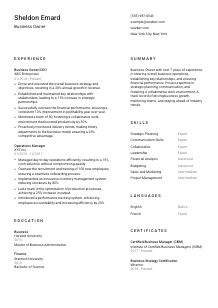
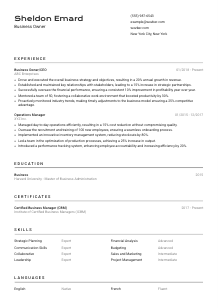
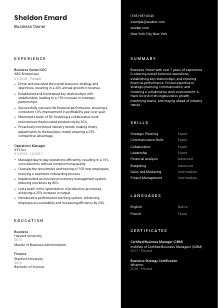
Master of your business domain? Step into this Business Owner resume example, created with Wozber free resume builder. Learn how to clearly narrate your entrepreneurial triumphs to match job expectations, and get ready to position your venture spirit for new growth opportunities!
Business owners are expected to make judgment calls that affect revenue, margin, team performance, and the direction of the company. A resume for this kind of role has to show more than ambition. It needs to make your operating range visible through business growth, financial control, strategic decisions, and the way you lead people through change.
A tailored resume helps separate hands-on operators from candidates who speak only in broad leadership terms. When your wording matches the job's priorities, an ATS can more accurately connect your background to business strategy, budgeting, stakeholder management, and profitability. Wozber's free resume builder helps structure that alignment cleanly, so hiring teams can quickly see whether you've actually built, run, or expanded a business at the level the role requires.
For a Business Owner, the personal details section should read like the top line of a professional profile. Keep it clean, credible, and easy to scan. This is where you confirm practical requirements early, especially when the employer has stated location and communication expectations.
Use your full name in a slightly larger font so it anchors the page immediately. Business Owner resumes often compete with candidates who have founder, general manager, or CEO backgrounds, so your name and title should make the document feel direct and senior from the first line. Wozber's ATS-friendly resume templates help keep that presentation polished without adding visual clutter.
Place "Business Owner" directly under your name when that is the role you are pursuing. If your recent title was "Business Owner/CEO" or "Founder," you can still target the exact job title in this header while keeping the fuller title in your experience section. That small adjustment helps the resume align with the posting and keeps your positioning clear.
Decision-makers should not have to hunt for how to reach you. Use current, business-ready contact information and avoid anything casual or outdated.
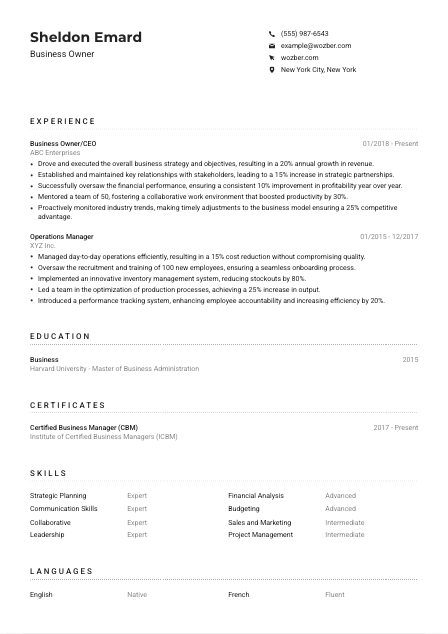
If the job asks for a specific location, include your city and state exactly. Here, listing New York City, New York helps remove doubt about availability and local presence. If you are relocating, say so clearly rather than leaving the employer to guess.
Include LinkedIn, a company site, or a professional portfolio only if it adds substance. For business ownership roles, this can reinforce your market presence through company growth, brand positioning, press mentions, or a clear overview of your leadership history. Check that dates, titles, and business claims match your resume exactly.
This section should confirm that you are easy to contact, properly positioned for the role, and already aligned with practical requirements such as location. Keep it precise and executive in tone.




Experience carries the most weight on a Business Owner resume because it shows whether you can translate strategy into operating results. Hiring teams look for proof of growth, profitability, team leadership, and commercial judgment, not just broad claims about entrepreneurship.
Read the job description for the operating themes behind the title. In this case, the employer wants someone who can drive business strategy, manage financial performance, build stakeholder relationships, lead a team, and adapt to market conditions. Those themes should shape your bullets, your verbs, and the outcomes you emphasize.
Start with your most recent position and include title, company, and dates clearly. For candidates with founder or owner backgrounds, this structure helps the reader follow scale and progression without confusion. Wozber can organize this into an ATS-compliant resume format that keeps complex leadership histories readable.
Each bullet should show a business decision and the result it produced. Prioritize revenue growth, margin improvement, cost control, partnership development, market expansion, process improvements, or team performance. The example resume does this well by tying business strategy to 20% annual revenue growth and stakeholder management to a 15% increase in strategic partnerships.
Metrics matter here because business ownership is judged through results. Include figures tied to revenue, profitability, headcount, cost reduction, productivity, retention, partnerships, or operational efficiency. The sample uses outcomes like 10% profitability improvement and a team productivity lift of 30%, which are far more convincing than saying you "successfully led the business."
Cut bullets that do not support strategic leadership, financial oversight, growth, or operational management. Earlier roles can stay on the resume if they show progression into ownership, but frame them around transferable results. An operations manager role, for example, earns its place when it demonstrates cost reduction, process optimization, hiring scale, or performance tracking that prepared you to run a business.
Your experience section should show a clear pattern of leading operations, improving financial outcomes, and making decisions that moved the business forward. If someone can scan it and understand how you create growth and stability, this section is doing its job.
Education matters here because the posting explicitly asks for a bachelor's degree in Business, Finance, or a related field. Once that box is checked, this section should stay straightforward and support the more important story told in your experience and results.
Place your bachelor's degree where it is easy to find, especially if it matches Business, Finance, or a related discipline. When the requirement is explicit, do not make the reviewer search for it. If you also hold an MBA or another advanced degree, list that as well because it strengthens your strategic and financial profile.
List degree, field of study, school, and graduation year in a consistent structure. Clear formatting matters for ATS parsing and for quick human review. Wozber's ATS-friendly resume format helps keep academic details readable without distracting from your leadership record.
Use the official degree title rather than an abbreviation the employer may not recognize immediately. "Bachelor of Science in Finance" and "Master of Business Administration" communicate more clearly than vague shorthand and connect directly to the role's focus on budgeting, planning, and financial analysis.
Most experienced business owners do not need long education detail, but selective additions can help if they reinforce strategic planning, finance, operations, or leadership. Use this sparingly. Senior candidates usually gain more from a concise education section than from listing old academic projects.
If you have completed later training in business strategy, finance, operations, or leadership, reference it here or in certifications. That helps show that your commercial judgment has continued to develop alongside your hands-on management experience.
For this role, education should confirm that you meet the stated academic requirement and support your credibility in business and finance. Then let your operating results carry the rest of the argument.
Certifications are rarely the deciding factor for a Business Owner role, but they can strengthen your profile when they support the employer's priorities. The most useful ones add weight in areas like strategy, financial management, operations, or leadership development.
Look for credentials that deepen the case for your ability to run a business, not just general professional development. For this kind of role, strategic planning, financial analysis, management, and business growth are the strongest themes to reinforce.
List certificates that connect directly to how businesses are led and scaled. The example's Certified Business Manager and Business Strategy certification work because they support decision-making, planning, and organizational leadership rather than unrelated technical topics.
Add completion dates or validity ranges where appropriate. In business leadership, current knowledge matters when the role involves market shifts, profitability pressure, and competitive adaptation. Dates also help the reviewer understand whether the credential reflects recent development or older training.
As your business responsibilities expand, update certifications to reflect that progression. A newer credential in finance, growth strategy, operations, or people leadership can sharpen your positioning, especially if you are moving toward larger businesses or more complex ownership environments.
A short, relevant certification section can strengthen your business profile when it echoes the role's strategic and financial demands. Keep it focused on credentials that add real executive value.
A Business Owner skills section should read like the operating toolkit behind your results. That means prioritizing commercial, financial, and leadership skills over broad personality traits. The list should support the story already proven in your experience section.
Start with the employer's language. Here, that includes financial analysis, budgeting, strategic planning, interpersonal communication, and leadership. These terms help your resume align with both ATS screening and the real scope of the role.
Business ownership sits at the intersection of numbers and people. Include operational and financial skills such as budgeting or strategic planning alongside leadership capabilities like team development, stakeholder communication, and performance management. The sample skill list works best where it pairs finance-oriented strengths with leadership and collaboration.
Do not overload this section with every ability you have developed over time. Choose the skills that support running a business, improving results, and leading teams. If a skill does not connect to business growth, sustainability, or decision-making, it probably belongs elsewhere or not at all.
When this section is done well, it gives a quick view of how you manage strategy, money, people, and execution. Keep the list tight enough that every item supports ownership-level responsibility.
Language skills matter most when they affect how you lead, negotiate, sell, or build relationships. For a Business Owner role, English proficiency may be required for internal leadership, financial reporting, and stakeholder communication, while additional languages can strengthen your value in broader markets.
If the job states that English is necessary, list it clearly and use an honest proficiency level such as Native or Fluent. For leadership roles, this is not a minor detail. It connects directly to negotiation, reporting, team communication, and external partnerships.
Lead with the required language, then add others in order of usefulness. If your business background includes international suppliers, clients, or expansion activity, additional languages can reinforce your ability to manage relationships across markets.
A second or third language can be worth listing even when not required, especially if it supports customer growth, partnership development, or cross-border operations. In the example, French adds range, though it should be treated as a bonus rather than a universal expectation for every Business Owner opening.
Stick to standard terms such as Native, Fluent, Intermediate, or Basic. Vague wording creates uncertainty, and language ability is easy to test during interviews or live business conversations.
If the company operates in multilingual markets or relies on international partners, your language section can carry more weight. If the role is locally focused, keep the section concise and let it complement, rather than compete with, your strategy and financial credentials.
Used well, this section shows how you communicate with teams, clients, and partners across markets. Keep it accurate and relevant to the scale of business you want to lead.
The summary should quickly establish the level at which you run a business. For this role, that means a short paragraph that combines years of leadership experience with concrete strengths in growth, financial oversight, stakeholder management, and team leadership.
Before writing, identify the few themes the employer cares about most. In this posting, those are business strategy, financial performance, relationship management, leadership, and adaptation to market trends. Build your opening around those themes rather than around generic entrepreneurial language.
Open with who you are professionally and how long you have operated at a leadership level. A phrase like "Business Owner with 7+ years of experience" is clear, direct, and immediately relevant when the role asks for at least 5 years in management or leadership.
Choose strengths that connect directly to the job and support them with business-facing results or scope. The example summary works because it links strategic planning, relationship building, and team leadership to growth and operational performance instead of stopping at abstract claims.
Aim for a summary that can be absorbed quickly and still convey scale, commercial judgment, and leadership credibility. Four lines is often enough. Every phrase should help answer a practical question: can this person grow, steady, and lead a business in a competitive market?
A strong summary gives the reader an immediate sense of your business range and the outcomes you are known for. Keep it specific enough to sound earned and concise enough to invite a closer look at your experience.
A Business Owner resume works when it shows that you can make strategic decisions, manage financial health, build strong partnerships, and lead people toward measurable outcomes. Every section should support that picture, from your location and degree details to the revenue, profitability, and operational improvements you highlight in experience.
Use Wozber's AI resume builder to sharpen that alignment, strengthen ATS optimization, and present your background in an ATS-friendly resume format that keeps the focus on business performance. The final resume should make one thing easy to judge: whether you can run and grow a business with confidence.




