



Use Wozber and land your dream job
Create Resume
No registration required
Navigating loan files, but your resume feels like it's stuck in the underwriting queue? Check out this Loan Processor resume example, created with Wozber free resume builder. Learn how to present your credit acuity and paperwork prowess to align perfectly with job requisites, advancing your career as smoothly as a loan approval!
Loan processing work lives in the details. Hiring teams want to see that you can move a file from application to underwriting without missing income documents, credit issues, disclosure requirements, or follow-up conditions that delay closing. Your resume should make that operational discipline visible, especially through file volume, approval pace, documentation accuracy, and compliance work.
When a Loan Processor resume is tailored well, the reader can quickly tell whether your background matches the lender's workflow, from reviewing applications to clearing underwriting conditions and working inside loan origination systems. Wozber's free resume builder helps you shape that experience into an ATS-compliant resume that uses the right mortgage terminology and surfaces the qualifications a lending team needs to see first.
This section is simple, but in lending roles it still carries practical value. Clear contact details, a matching title, and the right location can remove basic friction before anyone reviews your file-handling experience.
Use your full name as the top line of the resume, formatted clearly and professionally. Keep it slightly more prominent than the rest of the text so the document reads like a business record, not a design exercise. In a role built on accuracy and clean documentation, that tone matters from the first line.
Place "Loan Processor" directly under your name when that is the role you are targeting. This gives immediate context and helps align your resume with the title used in the posting. If your recent title was slightly different, such as Senior Loan Processor, you can still lead with the target title as long as your experience supports it.
List your phone number and a professional email address that you check regularly. Mortgage hiring often moves quickly when a team is filling a processing seat, so make it easy for recruiters, branch managers, or operations leads to reach you for next steps.
If the opening calls for candidates in a specific place, include your city and state. Here, listing Dallas, Texas directly answers a stated requirement and avoids uncertainty about availability. Only use location this way when it genuinely matters to the role or employer.
Include LinkedIn or a professional website only if it supports your application with consistent career history, licenses, or industry background. For Loan Processors, this is most useful when it reinforces mortgage experience, lending credentials, or progression from loan support into processing or underwriting-adjacent work.
Your personal details should answer the basics fast: who you are, what role you do, how to contact you, and whether you meet any location requirement. Wozber's free resume builder keeps this section clean and ATS-friendly so the review can move quickly to your loan processing track record.




This is the section that carries the most weight for a Loan Processor. Hiring managers look for signs that you can review complete files, verify borrower information, work through conditions, coordinate with loan officers and underwriters, and keep approvals moving without compliance gaps.
Start by identifying the work the employer needs done every day. In this posting, the priorities are clear: reviewing applications, verifying credit and financial documents, submitting complete files, resolving underwriting conditions, coordinating across lenders and brokers, and maintaining compliance with RESPA and TILA. Those themes should shape which bullets you keep and how you phrase them.
List your positions in reverse chronological order with job title, employer, and dates. For lending operations roles, career progression matters because it shows increasing file complexity, stronger judgment, and deeper exposure to underwriting standards or mortgage products. An ATS-friendly resume format also helps these roles and dates parse cleanly for screening systems.
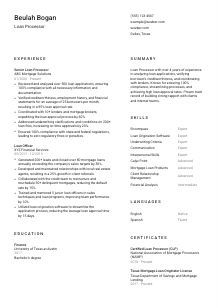
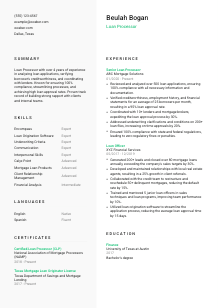
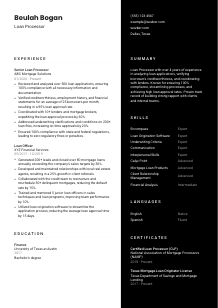
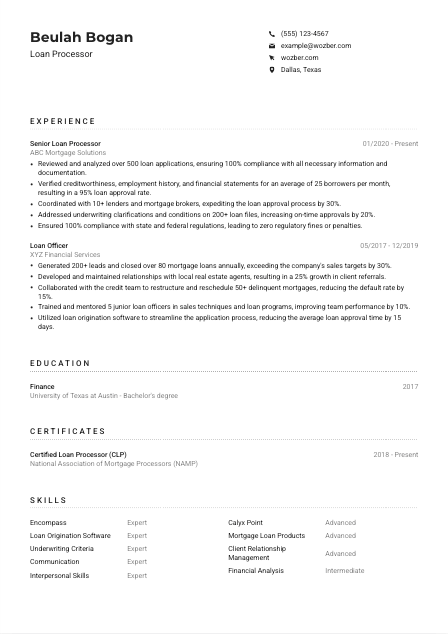
Write accomplishment bullets that show what you processed, verified, or improved. Good Loan Processor bullets often include file counts, approval rates, turnaround time, condition-clearing speed, or compliance results. The example resume does this well by citing 500+ reviewed applications, 25 borrowers per month, a 95% approval rate, and faster approvals through better coordination.
Do not stop at task lists like "reviewed documents" or "worked with lenders." Show what your actions changed. If you collected missing income documents faster, reduced suspense conditions, improved on-time submissions, or prevented disclosure errors, say so. A bullet about addressing underwriting clarifications on 200+ files and increasing on-time approvals by 20% is strong because it connects processor work to a result the business cares about.
Keep older or adjacent experience only when it supports your candidacy. A previous Loan Officer role can stay if it adds relevant lending knowledge, product familiarity, referral coordination, or system experience, but the strongest bullets should still reinforce processing value. Prioritize work that shows mortgage documentation, borrower verification, software use, and coordination under deadlines.
Your experience section should make it easy to picture you handling a live pipeline. Focus on loan volume, document accuracy, underwriting coordination, turnaround improvements, and regulatory discipline. Wozber's ATS-friendly resume template helps present that history in a structure both recruiters and screening systems can read quickly.
Education usually plays a supporting role in Loan Processor hiring, but it still matters when the posting calls for a specific academic background. Keep it straightforward and make the match obvious.
If the role asks for a bachelor's degree in Finance, Business, or a related field, list that qualification clearly. When your degree aligns closely, as a Bachelor's degree in Finance does here, there is no need to over-explain. The point is to confirm that you meet the stated baseline.
Present degree, field of study, school, and graduation year in a clean order. This keeps the section readable for both people and ATS parsing. In finance and mortgage roles, straightforward formatting also supports the broader impression that you understand documentation standards.
If your degree connects naturally to the work, let that connection stand on its own. Finance, business, economics, or similar coursework supports skills tied to borrower financial review, debt analysis, and document interpretation, all of which are relevant in processing work.
Relevant coursework can help when you are newer to mortgage operations or moving in from a related finance role. Courses in lending, credit analysis, real estate finance, or financial statement analysis may strengthen the picture. If you already have solid processing experience, keep the section lean.
Honors, scholarships, or major academic projects are worth including if they reinforce quantitative ability, financial analysis, or discipline. Otherwise, let experience and certifications do the heavier lifting. For most experienced Loan Processors, education should confirm qualification without taking too much space.
Use education to confirm that you meet the posted requirement and support your lending background. A concise, orderly entry is enough when the rest of the resume already shows mortgage processing competence.
Certifications are not always mandatory for Loan Processor roles, but they can add useful depth. In mortgage hiring, they often help show commitment to the field, knowledge of lending standards, and continued engagement with compliance or origination practices.
Start with credentials tied directly to mortgage processing, loan origination, compliance, or state lending practice. A certification such as Certified Loan Processor is a strong example because it reinforces specialization in the exact work the employer is hiring for.
Only list certifications that strengthen your case for the role. For Loan Processors, that usually means mortgage-focused credentials, lending licenses, compliance training, or recognized finance certifications. A shorter, relevant list is more useful than a long catalog with weak connection to daily processing work.
Add issue dates, renewal ranges, or active status when that information matters. This is especially useful for licenses or certifications that need maintenance. In the example, showing ongoing status for both the CLP and a Texas mortgage license helps communicate that the credentials are current and active.
Mortgage guidelines, disclosure rules, and lender overlays change over time, so ongoing certification or training can be a real advantage. If you have recent learning tied to underwriting updates, federal regulations, or loan products, include it when it supports the jobs you are targeting.
Well-chosen certifications add professional weight, especially when they relate to mortgage processing, compliance, or lending systems. They help show that your knowledge stays current in a field where documentation standards and regulations matter every day.
A Loan Processor skills section should read like the toolkit of someone who can keep files moving accurately. Prioritize systems knowledge, document review ability, underwriting familiarity, and the communication skills needed to work with borrowers, loan officers, underwriters, and closing teams.
Use the job description to identify the skills that matter most. Here, those include mortgage loan products, underwriting criteria, documentation requirements, loan origination software, and communication. These are not filler keywords. They point to the core mechanics of the job.
Only include skills you can support through your experience. If you list Encompass, Calyx Point, financial statement review, or borrower verification, your work history should show where those skills were used. That consistency matters in both ATS screening and human review.
Lead with the skills most central to processing performance. For this role, that usually means loan origination systems, mortgage documentation, underwriting criteria, compliance awareness, and communication with internal and external parties. The sample resume uses this approach by putting Encompass, loan origination software, and underwriting knowledge near the top.
Keep this section focused on the systems, lending knowledge, and coordination skills that drive approvals and keep files compliant. When the wording matches your actual background, Wozber can help turn it into stronger ATS optimization without making the section feel stuffed or generic.
Language ability matters in mortgage work because borrowers often need clear explanations, document follow-up, and timely updates. Still, this section should stay practical and tied to real communication needs, not turned into a generic selling point.
If the posting specifies English proficiency, list English clearly and use an honest proficiency level. That immediately confirms you meet a stated requirement and can handle the written and verbal communication the role depends on, from borrower outreach to internal file updates.
List the required language first, then any additional languages that could support client communication. For some lending markets, Spanish can be especially useful when working with a broader borrower base, but treat that as an advantage rather than a universal requirement unless the employer states otherwise.
Extra languages are worth listing when they genuinely help with borrower conversations, document clarification, or relationship management. If you would not be comfortable discussing loan steps or collecting information in that language, leave it off.
Stick to plain labels such as Native, Fluent, Intermediate, or Basic. That gives hiring teams a realistic sense of your communication range and avoids vague claims. In customer-facing finance roles, credibility matters more than trying to sound impressive.
Most Loan Processor positions are domestic and document-heavy, so language skills are usually supportive rather than central. Include them when they strengthen borrower service or market reach, but do not let this section crowd out more important processing qualifications.
The main requirement here is clear professional communication. Confirm English proficiency first, then add other languages only when they would genuinely help you serve borrowers or coordinate more effectively in the lending environment.
Your summary should quickly tell the reader what kind of Loan Processor you are. Focus on experience level, mortgage workflow strengths, software or compliance knowledge, and one or two measurable results that show how you handle files and support approvals.
Before writing the summary, note the role's main themes. In this case, those are mortgage product knowledge, underwriting and documentation standards, loan origination software, borrower verification, coordination, and compliance. Your summary should reflect that mix rather than sounding like a generic finance profile.
Lead with your title and years of relevant experience. A line such as "Loan Processor with 4+ years of mortgage processing experience" gives immediate context and helps separate you from broader banking or sales candidates whose background may be less focused.
Choose highlights that speak to processing performance. Good examples include handling high application volume, improving approval turnaround, maintaining strong compliance results, or working effectively with underwriters and lenders. The sample summary succeeds because it pairs experience with concrete strengths like 100% compliance and high approval rates.
Aim for 3 to 5 sentences. That is enough space to show your processing background, key strengths, and one or two results without repeating bullets from the experience section. The best summaries sound grounded in actual loan operations, not broad ambition.
A hiring team should finish your summary knowing your level, your mortgage processing strengths, and the kind of operational results you deliver. Keep it concise, role-specific, and aligned with the terminology used in the posting so the rest of the resume lands faster.
A well-built Loan Processor resume makes one thing easy to judge: can you move mortgage files forward accurately, efficiently, and in line with underwriting and compliance requirements? Keep every section pointed toward that answer, from your software knowledge to your approval metrics and documentation discipline.
Use Wozber to organize that experience into an ATS-friendly resume format, refine the language around the job description, and strengthen ATS optimization without losing the practical detail that matters in lending. The finished resume should show that you can step into a pipeline, manage conditions, and keep approvals on track.




