




Use Wozber and land your dream job
Create Resume
No registration required
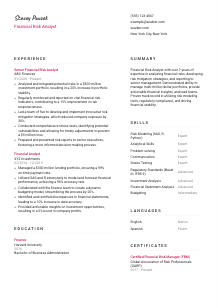
Navigating investment risks, but your resume seems uncertain? Check out this Financial Risk Analyst resume example, created with Wozber free resume builder. Learn how to present your risk assessment expertise to match job requirements, setting your career trajectory to blue-chip status!
Financial risk analysis is reviewed through the quality of your judgment. Hiring teams want to see how you evaluate portfolio exposure, interpret changing market conditions, and translate risk findings into actions that protect lending, investment, or balance sheet performance. Your resume should make that practical risk work visible, not bury it under broad finance language.
A tailored resume changes which part of your background stands out first. In this field, that often means surfacing the right modeling tools, regulatory framework knowledge, and reporting scope early enough for both ATS filters and human reviewers to connect your experience to portfolio monitoring and stress testing work. Wozber's free resume builder helps you shape an ATS-compliant resume around those role-specific terms so the hiring team can quickly see your command of risk analysis.
Financial institutions expect accuracy from the first line. Your contact section should read like the rest of your work: clean, precise, and aligned with the role you're targeting.
Place your name at the top in a clear, professional font and slightly larger size than the rest of the page. In a field where reports, dashboards, and committee materials rely on clean presentation, this small formatting choice reinforces attention to detail.
Add the job title directly under your name when it reflects the role you are applying for. "Financial Risk Analyst" immediately positions you in the right lane and helps separate you from broader finance candidates whose experience may lean more toward FP&A, audit, or investment analysis.
List a current phone number and a professional email address, ideally based on your name. If you include LinkedIn or a personal site, make sure the content supports a risk-focused profile with portfolio analysis, regulatory exposure, reporting experience, or quantitative work rather than a generic finance presence.
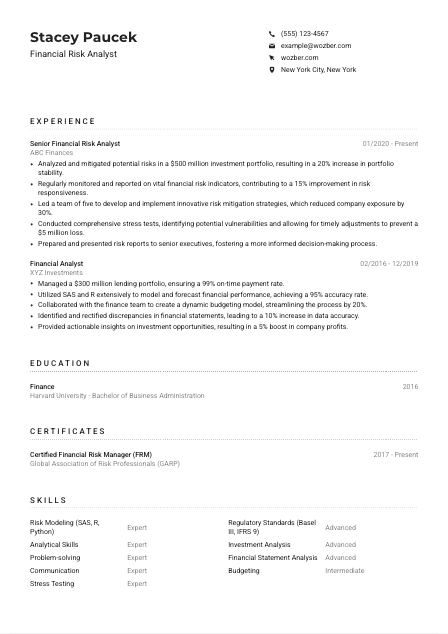
If a role names a location requirement, reflect that clearly in your header. Here, listing "New York City, New York" helps satisfy a stated hiring filter. Treat this as tailoring to the posting, not as a universal rule for every Financial Risk Analyst resume.
A well-maintained LinkedIn profile can extend what your resume starts. For risk professionals, that means matching titles, dates, FRM status, and technical keywords such as SAS, R, Python, stress testing, or Basel III so your digital profile supports the same story.
Your personal details should remove friction, confirm logistical basics, and immediately place you in financial risk rather than general finance. That sets the right expectation before the reader reaches your portfolio work and reporting history.




This section carries the most weight for Financial Risk Analyst hiring. Employers look for proof that you have worked with portfolios, risk indicators, modeling tools, stress scenarios, and senior-facing reporting, then turned that analysis into measurable action.
Read the posting for the actual work being hired, then mirror that language where it matches your background. For this role, the recurring themes are portfolio risk assessment, regular monitoring of key indicators, cross-functional mitigation planning, stress testing, and reporting to senior stakeholders. Those themes should appear in your bullet points, not just in your skills section.
Use reverse chronological order and give the most space to positions tied to credit risk, market risk, portfolio analysis, or other quantitative finance work. A move from a broader Financial Analyst role into a Senior Financial Risk Analyst title, like in the sample, shows a clear shift toward deeper risk ownership and should be easy to follow at a glance.
Avoid bullets that only describe routine tasks such as "monitored risk" or "prepared reports." Instead, show what your analysis influenced. Strong bullets explain the portfolio, the method, and the result, such as identifying vulnerabilities through stress tests, adjusting exposures, or improving responsiveness to changing risk indicators.
Quantify outcomes with measures common to the field: portfolio size, exposure reduction, forecast accuracy, loss avoidance, payment performance, or improvement in reporting cadence and response time. The sample does this well with figures like a $500 million investment portfolio, 30% lower exposure, and a prevented $5 million loss. Numbers like these make your impact concrete and credible.
Choose examples that support risk analysis work first. Modeling in SAS, R, or Python, interpreting Basel III or IFRS 9 implications, presenting findings to executives, and partnering with finance or lending teams all strengthen your case. If an older bullet is mostly about general budgeting or broad financial operations, keep it only if you can connect it to forecasting, controls, or analytical depth relevant to risk.
Your experience section should show that you can evaluate exposure, communicate risk clearly, and influence portfolio decisions with data. When those patterns are visible in your bullets, your resume reads like a risk hire rather than a general finance candidate.
For Financial Risk Analyst roles, education usually acts as a baseline qualification, but it also helps frame your technical foundation. Degrees in finance, accounting, economics, or related areas tell employers where your quantitative and regulatory knowledge started.
Start by confirming that your degree aligns with the posting. Here, a bachelor's degree in Finance, Accounting, Economics, or a related field is the stated requirement, so your most relevant degree should be easy to spot without extra searching.
List degree, field, school, and graduation year in a clean structure. That is usually all a hiring manager or ATS needs to confirm the baseline requirement. For experienced candidates, clarity matters more than extra design or long academic descriptions.
If your degree title is broad, make sure the field of study clarifies the finance connection. The sample's Bachelor of Business Administration becomes much more relevant because the field is Finance. That kind of specificity helps when your official degree title is not a perfect keyword match.
If you are earlier in your career, consider including coursework or projects tied to risk modeling, econometrics, derivatives, fixed income, or financial statement analysis. For more experienced analysts, those details are optional unless they directly support a specialized risk path.
Once your professional experience carries the weight, your education section can stay compact. Honors, student activities, or older academic distinctions matter less than a clear degree match and a track record in portfolio analysis, scenario testing, and regulatory reporting.
Your education should confirm that you meet the academic requirement and have a credible foundation for analytical finance work. Keep it easy to scan and aligned with the level of technical responsibility the role requires.
In financial risk hiring, certifications can signal deeper commitment to the discipline, especially when they connect directly to regulation, modeling, or portfolio risk. Used well, this section adds professional weight without taking over the resume.
When a job description calls out a credential, give it prominent placement if you hold it. In this case, the FRM designation is preferred, so listing it clearly can help reinforce your specialization in risk management and distinguish you from candidates with general finance backgrounds.
Focus on certifications that support the role's actual work. FRM, credit risk, quantitative finance, regulatory, or advanced analytics credentials carry more value here than broad business courses that do not connect to portfolio assessment or risk governance.
Show the year earned and, when relevant, the active period or renewal status. This is especially helpful for credentials that remain current through continuing requirements. It tells employers your knowledge of frameworks and standards is not outdated.
Risk functions evolve with regulation, data practices, and market conditions. Ongoing learning in stress testing, model risk, Basel updates, IFRS guidance, or programming tools strengthens your profile because it reflects the way the role actually changes over time.
This section should reinforce your depth in risk rather than simply expand your credential list. A well-chosen certification lineup tells employers you have invested in the technical and regulatory side of the job.
The skills section works best when it mirrors the tools and judgment areas the role depends on. For Financial Risk Analyst positions, that means balancing technical capability with the communication and interpretation skills needed to turn analysis into decisions.
Use the posting to identify the tools, frameworks, and capabilities the employer will expect on day one. Here that includes risk modeling tools such as SAS, R, or Python, plus analytical thinking, problem-solving, and communication. Those are stronger skill choices than generic finance terms with no link to risk practice.
Show both how you do the work and what you understand. Programming and modeling tools belong alongside items like stress testing, credit risk assessment, regulatory standards, portfolio analysis, and financial statement interpretation. The sample combines technical tools with Basel III and IFRS 9 knowledge, which is a useful model for structuring this balance.
Lead with the skills most likely to be screened, discussed, or tested. For this type of role, that usually means modeling tools, stress testing, risk analysis, and regulatory knowledge before broader abilities such as communication or budgeting. Order matters because it shapes the first read in both ATS systems and recruiter scans.
Your skills section should quickly confirm that you can model risk, interpret results, and speak the language of regulated finance. Keep it focused on capabilities that support real portfolio and reporting work.
Language skills matter in finance when they affect reporting quality, stakeholder communication, or work across markets. In many Financial Risk Analyst roles, the primary requirement is simply clear professional English for documentation, presentations, and risk reporting.
If the posting specifies a language requirement, list it clearly. Here, fluency in English is required, so English should appear first with an honest proficiency label such as Native or Fluent.
Place the languages most useful for the role at the top. That often means English first for reporting and cross-functional communication, followed by any additional languages that may help in multinational banking, investment, or client environments.
Additional languages are worth listing when they can help with cross-border stakeholders, regional exposure, or international portfolio coverage. They are usually secondary for this role, but they can still add range, especially in firms with global operations.
Stick to plain terms such as Native, Fluent, Intermediate, or Basic. Risk roles often involve written commentary, committee materials, and executive reporting, so exaggerated language claims can quickly create problems in interviews or on the job.
If another language has mattered in your work, make that relevance visible elsewhere in the resume through region coverage, stakeholder communication, or reporting context. Otherwise, keep this section straightforward and let your risk analysis experience stay central.
This section should confirm that you can communicate clearly in the language the role requires and, where relevant, support broader stakeholder coverage. Keep it accurate and business-focused.
Your summary should establish your lane within finance in a few lines. For this role, the best summaries quickly define your years of experience, risk focus, technical toolkit, and the scale or impact of your work.
Start by identifying the main kind of risk work the employer needs. Here, that means analyzing portfolio exposure, monitoring indicators, running stress scenarios, and presenting findings to leadership. Those are the themes that should anchor your opening lines.
Lead with a direct professional identity and a realistic experience count, such as "Financial Risk Analyst with 7+ years of experience." This works because it establishes both specialization and seniority immediately, before the reader moves into your detailed experience.
Choose two or three specifics that map to the role, such as risk modeling in Python or SAS, exposure to Basel III and IFRS 9, portfolio analysis, or executive risk reporting. The sample summary is effective because it mentions multi-million-dollar portfolios, mitigation strategy work, and regulatory knowledge without becoming too long.
Aim for a concise paragraph that reads like an informed overview, not a list of every strength you have. Three to five lines is usually enough to show your specialization, technical range, and business contribution while leaving room for your experience section to prove the details.
Your summary should tell the reader, within seconds, what type of risk analyst you are and where you have delivered results. When it is tailored well, the rest of the resume feels like proof instead of explanation.
A Financial Risk Analyst resume should make your portfolio work, modeling capability, regulatory knowledge, and reporting impact easy to find. When those elements are aligned with the job description, hiring teams can quickly place you in the right level of risk responsibility.
Use Wozber to tighten structure, improve ATS optimization, and build an ATS-friendly resume template around the language that matches your target role. The finished resume should make one thing clear right away: you can analyze risk rigorously and communicate it in a way the business can act on.




