



Use Wozber and land your dream job
Create Resume
No registration required
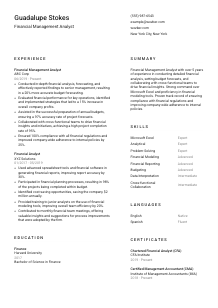
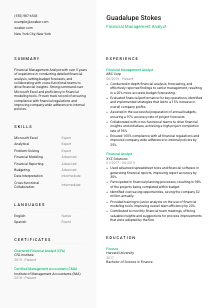
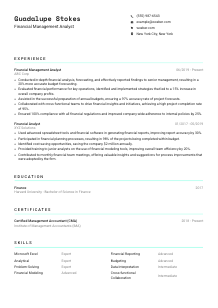
Balancing budgets but find your resume in the red? Check out this Financial Management Analyst resume example, created with Wozber free resume builder. It shows how to bring together your fiscal acumen and analytical finesse to match job expectations, sketching a career path to brighter financial horizons!
Financial Management Analysts are hired to make numbers usable. Hiring teams want to see whether you can turn forecasts, budget variance, and performance trends into decisions that senior leaders can actually act on. A resume for this role should quickly show analytical depth, comfort with reporting cycles, and a track record of improving financial performance, planning accuracy, or policy compliance.
When that detail is tailored to the target opening, the resume becomes much easier to process in both human review and ATS screening. Wozber's free resume builder helps organize role-specific language into an ATS-compliant resume, so core requirements like forecasting, budgeting, financial modeling, and cross-functional reporting are visible early. That makes it easier to recognize whether your background matches the level of financial ownership the role requires.
The top of the page should identify you fast and remove any friction around contactability, title match, and location expectations. For a Financial Management Analyst, this section should look clean, precise, and businesslike from the first line.
Use your full name as the most visible text in the header. Keep it simple and professional, with no extra labels or credentials crowding the line unless a certification is central enough to be recognized immediately, such as CMA or CFA in finance-heavy environments.
Place the role title directly under your name when it accurately reflects your background. Using "Financial Management Analyst" helps the reader connect your resume to the opening right away and reinforces alignment with ATS keyword matching.
Include a current phone number and a professional email address you check often. Finance hiring often moves through several interview rounds with short scheduling windows, especially when senior management or cross-functional stakeholders are involved, so your contact details need to be dependable and easy to scan.
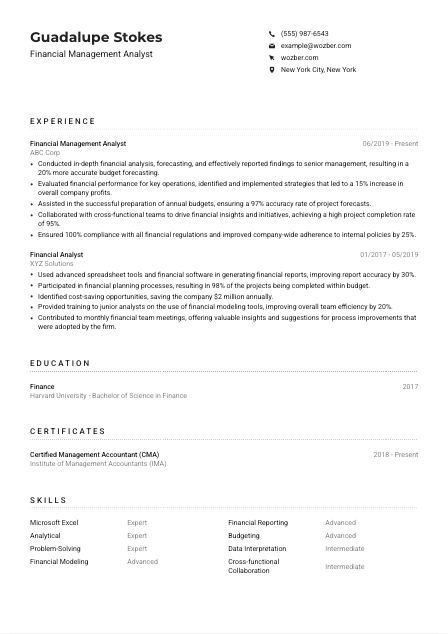
If the posting asks for New York City presence or relocation, state that clearly in your location line when it applies. In the example resume, listing New York City, New York immediately removes a potential concern tied to the employer's stated requirement. Use this approach whenever geography affects eligibility.
Include LinkedIn or a professional website only if it supports your finance profile with consistent titles, experience, and certifications. A hiring manager may check it for added context on your reporting background, industry exposure, or credential history, so keep it aligned with the resume.
This section should answer the basics immediately: who you are, what role you do, how to reach you, and whether any location requirement is already covered.




This section carries the most weight for a Financial Management Analyst because it shows how you handled actual budgets, forecasts, reporting, and financial performance. Hiring teams look for scope, business impact, and the kind of analysis you owned, not just a list of finance duties.
Read the job description line by line and identify the work themes that need to appear in your bullets. Here, that includes financial analysis, forecasting, reporting to senior management, budget preparation, performance evaluation, cross-functional collaboration, and compliance. Those priorities should shape which accomplishments you lead with.
Start with your most recent finance role and work backward. For each entry, include job title, company, and dates in a format that makes progression easy to follow. This helps the reader quickly understand whether your background has moved from support analysis into broader planning, reporting, or financial management responsibility.
Write bullets around what changed because of your analysis. Instead of saying you prepared forecasts or reviewed financials, show the result. The example does this well by connecting forecasting work to a 20% improvement in budget accuracy and financial performance review to a 15% increase in profits. That kind of phrasing makes your contribution concrete.
Use numbers that belong naturally in finance work, such as forecast accuracy, variance reduction, savings identified, profit improvement, budget adherence, reporting accuracy, or compliance rate. Metrics are especially persuasive in this field because they mirror how performance is tracked internally. Even one solid number per role can sharpen the section significantly.
Prioritize positions and bullets that support the target role's financial scope. Work involving planning cycles, month-end or quarterly analysis, management reporting, cost control, operational finance, or policy compliance deserves more space than unrelated responsibilities. If an older role is less relevant, trim it so the more strategic finance work stands out.
By the end of this section, a hiring team should be able to see the financial decisions you influenced, the reporting work you owned, and the measurable results tied to your analysis.
Education matters here because the role usually starts with a finance, business, or related academic foundation. This section does not need much space, but it should confirm that you meet the baseline training expected for analytical and planning work.
List the degree that best matches the posting's requirement first. If the employer asks for a Bachelor's degree in Finance, Business, or a related field, make sure your degree and field are written clearly. A Bachelor of Science in Finance, like the example resume uses, answers that requirement directly.
Include school name, degree, field of study, and graduation year or date in a clean order. Finance hiring rarely needs decorative detail here. The value is in making the qualification easy to verify while keeping attention on your experience and analytical credentials.
If your degree title is slightly different from the wording in the posting, clarify the field so the relevance is still easy to see. Employers scanning for finance or business education should not have to infer whether your academic background supports forecasting, budgeting, or financial analysis work.
Relevant coursework can strengthen this section when you're early in your career or changing focus within finance. Courses in corporate finance, financial statement analysis, managerial accounting, budgeting, or econometrics can add context if your work history is still developing.
Mention honors, scholarships, or finance-related extracurriculars only if they add real value. Examples might include academic distinction in finance, investment club leadership, or case competition work that supports analytical rigor. Keep this secondary once you have solid professional experience.
This section should quickly establish that your academic background supports the financial analysis, planning, and reporting responsibilities in the role.
Certifications carry real weight in finance because they signal deeper technical knowledge and ongoing commitment to the field. For Financial Management Analyst roles, they can strengthen your profile when the employer values analytical discipline, planning expertise, or broader financial judgment.
If you hold finance certifications that match the posting, list them prominently. In this case, CMA and CFA are especially relevant because the job description names them as preferred. Put the strongest role-aligned credentials first so they are seen early.
Do not overload this section with unrelated training. Prioritize credentials that support financial analysis, management accounting, investment analysis, reporting, or planning. A short list of well-matched certifications reads better than a broad catalog with little connection to the work.
Show the year earned and, when relevant, whether the credential is current. For designations with ongoing maintenance or multi-level progression, dates help the employer understand recency and professional continuity.
If you are pursuing a credential or regularly completing finance-related training, include that selectively when it adds value. In a field shaped by changing regulations, reporting standards, and analytical tools, continued learning supports your credibility.
Relevant certifications strengthen your resume when they reinforce the technical and professional standards expected in financial analysis and management reporting work.
The skills section should reflect how Financial Management Analysts actually work: building models, interpreting results, reporting findings, and supporting planning decisions with reliable analysis. Keep it specific enough to match the posting without turning it into a keyword dump.
Start with the skills named or implied in the posting. For this role, that includes financial modeling, spreadsheet proficiency, analytical thinking, problem-solving, data interpretation, budgeting, and collaboration. These are the capabilities you want mirrored in your resume language if they reflect your real experience.
Show both technical and functional strengths. Microsoft Excel is explicitly requested here, so it should appear if you use it confidently for modeling, analysis, forecasting, or reporting. Pair tool skills with finance capabilities such as financial reporting or budgeting to present a more complete working profile.
Place the highest-priority finance skills first. Lead with the tools and capabilities most likely to matter in day-to-day work, then follow with supporting strengths. In the example resume, Excel, analytical ability, financial modeling, reporting, and budgeting are all placed in ways that support the role's stated needs.
A recruiter should be able to scan this section and immediately see that you can handle the analysis, modeling, reporting, and planning work the role depends on.
Language skills are usually a supporting section for finance roles, but they still matter when the posting names a requirement or the work involves communication across teams, regions, or leadership groups. Keep this section factual and easy to interpret.
When the posting specifies a language, list it first with an honest proficiency level. Here, strong English proficiency is required, so English should lead the section if that applies to you.
Order languages by their value to the role rather than personal preference. If one language is required for reporting, stakeholder meetings, or documentation, it belongs at the top of the list.
Extra languages can still help, especially in firms with international operations or diverse client and vendor interactions. In the example, Spanish adds useful range beyond the required English, even though it is not a stated hiring requirement.
Choose straightforward levels such as Native, Fluent, Advanced, or Conversational. Avoid vague descriptions that leave the reader guessing how well you can write reports, participate in meetings, or explain financial findings.
If your language skills have supported reporting, cross-border communication, or collaboration with regional teams, that context is often better shown in experience bullets. Here, the language section should stay concise and credible.
This section should confirm that you can meet any stated communication requirement and, where relevant, support finance work across broader teams or markets.
The summary should capture your finance profile in a few lines: level of experience, core analytical strengths, and the business results your work tends to influence. For Financial Management Analyst roles, that usually means forecasting, planning, reporting, performance review, and compliance awareness.
Before writing the summary, identify the few responsibilities that define the opening. Here, financial analysis, forecasting, budgeting, reporting to senior management, and cross-functional partnership form the center of the role. Your summary should reflect that core rather than trying to cover every skill you have.
Lead with your title or closest equivalent, plus years of relevant experience and area of concentration. A direct opening such as "Financial Management Analyst with 5+ years of experience in forecasting, budget analysis, and management reporting" is stronger than a generic self-description.
Include two or three strengths that matter for the job, then anchor them with a measurable outcome if possible. The example summary works because it combines financial analysis, budget forecasting, Excel proficiency, and compliance work with a proven track record, creating a concise but role-relevant snapshot.
Aim for a short paragraph that reads quickly and stays grounded in finance work. Remove filler adjectives and focus on what you analyze, what you improve, and who you support. The reader should finish the summary with a clear sense of your analytical scope and business contribution.
A good summary gives the reader an immediate sense of your financial range, your reporting value, and the level of responsibility you are ready to handle.
A well-tailored Financial Management Analyst resume should show how you turn analysis into decisions, whether through sharper forecasts, stronger budget control, clearer management reporting, or better compliance outcomes. Keep every section focused on that practical financial contribution.
Use Wozber to build and refine an ATS-friendly resume format, align your language with the posting, and check fit with the ATS resume scanner. The finished resume should make it easy to judge your readiness for forecasting, planning, reporting, and performance analysis work.




