



Use Wozber and land your dream job
Create Resume
No registration required
Analyzing market trends, but your resume doesn't spark interest? Check out this Financial Analyst resume example, created with Wozber free resume builder. It shows how to blend your fiscal insights with job expectations, making your career investment truly appreciate in value!
Financial Analyst resumes are read through the lens of business judgment. Hiring teams want to see whether you can turn raw numbers into forecasts, budget decisions, variance explanations, and recommendations that management can act on. A generic finance resume often blurs that distinction by listing analysis tasks without showing reporting cadence, modeling depth, or the business outcome behind the work.
For this kind of role, tailoring changes how quickly your resume connects your experience to forecasting, reporting, and planning work. Wozber's free resume builder helps you organize that experience into an ATS-compliant resume that uses the same language employers use for financial analysis, Excel-heavy modeling, and budget support. That makes it easier for a hiring manager to see where you have already influenced reporting quality, planning accuracy, or executive decision-making.
This section should identify you cleanly and remove friction from the first scan. For a Financial Analyst, that means clear role labeling, professional contact details, and only the location information that matters for the application.
Your name should sit at the top in a clean, readable format. Keep the styling simple so the eye lands on it immediately, especially when a hiring manager is reviewing several finance resumes in one sitting. The goal is recognition, not design flair.
Place "Financial Analyst" directly under your name when that is the role you are pursuing. This keeps your positioning clear from the first line and helps align your resume with both ATS filters and recruiter expectations. If your current title differs slightly, you can still target the role as long as the experience below supports analysis, reporting, forecasting, or planning work.
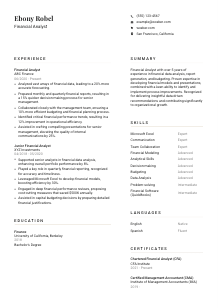
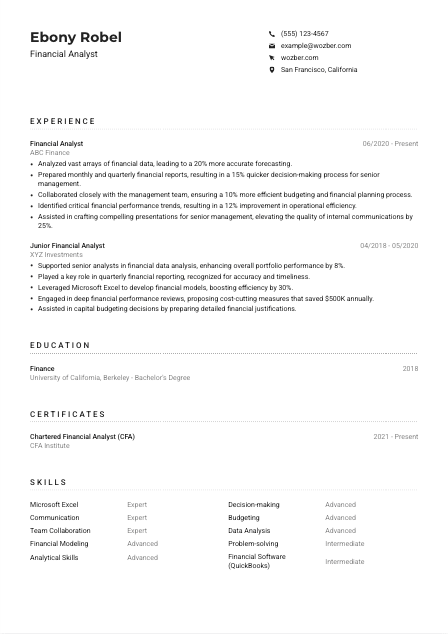
Include your phone number, a professional email address, and, when relevant, your city and state. In the provided example, listing "San Francisco, California" works well because the posting specifically calls for someone based there or willing to relocate. Use location this way only when it answers an actual job requirement.
A LinkedIn profile or personal website can help if it reinforces your finance background, credentials, or project work. Make sure the content matches your resume titles, dates, and achievements. Wozber supports this within an ATS-friendly resume format, so your links stay useful without disrupting structure.
Age, marital status, photo, and similar personal details do not strengthen a Financial Analyst application. Space is better used for qualifications tied to the role, such as reporting experience, Excel strength, or finance credentials.
When this section is handled well, the reader moves straight to your financial background without getting distracted by missing basics or irrelevant personal information.




This is where Financial Analyst candidates separate themselves. Employers are looking for proof that you can analyze performance, build or use models, support budgeting, and report findings in a way that helps managers make decisions.
Read the job description for the work patterns behind the title. Here, the key themes are financial data analysis, forecasting support, recurring monthly and quarterly reporting, budgeting collaboration, trend identification, and presentation support for senior management. Use those themes to decide which achievements belong on the page and which can be cut.
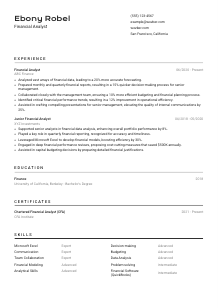
List roles in reverse chronological order so the reader sees your current analytical scope first. For this profession, recent experience often shows your comfort with current reporting cycles, planning processes, and tools such as Excel-based models. If you progressed from Junior Financial Analyst to Financial Analyst, that progression itself is worth making obvious.
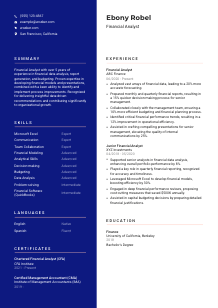
Each bullet should show what you analyzed, what you produced, and what changed because of it. The example does this well with points such as improving forecasting accuracy by 20% and speeding senior-management decision-making by 15% through stronger monthly and quarterly reports. That kind of phrasing tells a hiring manager you contributed to business decisions, not just assembled spreadsheets.
Financial work is measured, so your resume should be too. Use percentages, dollar amounts, cycle-time improvements, cost savings, forecast accuracy, or efficiency gains when they are real and defensible. A bullet like "proposed cost-cutting measures that saved $500K annually" is much more persuasive than saying you "supported financial reviews."
Trim bullets that do not support the target role. For a Financial Analyst opening, keep the focus on forecasting, budgeting, variance review, financial modeling, reporting cadence, and management-facing recommendations. If you have broader finance or operations experience, keep only the parts that connect clearly to analysis and planning.
A strong experience section shows more than finance exposure. It shows that your models, reports, and recommendations improved forecasting, budgeting, or business performance in measurable ways.
Most Financial Analyst roles still start with a degree requirement, so your education section needs to answer that question quickly. Keep it clean, accurate, and easy to match against the posting.
If the posting asks for a bachelor's degree in Finance, Accounting, Economics, or a related field, make sure your degree and field are easy to spot. In the example, a Bachelor's Degree in Finance from UC Berkeley lines up neatly with that requirement. When your field is adjacent, use the exact academic wording and let your experience reinforce the fit.
List school, degree, field of study, and graduation year or date in a straightforward order. This is better for both ATS parsing and fast human review. Wozber's ATS-friendly resume template helps keep the section structured so the credential is visible immediately.
When your degree directly supports the role, do not bury it under extra academic detail. A finance degree already answers an important screening requirement for this kind of opening. Let that relevance do the work before adding anything optional.
Relevant coursework can help if you are early in your career, changing from a related discipline, or applying to a role that emphasizes a particular area such as corporate finance, valuation, econometrics, or accounting analysis. Use courses selectively and only when they add information your experience does not yet show.
Honors, finance society involvement, case competitions, or capstone projects can be useful if they point to analytical training or business judgment. For example, an investment analysis project or financial modeling competition can reinforce your technical foundation. Skip older or unrelated achievements once your professional record is stronger.
Your education section should quickly establish the academic base for the role, then get out of the way so the reader can focus on your analytical work.
Certifications matter in finance because they show continued technical development and commitment to the field. They are especially useful when they reinforce analysis, valuation, accounting knowledge, or credibility with senior stakeholders.
Lead with certifications that matter most to Financial Analyst hiring. In this posting, CFA is listed as a plus, so it should appear first if you hold it or are actively pursuing it. The example does that well by placing the CFA credential above the CMA.
Do not overload this section with every short course or platform badge. Prioritize credentials that support financial analysis, investment analysis, accounting rigor, reporting, or planning work. A short list of relevant certifications is stronger than a long list with weak connection to the job.
Include dates or status where it helps clarify whether a credential is current, active, or in progress. That matters for finance certifications that involve multi-level progress or continuing requirements. Clear dating also helps the reader understand your professional development timeline.
The field changes with new reporting expectations, planning tools, and analytical methods, so current certifications can strengthen your profile over time. Whether you pursue CFA, CMA, FP&A-focused training, or advanced Excel and modeling coursework, keep the section current and relevant to the work you want next.
Relevant credentials add weight when they support the kind of analysis, modeling, and financial judgment the role requires.
A Financial Analyst skills section should look like the toolkit behind your forecasts, reports, and recommendations. Keep it focused on the capabilities that support analysis, planning, modeling, and communication with decision-makers.
Start with the posting, not with a generic finance list. Here, the employer is clearly asking for Excel proficiency, financial modeling ability, analytical thinking, decision-making, problem-solving, and strong English communication. Those are better anchors than broad terms that could apply to any office role.
Choose skills that are backed up by your bullet points. If you list Financial Modeling, Microsoft Excel, Budgeting, or Data Analysis, your experience should show where you used them in forecasting, reporting, or planning. In the sample resume, Excel and financial modeling are reinforced by bullets about faster model development and better forecasting accuracy.
Group technical and business-facing skills in a way that is easy to scan. For this profession, that often means putting tools and analytical capabilities first, followed by communication or collaboration skills that support presentations and management partnership. Wozber's ATS-friendly resume template helps keep that structure readable for both ATS systems and human reviewers.
When your skills section matches the finance work in your experience, it reads as a credible operating toolkit rather than a loose keyword list.
Language skills matter when they affect reporting, stakeholder communication, or work across regions. For many Financial Analyst roles, English proficiency is the baseline because reporting, presentations, and planning discussions depend on clear written and verbal communication.
If the job asks for English proficiency, include it clearly. That requirement is practical for Financial Analysts because monthly reports, budget discussions, and presentation materials need precise language. Make sure your listed level matches your real working ability.
For an English-language finance role, list English first so the requirement is answered immediately. This is especially important when the position involves reporting to management or preparing presentation materials for leadership.
Additional languages can be useful if the company works across markets, supports international stakeholders, or handles regional reporting. In the example, Spanish adds breadth, but it should remain secondary to the core requirement unless the job specifically calls for multilingual communication.
Terms such as "Native," "Fluent," "Intermediate," and "Basic" are easy to understand and help avoid overstatement. Keep the labels honest. A finance role may require nuanced communication, especially when discussing performance trends or recommendations with stakeholders.
If the employer operates across geographies or supports global finance teams, language skills can strengthen your profile. They are most valuable when they connect to real work such as cross-border reporting, investor communication, or collaboration with regional teams. Otherwise, keep the section concise.
For Financial Analyst applications, language skills matter most when they strengthen reporting clarity, stakeholder communication, or regional coverage.
Your summary should quickly establish the kind of Financial Analyst you are. Focus on the work you handle, the analytical strengths you bring, and the business outcomes you have influenced.
Start by identifying the core work in the posting, then reflect the parts you genuinely cover. Here, that would mean some combination of financial analysis, forecasting, reporting, budgeting support, trend identification, and presentation preparation. This keeps the opening aligned with the role from the first sentence.
State your title, years of experience, and strongest area of contribution in one compact line. A summary such as "Financial Analyst with 5+ years of experience in financial analysis, reporting, and budgeting" immediately gives the reader the right frame. Keep the tone factual and specific.
Choose strengths with direct relevance to the role, such as financial modeling, Excel-based analysis, identifying performance trends, or turning data into management recommendations. The example summary works because it connects analysis, report generation, budgeting, and process improvement instead of using vague finance language.
Aim for 3 to 5 lines that cover experience level, core analytical scope, and one or two outcomes or differentiators. Avoid generic claims about being driven or detail-oriented unless they are supported by specific finance work. The summary should read like a compact forecast of the value the rest of the resume will prove.
A well-written summary helps the reader place you quickly as someone who can support reporting, planning, and analysis from day one.
You now have a clearer structure for presenting yourself as a Financial Analyst who can forecast, report, model, and support better decisions. Use Wozber's free resume builder to shape that experience into an ATS-compliant resume with clean structure, targeted language, and stronger ATS optimization.
Keep each section tied to real finance work, measurable outcomes, and the tools you actually use. The finished resume should make it easy to judge your readiness for analysis, planning, and management-facing reporting.




