



Use Wozber and land your dream job
Create Resume
No registration required
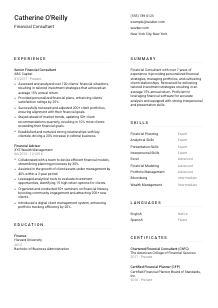
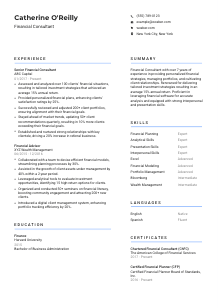
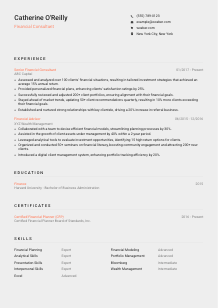
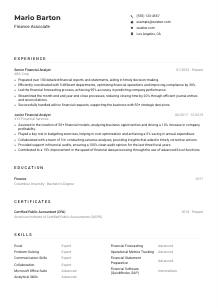
Guiding money matters, but your resume's investments seem risky? Check out this Financial Consultant resume example, created with Wozber free resume builder. It shows how to structure and quantify your fiscal expertise to match job specifications, making your career path as profitable as your best investment advice!
Financial consulting resumes are strongest when they show how you turn client goals into disciplined financial recommendations. Hiring teams look past broad claims about analysis and focus on whether you can assess risk tolerance, build practical strategies, monitor portfolios over time, and explain decisions in a way clients trust.
A tailored resume changes how quickly that client advisory range becomes visible. Using Wozber's free resume builder to match your language to the posting and keep an ATS-friendly resume format makes it easier to surface the experience, tools, and portfolio work that matter first, so your resume reads like a financial consultant who can guide decisions, not just run numbers.
This section is brief, but it still does real work. In a client-facing finance role, clean contact details and a clear professional label show precision from the first line.
Use your full name as the most visible text on the page so the resume feels immediately professional and easy to reference. Keep the styling simple and polished. In finance, small presentation choices matter because they reflect the same care clients expect in reports, recommendations, and portfolio reviews.
Place "Financial Consultant" directly under your name when that is the role you are targeting. Matching the posting title helps both recruiters and ATS systems understand your direction quickly, especially when your background includes adjacent titles such as Financial Advisor, Wealth Manager, or Investment Analyst.
List a reliable phone number and a professional email address that you check regularly. Avoid outdated or casual email handles. A role built on client communication and relationship management starts with contact details that look dependable and are free of errors.
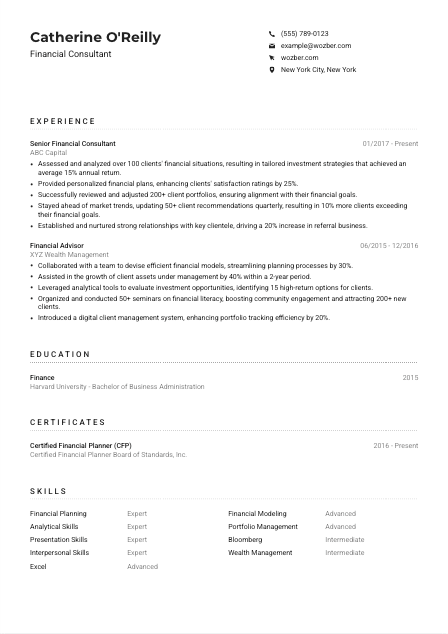
If a job specifically asks for candidates in a certain market, state your city and state clearly. Here, listing New York City, New York directly addresses the employer's stated location requirement and removes questions about relocation or local availability. Only include this level of detail when it helps meet the role's stated terms.
Include a LinkedIn profile or professional website if it supports your candidacy with aligned experience, certifications, or thought leadership. For a financial consultant, that might mean a polished profile showing advisory experience, CFP or ChFC credentials, or client-facing accomplishments that match the resume.
Your personal details should confirm that you are accessible, professionally presented, and aligned with the role from the opening lines. For financial consulting, that means accuracy, the right title, and location clarity where the posting calls for it.




Experience is where financial consulting becomes tangible. This section should show the quality of your client work through portfolio outcomes, planning scope, financial analysis, and the relationships you managed over time.
Start by marking the work patterns in the posting, not just the keywords. For this kind of role, that includes assessing financial situations, understanding goals and time horizons, making investment recommendations, reviewing portfolios regularly, staying current on market conditions, and maintaining trusted client relationships. Those are the themes your experience bullets should reflect.
List each role with job title, employer, and dates, starting with the most recent. Financial consulting careers often build across advisory, planning, analysis, and wealth management positions, so a clear timeline helps employers understand how your client scope and strategic responsibility have progressed.
Under each role, focus on achievements that show how you translated analysis into client recommendations and measurable results. The sample resume does this well by tying activities to outcomes such as tailored investment strategies, portfolio reviews, and stronger client satisfaction. That is much stronger than listing generic duties like "managed accounts" or "worked with clients."
Metrics carry weight in finance when they are specific and credible. Use numbers tied to annual return, portfolio volume, clients served, assets grown, review cadence, referrals, satisfaction, or process efficiency. The example uses figures such as 100+ clients assessed, 200+ portfolios reviewed, and a 20% increase in referral business, which gives hiring teams a clearer read on both scale and results.
Keep the section centered on planning, analysis, advisory work, portfolio oversight, and client relationship management. If you include broader finance experience, frame it through the parts that connect to consulting, such as financial modeling, investment evaluation, or presenting recommendations to clients or stakeholders. Relevance matters more than listing every finance task you have handled.
For a financial consultant, experience should show judgment, measurable client outcomes, and consistent portfolio oversight. When your bullets connect recommendations to returns, retention, referrals, or planning results, the hiring team can picture you in front of clients.
Education will rarely outweigh strong advisory experience, but it still establishes the academic base behind your analysis and recommendations. In finance, that baseline should be easy to find and easy to read.
If the role asks for a Bachelor's degree in Finance, Business, or a related field, make sure that qualification is visible without effort. A degree such as a Bachelor of Business Administration in Finance, like the one in the example, directly supports the analytical and planning side of the work.
List the degree, field of study, school, and graduation year in a consistent structure. Clean formatting matters here because employers often scan this section quickly to confirm that the educational requirement is met before moving back to your advisory experience.
If your degree aligns closely with the posting, use wording that makes that alignment obvious. "Finance," "Business," and related fields should appear exactly when they truthfully describe your background. That improves both readability and ATS matching without stretching the facts.
Early-career candidates can include honors, finance coursework, investment club work, or analytical projects if those details help bridge experience gaps. For more experienced financial consultants, education usually stays concise unless a specific academic distinction adds weight to your advisory credibility.
If you have completed extra study in portfolio management, financial analysis, tax planning, retirement planning, or client advisory topics, include it when relevant. Ongoing education is especially useful when it sharpens the services you offer or supports the markets and client segments you work with.
This section should quickly establish that you meet the academic requirement and have the right finance foundation. Once that is clear, the rest of the resume can focus on client strategy, portfolio performance, and advisory results.
Certifications carry real weight in financial consulting because they signal recognized standards in planning, ethics, and client guidance. When a posting mentions them, they deserve visible placement.
Review the posting for certifications named directly or implied by the work. Here, CFP and ChFC are listed as preferred, which tells you that structured planning knowledge and recognized advisory credentials would strengthen your profile if you hold them.
List credentials that support the kind of consulting work you want to do. CFP and ChFC are especially relevant because they connect directly to personalized financial strategies, long-term planning, and trusted client recommendations. Put the most relevant ones first.
Show the issuing body and the active dates or year earned so employers can see the credential is current and legitimate. The sample resume handles this well by naming both the certification and issuing organization, which adds credibility at a glance.
Finance changes with markets, regulations, products, and client expectations. If you pursue continuing education or maintain active credentials, include that information when appropriate. It signals that your advice is informed by current practice rather than outdated knowledge.
Relevant credentials help hiring teams trust your planning framework and professional standards. For client-facing finance roles, they can reinforce the difference between general finance experience and true advisory depth.
A financial consultant's skills section should read like the toolkit behind sound recommendations. That means balancing technical finance capability with the client-facing strengths needed to explain options, manage expectations, and build long-term trust.
Start with the terms the employer actually uses. In this case, that includes financial planning, analysis, investment advisory work, presentation skills, interpersonal skills, and software such as Excel, Bloomberg, and financial modeling tools. These are the skills most likely to matter in screening and interviews.
Lead with skills tied to the core work, such as financial planning, portfolio management, investment analysis, risk assessment, and client relationship management. Then add supporting strengths like presentation and communication. The example also includes wealth management and financial modeling, which helps show both strategic and analytical range.
Do not overload this section with every finance or office tool you have touched. Focus on skills that support the actual workflow of a financial consultant, from evaluating client situations to modeling scenarios and explaining recommendations clearly. A tighter list reads as more credible and targeted.
Your skills should reinforce the experience section, not repeat generic finance language. When the list reflects advisory work, portfolio analysis, and client communication, it adds real weight to your application.
Language ability matters most when it affects how you work with clients, present financial information, or serve a specific market. Keep this section accurate and practical.
If the posting states that English proficiency is critical, list English prominently and state your level clearly. That matters in financial consulting because recommendations, risk discussions, and portfolio updates all depend on precise communication.
Choose direct labels such as Native, Fluent, Intermediate, or Basic rather than vague descriptions. The example lists English as Native, which gives immediate clarity and aligns well with a role that depends on trusted client conversations and polished presentations.
Additional languages can be valuable when serving multilingual households, international clients, or diverse local markets. Spanish, for example, may strengthen your profile in some client-facing advisory environments, even when it is not listed as a formal requirement.
Only claim a level you can comfortably use in meetings, planning conversations, and written communication. In a financial consulting role, overstating fluency can become obvious quickly when you need to explain investment options or answer client questions in detail.
If another language has helped you build trust, run seminars, explain financial concepts, or support cross-border conversations, it is worth including. Use this section to show communication range that could matter in advisory work, not just as a general personal detail.
For financial consultants, language proficiency is most useful when it supports clear advice and stronger relationships. Keep the section factual and tied to how you actually communicate with clients.
Your summary should quickly tell the reader what kind of financial consultant you are, how much experience you bring, and what results or strengths define your work. Keep it focused on advisory value, not general ambition.
Before writing, identify the main themes of the job. Here, those include assessing financial situations, shaping personalized strategies, monitoring portfolios, interpreting market conditions, and maintaining client trust. Those themes should shape what you emphasize in the first lines.
Lead with your professional identity and years of relevant experience. A line such as "Financial Consultant with 7+ years of experience in personalized financial planning and portfolio management" gives a much clearer opening than a generic statement about being results-driven.
Follow the opening with concrete strengths, such as client strategy, investment recommendations, portfolio oversight, financial modeling, or relationship growth. The sample summary works because it includes both functional scope and a measurable result, referencing tailored strategies that delivered an average 15% annual return.
Aim for a short paragraph that can be read in seconds. Focus on what distinguishes your advisory practice, the tools or methods you use, and the outcomes you consistently drive. Leave detailed career history for the experience section and keep the summary concentrated on your strongest match for the role.
When this section is done well, it frames the rest of the resume around financial judgment, client guidance, and measurable results. That gives hiring teams a clear reason to keep reading your portfolio and planning experience in full.
A well-tailored Financial Consultant resume shows more than finance knowledge. It shows how you assess client needs, shape recommendations, monitor portfolios, and build durable relationships with clear business results.
Use Wozber's free resume builder and ATS resume scanner to align your wording, structure, and role-specific terminology with the job description while keeping the resume clean and ATS-compliant. The final document should make your client advisory range and financial judgment easy to recognize.




