



Use Wozber and land your dream job
Create Resume
No registration required
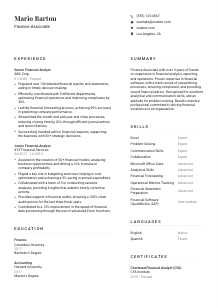
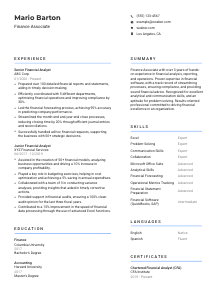
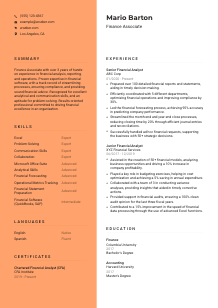
Juggling figures, but your resume doesn't add up? Check out this Finance Associate resume example, created with Wozber free resume builder. It shows how to smoothly align your financial acumen with job prerequisites, setting your career trajectory on a profit-earning path!
Finance Associate hiring usually turns on one practical question: can you handle recurring reporting, close support, reconciliations, and forecasting without creating extra cleanup for the team. Your resume should make that operating reliability visible. Hiring managers want to see accurate reporting, comfort with numbers, and the kind of cross-functional coordination that keeps finance processes moving on schedule.
Resume tailoring changes how quickly that finance story comes through, especially when an ATS screens for terms tied to reporting, Excel, reconciliations, and financial analysis. Wozber's free resume builder helps you align your wording with the posting while keeping an ATS-compliant resume easy to scan, so the hiring team can quickly see where you've supported close cycles, reporting accuracy, and operational finance work.
The top of the page should read like a finance professional's header: accurate, clean, and easy to process. Small errors here raise the wrong questions in a role built on precision.
Set your name in a slightly larger font than the rest of the header so it stands out immediately. Keep the styling simple and professional. For finance roles, clean presentation matters because it mirrors the kind of organized reporting and documentation the job depends on.
Place "Finance Associate" directly under your name if that is the role you are pursuing. This creates an immediate match between your resume and the position. When a posting is centered on reporting, close support, and financial analysis, a clear title helps frame the rest of your experience in that context.
Include your phone number, professional email address, and, if relevant, a LinkedIn profile or personal website. Check every detail carefully. In finance, one wrong digit suggests the same kind of inattention that can cause issues in journal entries, reconciliations, or report distribution.
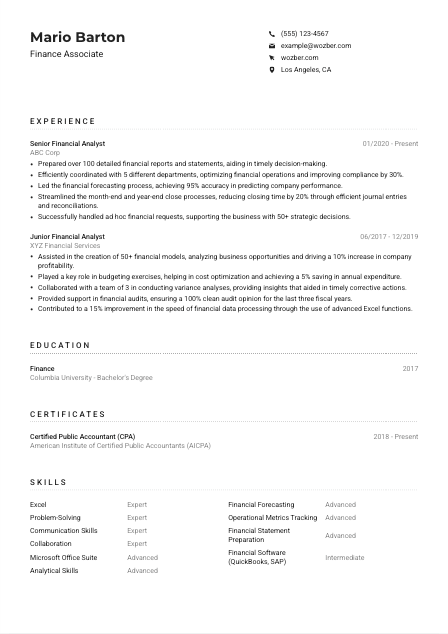
If the employer specifies a location requirement, include your city and state. Here, listing "Los Angeles, CA" directly addresses a stated condition in the posting. Use location as a practical signal of availability, not as filler.
If your LinkedIn profile is current and reflects finance work such as reporting, budgeting, analysis, or close support, include it. Skip links that do not reinforce your candidacy. A useful profile gives added context on tools, certifications, or career progression without crowding the resume header.
This section should confirm that you are easy to contact, aligned with the target role, and available for the job as posted. For a Finance Associate, accuracy starts before the first bullet point.




Finance teams read experience sections for proof that you can keep recurring work accurate and keep deadlines moving. Focus less on broad finance claims and more on the reporting cycles, analyses, reconciliations, and process improvements you have actually handled.
Before editing your bullets, mark the recurring tasks in the job description: financial reports, forecasting, operational metrics tracking, department coordination, journal entries, and reconciliations. Then match those duties to work you have already done. In the sample resume, bullets tied to forecasting accuracy, report preparation, and close-process improvements map directly to those needs.
List your positions in reverse chronological order with company name, title, and dates. That structure lets the reader follow your progression from analytical support work into broader reporting or close responsibilities. If you have grown from junior analysis into ownership of monthly reporting, make that progression obvious.
Use numbers that reflect finance impact: reporting volume, forecast accuracy, close-cycle improvements, cost savings, audit results, processing speed, or compliance gains. "Prepared over 100 financial reports" and "reduced closing time by 20%" work well because they show scope and operational effect, not just activity.
Keep older or less relevant jobs brief unless they strengthen your case for analysis, reporting discipline, systems work, or business support. If a past role was broader than finance, emphasize the parts involving budgeting, variance analysis, data cleanup, or stakeholder reporting. Every bullet should push your candidacy toward Finance Associate work.
Use action-led bullets that connect the task to a business outcome. For example, coordinating with departments is stronger when it ends with a result such as faster reporting, improved compliance, or cleaner operational data. The sample resume does this well by linking cross-functional coordination to a 30% compliance improvement and ad hoc support to 50+ business decisions.
A Finance Associate resume earns attention when the experience section makes reporting accuracy, close support, and analytical contribution easy to spot. If your bullets show what you handled, how often, and what improved, the section is doing its job.
For Finance Associate roles, education is often a baseline screening factor before the reader gets to your deeper experience. Make the degree, field, and school easy to find so your academic background supports the role immediately.
If the job asks for a Bachelor's degree in Finance, Accounting, or a related field, present that qualification clearly. In this case, a Bachelor's in Finance meets the requirement directly. If you also hold a Master's in Accounting or a related field, include it as added depth rather than burying the required degree.
List degree, field of study, school, and graduation year in a consistent order. Finance hiring teams do not need decorative formatting here. They need to confirm your educational background quickly and move on to the substance of your experience.
Use the same field names the employer uses when they accurately describe your background. If your degree is in Finance, Accounting, Economics, or another closely related field, label it plainly. That helps both ATS parsing and human review without forcing awkward wording.
Include honors, finance-related coursework, capstone projects, or student leadership only if they support your candidacy, especially if you are earlier in your career. For example, coursework in financial analysis, corporate finance, or accounting systems can add context when professional experience is still developing.
If you have finance-related coursework beyond your degree, include it when it shows current development in analysis, reporting, valuation, or accounting. Formal credentials such as CPA or CFA usually belong in the Certificates section, but relevant ongoing study can also reinforce your technical foundation here.
Your education section should answer the degree question in seconds and then support the rest of your finance narrative. Clear, direct formatting keeps the focus where it belongs: on how your training connects to reporting and analytical work.
Certifications can quickly elevate a finance profile, especially when they relate to accounting standards, analysis, or professional rigor. They are most useful when presented as relevant credentials, not as a list of unrelated achievements.
When a posting lists CPA or CFA as a plus, place those credentials prominently in this section. They carry real weight because they suggest stronger grounding in accounting, financial analysis, ethics, and professional standards. In the sample resume, listing both immediately strengthens the candidate's positioning.
Prioritize certifications that support reporting, accounting, analysis, compliance, or financial systems. A shorter list of relevant credentials is more effective than a long list that drifts away from the role's actual responsibilities.
Show when the certification was earned and whether it is current, especially for credentials that require ongoing standing. That helps the reader understand whether the knowledge is recent and whether the designation is active.
Update certifications as you complete exams, renew credentials, or finish relevant finance training. In a field shaped by changing standards, software, and reporting expectations, an updated certifications section shows professional maintenance, not just past achievement.
For a Finance Associate, the right credentials sharpen your profile by reinforcing technical knowledge and commitment to the field. Keep this section focused on the qualifications that matter in finance and accounting settings.
A Finance Associate skills section should look like a practical toolkit for reporting, analysis, and process support. Employers are usually scanning for a mix of spreadsheet strength, financial systems familiarity, and clear communication with non-finance partners.
Start with the language in the posting. Here that includes Excel, Microsoft Office, financial software, analytical ability, problem-solving, communication, forecasting, and operational metrics tracking. Use those terms when they reflect your real experience so the resume aligns naturally with both the role and ATS screening.
Choose skills you have used in actual work, such as financial reporting, reconciliations, variance analysis, budgeting support, close processes, or ERP and accounting software. The sample resume works because it mixes tools like Excel and financial software with job-linked capabilities like forecasting and financial statement preparation.
Organize skills so they are easy to review in seconds. A clean section improves readability for both recruiters and ATS tools, especially in an ATS-friendly resume format. If you are using Wozber's ATS-friendly resume template, keep naming consistent with the posting so the finance tools and analytical capabilities are immediately recognizable.
This section should read like the toolkit behind your reporting and analytical work, not like a generic keyword block. When the listed skills match your experience and the employer's language, the resume feels more credible and more relevant.
Finance work depends on clear communication, whether you are explaining a variance, sending a report, or following up on missing data from another department. If language ability is mentioned in the posting, address it directly and keep the section practical.
If the role requires clear and effective English communication, list your English level explicitly. For finance positions, this matters because reporting notes, email communication, and cross-functional follow-up often depend on concise, accurate wording.
List other languages when they are relevant to the employer, client base, or operating environment. Extra language ability can support cross-border reporting, vendor communication, or collaboration across regional teams, but it should remain a secondary strength unless the role specifically emphasizes it.
Describe your ability with terms such as Native, Fluent, Intermediate, or Basic. Overstating language skill can create problems quickly in meetings, written communication, or stakeholder-facing work where precision matters.
Some finance roles touch international entities, multinational reporting, or cross-border operations. In those cases, language skills can be especially useful. If the position is more domestic and operational, keep this section brief and accurate rather than trying to force strategic weight onto it.
Format language entries with the same discipline you use elsewhere on the resume. Consistency helps the document feel reliable, which matters in finance roles where detail orientation shows up in every section, not only in the experience bullets.
For a Finance Associate, language ability matters most when it supports accurate communication with teammates, managers, and business partners. Present it clearly, and let it reinforce your professionalism.
The summary is your chance to frame your experience before the reader gets into the detail. For Finance Associate roles, that usually means a short statement covering your finance background, your strongest functional areas, and the kind of results you have supported.
Build your summary around the work the employer actually needs done. For this role, that includes financial reporting, forecasting, close support, reconciliations, operational metrics, and cross-functional coordination. Use those themes selectively so the opening lines already sound relevant to finance operations.
Lead with your years of experience and your functional focus. "Finance professional with 3+ years in reporting, analysis, and close support" says more than a broad claim about being results-driven. It gives the reader immediate context for your level and scope.
Mention the kinds of outcomes you have delivered, such as improving close timelines, supporting forecasting accuracy, strengthening compliance, or handling high report volume. The sample summary is stronger because it points to process improvement and financial operations rather than staying purely descriptive.
Aim for a concise paragraph of about four to five lines. Every sentence should add role-relevant information. If a line does not help explain your reporting experience, analytical capability, systems fluency, or business support value, cut it.
Your summary should quickly tell the reader what kind of finance work you have done and where you can contribute next. When it names the right responsibilities and backs them with real scope, the rest of the resume lands more strongly.
A Finance Associate resume works when it makes recurring finance work easy to understand: reporting, reconciliations, forecasting, close support, and coordination across teams. Keep the language specific, quantify results where you can, and match the posting's terminology when it reflects your real background.
Use Wozber's free resume builder to structure your content, strengthen ATS optimization, and refine wording with the ATS resume scanner so the final document stays targeted and easy to review. The finished resume should make one thing clear right away: you can support the finance function with accuracy and dependable follow-through.




