



Use Wozber and land your dream job
Create Resume
No registration required
Mastering financials, but your resume looks "account-incomplete"? Browse this Finance Coordinator resume example, created with Wozber free resume builder. Learn how to balance your fiscal expertise with job specifics, putting your career on a path as prosperous as a well-funded portfolio!
Finance coordination work lives in the details. Hiring teams want to see that you can keep reporting accurate, move invoices and reconciliations without delay, and support budgeting without losing track of compliance or follow-through. Your resume needs to show that you can handle day-to-day financial operations while keeping numbers dependable for month-end reporting and cross-functional decisions.
A tailored Finance Coordinator resume quickly shows whether your background is closer to general administration or to hands-on finance support. Using Wozber's free resume builder and its ATS optimization features helps you line up your wording with the posting, surface the right finance terms, and keep the document easy to parse. That matters when the employer is scanning for experience with reporting, AP and AR, forecasting support, and financial process discipline.
Personal details do more than identify you. In finance hiring, they set an early tone of accuracy and professionalism, which matters in a role tied to records, payments, and reporting deadlines. Keep this section clean, complete, and aligned with any stated requirements.
Use your full name at the top in a clear, readable format. This is basic, but it still matters. A Finance Coordinator resume should look orderly from the first line, and a cluttered header can undermine that impression before anyone reaches your reporting or reconciliation work.
Place "Finance Coordinator" directly under your name if that is the role you are targeting. It helps frame your background around finance operations, reporting support, budgeting assistance, and AP or AR coordination instead of leaving the reviewer to guess how your experience maps to the opening.
List a phone number you actually answer and a professional email address, ideally based on your name. Accuracy is essential here. For a finance role, even small errors in contact information can create the wrong impression about your attention to detail.
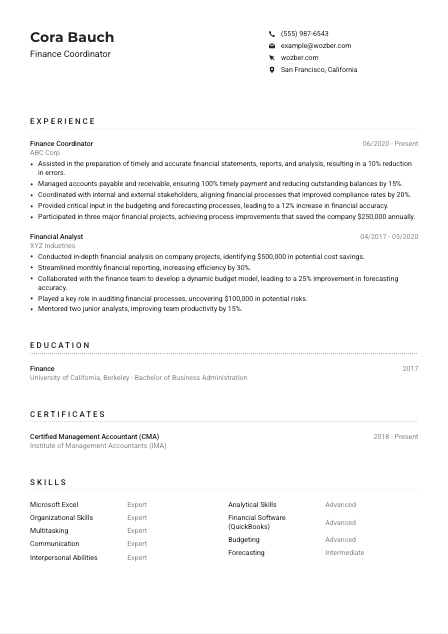
If the posting names a location requirement, reflect it clearly in this section. Here, San Francisco, California is part of the stated criteria, so listing that city and state immediately removes doubt about eligibility. For other Finance Coordinator jobs, follow the same rule only when location is relevant to the employer's requirements.
A LinkedIn profile can strengthen your application if it reinforces your finance background. Make sure dates, titles, and core achievements match your resume. If your profile includes finance software exposure, reporting work, or budgeting support, it should tell the same story with the same level of accuracy.
Your header should make you easy to contact and easy to place. For a Finance Coordinator, that means polished basics, no inconsistencies, and immediate confirmation of any location requirement.




This section carries the most weight for Finance Coordinator hiring. Employers are looking for proof that you have handled financial workflows with precision, supported reporting cycles, and improved processes without creating compliance or accuracy issues. Show responsibilities and results together.
Pull out the recurring themes from the job description before you write or revise a single bullet. For this role, that means financial statements and analysis, accounts payable and receivable, reconciliation, budgeting and forecasting support, stakeholder coordination, and process improvement. Your experience section should mirror those workstreams using language that reflects what you have actually done.
List jobs in reverse chronological order with title, company, and dates presented consistently. Finance hiring often involves quick review for tenure, progression, and recent exposure to reporting or transactional work. A clean structure helps the reviewer find your latest finance scope fast.
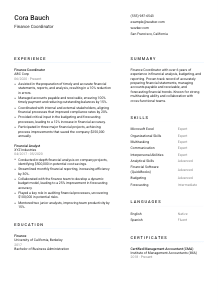
Lead with what you handled, then show what improved. Good Finance Coordinator bullets mention tasks such as preparing reports, processing AP and AR, reconciling balances, supporting forecasts, or coordinating with internal teams and vendors. The sample resume does this well by pairing finance duties with results like fewer reporting errors and stronger compliance.
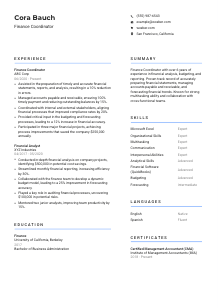
Metrics give finance work credibility. Include figures tied to accuracy, timeliness, cash flow, outstanding balances, cost savings, forecasting precision, or reporting efficiency. The example's 10% error reduction, 15% drop in outstanding balances, and $250,000 in annual savings work because they reflect results a finance team actually tracks.
If an older role was broader or more administrative, keep only the parts that support the target position. Prioritize bullets tied to reporting, analysis, financial controls, reconciliations, budgeting support, and cross-functional coordination. That keeps your resume centered on finance operations instead of drifting into unrelated office support.
By the end of this section, the reader should be able to connect your past work to the role's daily demands. They should see that you can manage finance processes accurately, support reporting cycles, and contribute to cleaner, more reliable operations.
Finance Coordinator roles often set a clear baseline for education, especially when the work includes reporting, forecasting support, and financial analysis. Your education section should confirm that foundation quickly, without making the reader hunt for the degree or field.
If the posting asks for a bachelor's degree in Finance, Accounting, or a related field, present that information plainly. Degree, major, school, and graduation year are usually enough. In the example, a Bachelor of Business Administration in Finance addresses the requirement cleanly.
Use a simple, consistent structure so the degree can be verified in seconds. This is especially important when education is a checklist item in screening. Avoid overloading the section with minor details that distract from the credential itself.
Do not bury the relevant major. For finance roles, the field matters because it signals formal grounding in accounting principles, financial analysis, budgeting, and reporting concepts. If your degree is in a related discipline, name it clearly and let your experience reinforce the finance relevance.
Most experienced Finance Coordinators do not need a course list. Include selected coursework only if it helps explain early-career relevance, a related-field degree, or specific exposure to accounting, corporate finance, Excel-based analysis, or forecasting methods.
Projects, honors, or finance competitions can help when they show practical application of financial concepts. If you are earlier in your career, a budgeting model, financial analysis project, or accounting capstone can support your profile. If you already have several years of direct finance work, keep this section lean.
Education should confirm that you meet the role's baseline and support the technical nature of your finance work. Keep it easy to verify and proportionate to your level of experience.
Certifications are not always required for Finance Coordinator jobs, but the right one can strengthen your profile, especially when it reflects financial management, analysis, or process discipline. Use this section to add professional depth, not to pad the resume.
Choose certifications that make sense for the work, such as management accounting, bookkeeping, financial analysis, or ERP-related finance training. While this posting does not require a certification, a credential like the CMA supports credibility in budgeting, reporting, and financial decision support.
If you have several certificates, lead with those closest to the target role. A finance-specific certification carries more weight here than a broad business course because it speaks more directly to reporting standards, cost control, analysis, or accounting processes.
Include the year earned and, if relevant, whether the credential is active. That gives context on recency and continued professional engagement. In the sample, "2018 - Present" for the CMA signals that the certification remains current.
Finance tools, reporting practices, and compliance expectations keep changing. Updated credentials in Excel, financial systems, or accounting topics can be useful additions over time, especially if they support the type of reporting and process work the target employer emphasizes.
Relevant certifications can strengthen your finance profile, especially when they align with the reporting, analysis, and process responsibilities of the job. Keep the list focused and current.
Finance Coordinator skills need to reflect both technical execution and operational reliability. Employers usually want a mix of spreadsheet strength, finance systems knowledge, analytical judgment, and the communication skills needed to keep payments, reports, and cross-team requests moving on time.
Start with the exact capabilities the employer names. Here that includes advanced Microsoft Excel, financial management software, analytical strength, organization, multitasking, communication, and interpersonal ability. Your skills section should reflect that mix using terms you can support elsewhere in the resume.
Do not make this section purely software-based. Finance Coordinators often sit between accounting processes and the people who depend on them, so include both technical tools and execution skills. Excel, financial software, budgeting, forecasting, reconciliation, and reporting belong alongside communication, organization, and stakeholder coordination.
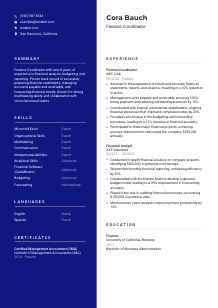
A simple structure makes the section easier to scan. You might separate technical skills from core professional skills, or simply order them by relevance. The sample works because it leads with Excel and finance software, then supports the role's coordination side with organizational, communication, and analytical abilities.
This section should show that you can work with numbers, systems, and people in the same role. Keep every skill tied to actual Finance Coordinator work you have done or can discuss in detail.
Language ability matters when the role calls for clear professional communication across teams, vendors, or clients. In finance, that communication often involves payment status, reporting follow-ups, reconciliations, and procedural questions, so your listed proficiency should be accurate and useful.
If the posting specifies English proficiency, list English clearly and place it first. Use an honest level such as "Native" or "Fluent" so the employer can quickly confirm that you can handle professional communication tied to finance operations and reporting.
Additional languages are worth including when they are genuinely usable in a professional setting. In some finance environments, they can help with vendor communication, internal coordination across teams, or customer-facing payment issues. They are a bonus, not a substitute for the core finance requirements.
Choose labels that reflect how well you can actually work in that language. If you can explain invoice issues, discuss reports, or manage stakeholder communication in that language, say so with an appropriate proficiency level. Inflated language claims are easy to expose in interviews.
In some markets, additional languages can be practically useful, especially in organizations with diverse clients, vendors, or teams. That does not make them a universal requirement for Finance Coordinator roles, but when they support smoother communication, they are worth showing.
Present languages as a practical business asset. In this profession, their value usually appears in clearer coordination, smoother issue resolution, and stronger communication around transactions, reporting, or process updates rather than in broad claims about global mindset.
List only the languages you can use with confidence in a professional setting. Done well, this section adds credibility to your communication strengths without overstating its importance.
Your summary should position you as someone who can support the finance function from day one. In a few lines, show the level of experience you bring, the finance processes you know well, and the kind of results you have delivered in reporting, payables and receivables, forecasting support, or process improvement.
Before writing, identify the two or three responsibilities that matter most in the posting. For this opening, those include financial reporting support, AP and AR management, budgeting and forecasting input, and process coordination. Use that priority mix to decide what belongs in the summary and what does not.
Start with your professional identity and experience level. That immediately gives context. The sample summary does this effectively with "Finance Coordinator" and more than 6 years of experience, which signals that the candidate is already operating beyond entry level.
Follow with the work you do best and the systems or processes most relevant to the role. Mention financial statements, reporting, AP and AR, budgeting, forecasting, reconciliations, Excel, or financial software if those are genuine strengths. Keep the wording close to the employer's language without turning the summary into a copied keyword list.
Aim for a short paragraph that reads like a professional snapshot, not a mini cover letter. A few precise claims are stronger than a broad list. If you mention multitasking or collaboration, anchor them in finance context, such as managing reporting deadlines, coordinating with stakeholders, or supporting multiple financial processes at once.
A well-written summary gives the reader an immediate sense of your finance scope and operating level. It should make your reporting, coordination, and process strengths clear before they even reach the experience section.
A Finance Coordinator resume should leave little ambiguity about what you can handle: accurate reporting support, disciplined AP and AR work, useful budgeting input, and steady coordination across finance processes.
Use Wozber to shape that experience into an ATS-compliant resume with clear role language, strong structure, and practical ATS alignment. The final document should make it easy to see that you can keep financial operations organized, accurate, and on schedule.




