



Use Wozber and land your dream job
Create Resume
No registration required
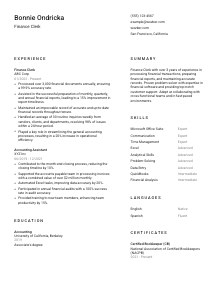
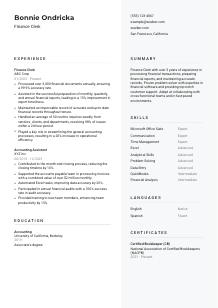
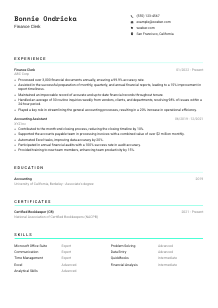
Counting coins, but your resume isn't adding up? Check out this Finance Clerk resume example, built with Wozber free resume builder. Learn how to showcase your number-crunching skills to match the job's monetary metrics, paving the way for a financial career that's always in the black!
Finance Clerk work runs on consistency. Hiring teams look for people who can keep invoices, payables, receivables, and financial records moving without errors piling up at month-end. Your resume should make that operational reliability visible, especially in the way you describe document volume, reporting support, record accuracy, and day-to-day coordination with vendors or internal teams.
A tailored resume also helps separate general administrative experience from real finance support work. When your wording matches the posting's terms for invoices, accounts payable and receivable, financial reporting, and Excel-based processing, Wozber's free resume builder helps you shape an ATS-compliant resume that surfaces the right finance keywords and responsibilities early. That makes it easier for reviewers to see whether you can step into routine financial workflows with minimal ramp-up.
This section should confirm that you are reachable, professional, and aligned with any basic application requirements before the reader reaches your accounting experience. For a Finance Clerk, clean presentation matters because the role itself depends on accuracy, record quality, and clear written communication.
Use your full name as the most visible text on the page. Keep the formatting clean and businesslike. A Finance Clerk resume benefits from the same clarity expected in financial records, vendor correspondence, and report support.
Place "Finance Clerk" directly beneath your name if that is the role you are pursuing. This keeps your positioning clear and avoids looking unfocused, especially when employers are sorting candidates across accounting assistant, bookkeeping, and finance support roles.
Include a reliable phone number and a professional email address. If the job asks for clear written English, even your email address should look polished and error-free. Small details matter in finance because sloppy contact information can raise questions about data accuracy and care.
Add your city and state when the employer specifies a location requirement. Here, listing "San Francisco, California" directly addresses the posting without taking up much space. Use location this way only when it supports the application, not as filler.
Add a LinkedIn profile or professional website only if it supports your candidacy. For a Finance Clerk, that usually means a profile with matching job titles, dates, accounting software exposure, or reporting experience. If the link is incomplete or inconsistent with your resume, leave it out.
This section does not need personality flourishes. It needs accuracy, professionalism, and any practical detail that confirms you can move smoothly into the employer's finance workflow.




This is where Finance Clerk resumes win or lose attention. Employers need to see that you have already handled routine financial processing, supported reporting cycles, and kept records dependable under recurring deadlines. Generic office bullets will not carry much weight here.
Pull the core duties from the job description and reflect them in your bullet points using truthful, role-specific language. For this opening, that means invoices, bills, accounts payable and receivable, financial records, reporting support, and routine financial inquiries. If you have done that work under a different title, such as Accounting Assistant, make the overlap obvious in the bullets.
List your most recent role first, then work backward. Include company, title, and dates without clutter. Finance hiring often depends on how recently you handled recurring tasks like month-end support, invoice processing, or audit preparation, so a clean timeline helps the reader place your experience fast.
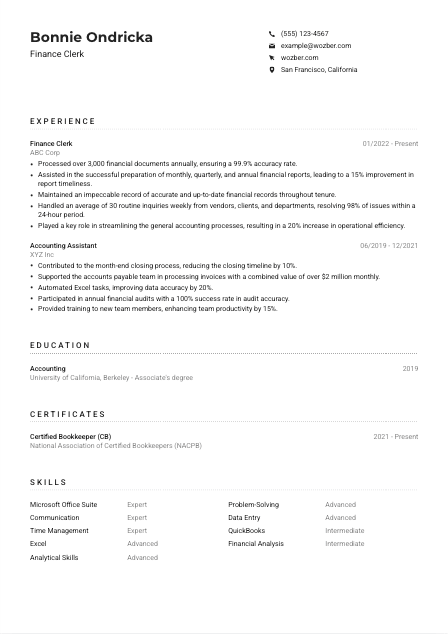
Routine finance work still needs measurable impact. Instead of writing that you "processed invoices" or "maintained records," show what that looked like in practice through accuracy, speed, timeliness, or issue resolution. The example resume does this well with details like 99.9% document accuracy and faster reporting timeliness, which tell the reader how well the work was done.
Finance teams trust numbers, so quantify the workload you managed. Useful measures include document volume, dollar value, close-cycle improvement, report turnaround, issue resolution time, and audit accuracy. "Processed over 3,000 financial documents annually" and "supported invoices totaling $2 million monthly" are strong because they show both scope and consistency.
Prioritize experience that proves you can support accounting workflows. If you also handled broader admin work, keep only the parts that connect to finance operations, such as vendor communication, reconciliations, reporting support, Excel tracking, or records maintenance. Every bullet should help the employer picture you inside their ledger, reporting, and document flow.
A Finance Clerk experience section should make your daily contribution easy to picture. When your bullets show transaction volume, reporting support, record accuracy, and operational improvement, your background reads as immediately usable.
For Finance Clerk roles, education usually serves as a baseline check rather than the main selling point. Still, it matters because it confirms your grounding in accounting concepts, financial records, and the structure behind the daily work you will support.
If the posting requires an Associate's degree in Accounting, Finance, or a related field, list that clearly and use the exact field when applicable. An Associate's degree in Accounting, as shown in the example, matches the requirement directly and removes doubt early in the review.
Use a simple format with school, degree, field of study, and graduation year or date. Finance resumes benefit from order and consistency, and this section should read as cleanly as a financial record header.
When your degree is closely tied to the role, do not bury the field. "Accounting" or "Finance" should be easy to spot because it supports your readiness for document processing, reporting support, and general accounting tasks.
If you are earlier in your career or your work experience is limited, relevant coursework can help. Choose subjects that support the role, such as financial accounting, bookkeeping, spreadsheet analysis, payroll fundamentals, or accounts payable systems. Skip this if you already have enough practical experience to carry the resume.
Honors, scholarships, or accounting-related student activities can add context, especially for early-career candidates. Keep them only if they reinforce finance discipline, analytical ability, or commitment to the field. For experienced applicants, this section should stay concise.
This section should quickly reassure the employer that you meet the academic requirement and understand the accounting basics behind the role. Clear, relevant education is enough.
Certifications are not mandatory for every Finance Clerk position, but they can strengthen your profile when they connect directly to bookkeeping, accounting operations, or financial controls. They are especially useful when the employer names a preferred credential.
Feature certificates that support the work of maintaining records, processing transactions, and assisting with reporting. In this case, Certified Bookkeeper is worth highlighting because the posting names it as a plus, making it a direct tailoring opportunity.
Do not crowd this section with unrelated training. Prioritize credentials tied to bookkeeping, accounting software, payroll, audit support, or spreadsheet-heavy finance work. Relevance matters more than volume.
Include the issue date or active date range so employers can place the credential in context. Recent or active certifications suggest current familiarity with accounting practices and professional standards.
If you are maintaining a credential or completing related coursework, show that progression clearly. Finance teams value people who stay current with bookkeeping standards, reporting practices, and the tools used in daily transaction work.
A well-chosen certificate adds credibility when it maps directly to the job's accounting tasks. Keep the section relevant, current, and easy to verify.
The best Finance Clerk skills sections balance technical ability with the practical judgment needed for daily transaction work. Employers want to see the tools you use, the finance tasks you can support, and the problem-solving ability you bring when records, payments, or inquiries do not line up cleanly.
Start with the skills the employer explicitly mentions, then add closely related ones you genuinely use. For this role, that includes Microsoft Office Suite, Excel, analytical skills, problem-solving, and clear written communication. From there, you can add adjacent finance skills such as data entry accuracy, accounts payable support, accounts receivable tracking, or bookkeeping software.
Use the same language the posting uses when it reflects your real experience. That helps both human reviewers and ATS screening connect your resume to the job. If the employer asks for Excel proficiency, do not replace it with vague phrasing like "spreadsheet knowledge" when you can state Excel directly.
Organize the section so it reads quickly. For example, separate software tools like Excel and QuickBooks from analytical strengths and communication skills. The example resume shows a useful mix of technical tools, data handling, and soft skills, though you should keep the list tailored to the specific finance opening rather than listing every general strength you have.
This section should support the rest of the resume, not repeat it blindly. Focus on the tools, analytical strengths, and accounting capabilities that help a Finance Clerk keep transactions and records accurate.
Language skills matter in finance when the role involves written communication, vendor contact, or coordination across departments. This section should stay practical and support the communication demands of the job rather than taking up space for its own sake.
If the job specifically requires clear written English, list English first and state your proficiency honestly. For a Finance Clerk, written clarity matters in emails, invoice follow-up, payment questions, and internal finance communication.
Lead with the language most relevant to the role. Doing so makes the requirement easy to confirm and keeps this section aligned with the posting.
Additional languages can help in organizations that work with multilingual vendors, customers, or internal teams. Spanish, for example, may be useful in some finance support environments, but it should be treated as an added asset rather than a replacement for finance experience.
Choose clear descriptions such as Native, Fluent, Advanced, or Conversational, and be prepared to work at the level you claim. Finance communication often involves specific payment, billing, or record-related wording, so accuracy here matters.
If the position includes frequent vendor or client contact, an additional language can strengthen your case. If the role is mostly internal and document-focused, keep this section brief and let your accounting background lead.
List languages when they clarify your ability to handle written finance communication or support a broader client base. Otherwise, keep the section lean and focused on what the job actually requires.
The summary should frame you as someone who can handle the pace and precision of finance support work. In a few lines, show your level of experience, the kinds of transactions or reporting tasks you handle, and the tools or strengths that make you dependable in an accounting environment.
Open with your title, years of experience, and the type of finance work you have handled. For this role, that usually means transaction processing, record maintenance, accounts payable and receivable support, and reporting assistance. Skip broad claims and lead with real scope.
Your opening sentence should tell the reader where you sit in the finance function. A line like the example's "Finance Clerk with over 3 years of experience" works because it immediately establishes level, field, and relevance.
Work in a few high-value details from the posting, such as Excel proficiency, analytical problem-solving, financial document handling, or cross-functional communication. Keep the wording natural and tied to the actual work you do.
Aim for 3 to 5 lines with no filler. A Finance Clerk summary should read like a concise professional snapshot, not a mission statement. If possible, hint at outcomes such as accuracy, timeliness, reporting support, or efficient issue resolution without turning the paragraph into a list.
When this section is done well, the employer immediately understands your finance focus, your level, and the kind of day-to-day accounting support you can provide. That clarity sets up the rest of the resume.
A Finance Clerk resume should show that you can keep financial documents accurate, support recurring reporting cycles, and handle routine accounting tasks without creating extra cleanup for the team. When each section points back to transaction volume, record quality, Excel capability, and dependable communication, your application becomes much easier to trust.
Use Wozber's AI resume builder to tailor your content around the posting's finance terms, strengthen ATS optimization, and present everything in an ATS-friendly resume format. The final result should make one thing clear right away: you can step into the finance workflow and keep it running accurately.




