



Use Wozber and land your dream job
Create Resume
No registration required
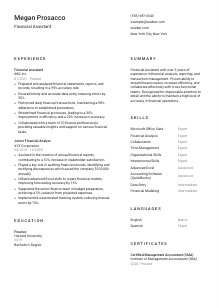
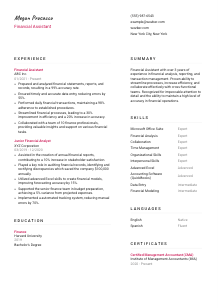
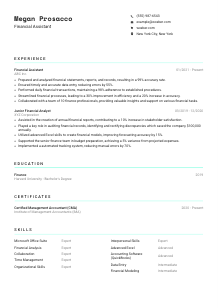
Balancing ledgers, but your resume isn't adding up? Check out this Financial Assistant resume example, made with Wozber free resume builder. It shows how to align your fiscal flair with job criteria, multiplying your chances of landing that prime number position!
Financial Assistant work sits close to the numbers that keep a business running day to day. When a hiring team opens your resume, they want to see whether you can handle transaction accuracy, support reporting, and keep financial records clean enough for month-end review, audit follow-up, and routine decision-making.
A tailored resume changes how quickly that picture comes into focus. When your wording reflects the posting's finance terms, software expectations, and reporting tasks, Wozber's free resume builder helps you shape an ATS-compliant resume that surfaces the right experience early, especially your accuracy with financial data, transaction processing, and support for financial statements.
For a Financial Assistant, the header does more than identify you. It should immediately confirm that you are reachable, professionally presented, and, when relevant to the posting, available in the required location without creating extra questions for the employer.
Use your full name in a slightly larger font than the rest of the resume so it stands out at a glance. In finance support roles, clean presentation matters because employers often associate a tidy resume with the same care you would bring to data entry, reconciliations, and transaction records.
Place "Financial Assistant" directly under your name when that is the role you are pursuing. Matching the posted title helps position you correctly in ATS searches and tells the reader right away that your background is aligned with financial reporting support, payables and receivables work, and day-to-day finance operations.
List a reliable phone number and a professional email address, ideally in a straightforward format such as firstname.lastname@email.com. Finance teams handle time-sensitive requests around invoices, statements, and reporting deadlines, so your contact information should be easy to trust and easy to use.
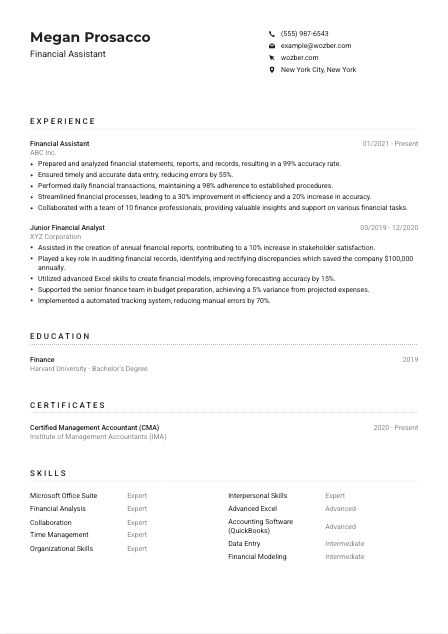
If a job specifies a city or region, add that information in your header. Here, listing "New York City, New York" directly addresses the stated location requirement and removes uncertainty about your availability for the role. Use this only when location is relevant to the employer's screening criteria.
A LinkedIn profile or personal website can help if it reinforces your finance background, software skills, or career progression. Make sure the dates, titles, and achievements match your resume exactly. For a Financial Assistant, consistency matters because hiring teams notice discrepancies quickly.
Your personal details should answer the practical basics fast: who you are, how to reach you, and whether you meet any location requirement tied to the job. Keep it crisp and reliable, just like the financial records you would be asked to maintain.




This section usually carries the most weight for Financial Assistant hiring. Employers want to see whether you have already worked with financial records, recurring transactions, reporting support, and the kind of accuracy that keeps errors from flowing into larger finance processes.
Before editing your bullets, mark the responsibilities that define the role. In this posting, that includes preparing and analyzing financial statements, entering financial data accurately, handling receivables and payables, improving process efficiency, and collaborating with the finance team. Those themes should guide which accomplishments you keep and which you cut.
List your experience in reverse chronological order so the employer sees your most relevant finance work first. Include your job title, company name, and dates of employment. For this kind of role, progression from positions such as Junior Financial Analyst to Financial Assistant can show growing exposure to reporting, tracking, and operational finance work.
Turn routine finance duties into measurable achievements. Instead of saying you "assisted with financial statements," show the result. The sample resume does this well with a bullet that ties financial statement preparation and analysis to a 99% accuracy rate. That kind of phrasing shows both responsibility and execution quality.
Financial employers are used to working with percentages, variances, error rates, savings, and processing improvements, so use them naturally. Reduced entry errors by 55%, improved efficiency by 30%, or saved $100,000 through discrepancy review all tell a clearer story than broad claims about being detail-oriented. Pick metrics that reflect the work you actually owned.
Prioritize bullets that show transaction processing, reconciliation support, reporting assistance, Excel-based analysis, financial software use, and coordination with internal teams. If you have broader business experience, keep only the parts that connect to financial control, record accuracy, or reporting workflows. The closer each bullet sits to the posted work, the easier it is to see you in the seat.
Your experience section should make one thing obvious: you can support finance operations with accuracy, speed, and dependable follow-through. If your bullets show reporting support, clean transaction handling, and measurable process improvement, you are speaking the language of this role.
Education matters here because the posting asks for a bachelor's degree in Finance, Accounting, or a related field. This section does not need decoration, but it should clearly show the academic foundation behind your financial reporting, analysis, and accounting support work.
If you hold a bachelor's degree in Finance, Accounting, or a related discipline, state it clearly and without extra wording. In the example, "Bachelor's Degree in Finance" lines up neatly with the posting and immediately checks an important qualification box.
List your degree, field of study, school, and graduation year in a consistent format. Hiring teams reviewing finance resumes often scan quickly for required qualifications, and a structured entry makes that review faster both for recruiters and for ATS parsing.
When your degree is directly related to the role, lead with the credential and field before anything else. A finance-focused degree reinforces your grounding in accounting principles, financial statements, budgeting concepts, and analytical coursework that support day-to-day assistant responsibilities.
Relevant coursework can help if you are early in your career or if your experience is lighter than the role requires. Courses in financial accounting, managerial accounting, corporate finance, Excel for business analysis, or auditing can strengthen your profile when they connect to the target job.
Academic honors, finance society involvement, case competitions, or projects tied to analysis, reporting, or process improvement can add useful context. Keep these details only if they reinforce skills the employer cares about, such as analytical ability, structured problem-solving, or familiarity with financial data.
This section should confirm that you meet the formal academic requirement and have a credible base in finance or accounting. Keep it clear and job-relevant, especially if your degree is one of the first filters used in the hiring process.
Certifications are often secondary for Financial Assistant roles, but they can still help when they deepen your accounting knowledge, show commitment to the field, or support future growth into analyst or senior finance support positions.
Check whether the posting names a required or preferred certification. If it does not, choose credentials that still support the job's responsibilities. A certification such as CMA is not universal for Financial Assistant roles, but it does signal stronger grounding in accounting, financial analysis, and performance reporting.
Include certifications that strengthen your fit for financial reporting, accounting operations, Excel-heavy analysis, or related finance systems. One respected credential is usually more persuasive than a long list of generic course completions.
If a certification is active, in progress, or renewed periodically, include dates so the employer can understand its current status. In regulated or standards-sensitive finance environments, current credentials can carry more weight than older, inactive ones.
Finance processes, software, and reporting expectations change over time, especially as teams automate more routine work. Adding a relevant certification can show that you are building beyond basic transactional support into stronger analysis, controls awareness, or systems knowledge.
Certifications are most useful here when they sharpen your finance credibility and support the type of work the role involves. Keep them relevant, current, and clearly connected to accounting or financial operations.
A Financial Assistant skills section should read like the toolkit behind your actual work. Focus on the systems, analysis skills, and workplace habits that support accurate entries, dependable reporting, and smooth coordination with the finance team.
Read the job description for both explicit and implied requirements. This one calls out financial software, Microsoft Office, advanced Excel, analytical ability, organization, time management, communication, and collaboration. Those terms give you a practical map for what belongs in your skills section.
List the technical and professional skills that show up in your experience bullets. If you claim advanced Excel, your work history should back it up with models, reporting, reconciliations, or forecasting support. The sample resume handles this well by pairing Excel with financial modeling and forecasting improvements.
Group the most relevant capabilities near the top, especially finance software, Excel, financial analysis, data entry accuracy, and organizational skills. Avoid padding the section with broad traits that are not supported anywhere else. A shorter, role-specific list is usually stronger for ATS optimization and for human review.
This section should tell the employer that you can work confidently with financial data, office tools, and team workflows from day one. When your skills mirror the posting and match your experience, they strengthen both ATS alignment and credibility.
Language skills may not be the deciding factor for every Financial Assistant opening, but they matter when the posting calls for professional communication, cross-functional teamwork, or support across a diverse internal or client-facing environment.
If the employer asks for professional English, include it clearly with an honest proficiency level. That requirement matters in finance because written communication often touches invoices, internal requests, reporting notes, and follow-up with colleagues across departments.
List the most important language at the top of the section so it is easy to scan. For this role, English should appear first because it is explicitly named in the posting.
Extra languages can be worth listing when they support teamwork, vendor communication, or a multilingual workplace. Spanish, for example, may not be required, but it can still be useful depending on the business environment and the people you support.
Choose simple levels such as Native, Fluent, Intermediate, or Basic. Finance teams rely on precise communication, so vague language claims can create the wrong expectations.
If languages are not central to the job, keep this section brief. Its purpose is to confirm communication ability, not to compete with your finance experience, reporting skills, or software proficiency.
For a Financial Assistant, language skills are most useful when they support professional communication and cross-team coordination. Present them clearly, then let your finance experience remain the main driver of the application.
The summary sits at the top of the resume, so it needs to frame your value quickly. For Financial Assistant roles, that usually means combining years of experience with a few core strengths such as reporting support, transaction accuracy, Excel capability, and process improvement.
Pull out two or three recurring ideas from the job description before you write. Here, the central themes are financial statements, accurate data entry, transaction processing, process efficiency, and teamwork. Those points should shape your opening lines.
Start by naming your role identity and relevant experience, such as "Financial Assistant with 3+ years of experience in financial reporting support and transaction management." This gives the reader immediate context and helps anchor the rest of the summary.
Use one or two concrete contributions that fit the position, such as improving accuracy, reducing errors, streamlining processes, or supporting financial analysis. The sample summary works because it connects experience to efficiency and operational accuracy rather than relying on generic claims.
Aim for a compact paragraph that sounds grounded in actual finance work. Four lines are usually enough. Cut filler, avoid vague adjectives, and use terms that connect directly to the posting, especially if you want the summary to support ATS matching as well as human review.
Your summary should quickly position you as someone who can keep financial operations accurate, organized, and moving. If it reflects your real experience with reporting, transactions, and process support, it gives the rest of the resume a clear direction.
A Financial Assistant resume should leave little room for guesswork. When the document clearly shows finance education, relevant experience, accurate transaction handling, Excel or financial software capability, and support for reporting, hiring teams can place you much faster in the right part of the candidate pool.
Use Wozber's free resume builder, ATS-friendly resume templates, and ATS resume scanner to align your wording with the job description, strengthen ATS optimization, and present your background in a clean format. The finished resume should make one thing easy to judge: you can support financial operations with accuracy and reliability from day one.