



Use Wozber and land your dream job
Create Resume
No registration required
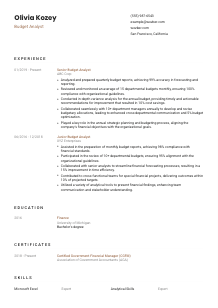
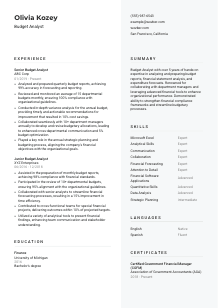
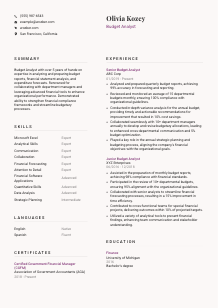
Balancing spreadsheets, but your resume doesn't add up? Check out this Budget Analyst resume example, created with Wozber free resume builder. It shows how to showcase your fiscal expertise to align with job criteria, setting your career on a financial trajectory that's always in the black!
Budget Analyst hiring usually turns on one practical question: can you turn budget data into decisions that managers can actually use. A resume in this field needs to show more than spreadsheet comfort. It should make clear that you can monitor departmental spending, explain variances, prepare reliable forecasts, and support planning cycles without losing track of policy, timing, or financial detail.
When the resume mirrors the language of the target posting, the hiring team can quickly separate broad finance experience from hands-on budget analysis. Wozber's free resume builder helps you shape that alignment in an ATS-friendly resume format, so budgeting work, forecasting results, and stakeholder-facing communication are easier to identify early. That matters when the role calls for someone who can review allocations, flag issues, and present recommendations with confidence.
For a Budget Analyst, the top of the resume should read like a clean header on a financial report. Keep it precise, professional, and easy to scan. This section does not need personality flourishes. It needs to confirm who you are, what role you are targeting, and whether basic logistical requirements are already covered.
Place your full name at the top in a slightly larger font than the rest of the document. Hiring teams often review many finance resumes in sequence, so clarity matters. A clean, readable header helps them orient quickly before they move into your budgeting experience, reporting scope, and technical skills.
Put "Budget Analyst" beneath your name if that is the role you are pursuing. This immediately connects your resume to the opening and helps frame everything that follows, from variance analysis to budget monitoring. If your current title is slightly different, such as Senior Budget Analyst or Financial Analyst, your resume can still target the role as long as the experience below clearly supports it.
List a reliable phone number and a professional email address. Use a format based on your name rather than a casual handle. Finance hiring often moves through scheduled interviews and follow-up requests for work history or references, so this information needs to be accurate and easy to use.
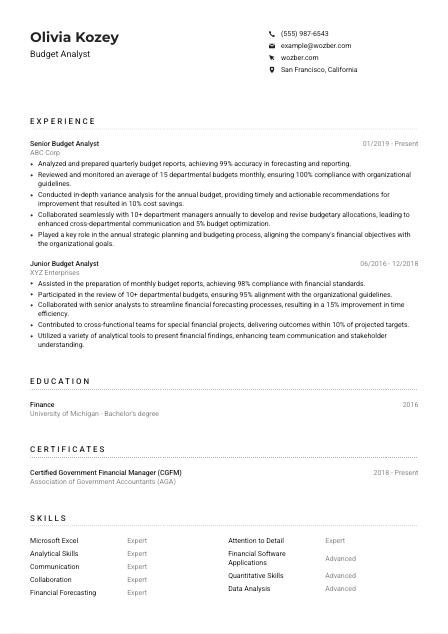
If a job specifies a location requirement, include your city and state so the employer does not have to guess. In the example, listing "San Francisco, California" directly supports a posting that asks candidates to be located in or willing to relocate there. Treat location this way when it is a stated filter, not as a standard rule for every Budget Analyst resume.
Include LinkedIn or a relevant professional website only if it supports the same story your resume tells. For Budget Analysts, that usually means a polished profile with consistent titles, dates, and finance-focused achievements rather than a general online presence. If it is outdated or sparse, leave it off until it reflects your current budgeting and analysis work.
This section should remove basic friction before the reader gets to your financial experience. When your title, contact details, and any required location information are clear, the hiring team can move straight to the part that matters most: how you manage budgets, interpret variances, and support planning decisions.




This is the section where Budget Analysts separate themselves from general finance candidates. Employers look for direct signs that you have worked with live budgets, reporting cycles, forecast revisions, and department stakeholders. Your bullets should show the scale of the work, the accuracy of your analysis, and what changed because of your recommendations.
Start by pulling out the core responsibilities from the posting and mapping them to your own experience. For this role, that includes preparing budget reports, monitoring departmental budgets, conducting variance analysis, and supporting strategic planning. If you have done those tasks under a different title, use accomplishment bullets to make the connection explicit rather than assuming the reader will infer it.
List your jobs in reverse chronological order with title, employer, and dates. That structure is standard, but it matters even more in finance because hiring teams often track progression from analyst support work into fuller ownership of budget review, forecasting, and planning. Clear dates also help them gauge whether you meet an experience threshold such as 3+ years in budgeting or financial analysis.
Generic lines like "responsible for budgets" do not show enough. Focus on what you analyzed, what you produced, who you supported, and what improved. The example does this well with bullets that mention quarterly budget reports, departmental monitoring, variance analysis, and recommendations that led to 10% cost savings. That kind of phrasing shows both the workflow and the business result.
Numbers make budget work concrete. Use metrics tied to the profession, such as forecast accuracy, number of departmental budgets reviewed, monthly or quarterly reporting cadence, time saved through process improvements, savings identified, or compliance rates. The sample resume includes 99% forecasting accuracy, oversight of 15 departmental budgets, and a 15% efficiency improvement, all of which help the reader understand scope and effectiveness quickly.
Prioritize experience that shows budgeting, expenditure tracking, financial analysis, reporting, or collaboration with department managers. If you have broader finance history, keep the bullets that reinforce planning, allocation, compliance, or financial decision support. A Budget Analyst resume should make it easy to see how you handle budget cycles and financial recommendations, not bury that work under unrelated administrative tasks.
Your experience section should leave little doubt that you can manage the rhythm of budget analysis: reports, reviews, forecasts, variances, and conversations with stakeholders. When each bullet ties financial activity to a measurable result, your background reads like someone ready to step into the next budgeting cycle and contribute immediately.
Education matters in Budget Analyst hiring because it establishes formal grounding in finance, accounting, and quantitative thinking. Most employers are not looking for a long academic story here. They want to confirm that your degree supports the analytical work the role requires.
If the role calls for a Bachelor's degree in Finance, Accounting, or a related field, present that information clearly and in familiar wording. In the example, "Bachelor's degree" in "Finance" aligns directly with the requirement. When your field is adjacent, such as economics or business, make sure the rest of the resume reinforces budgeting and financial analysis experience.
List degree, field of study, school, and graduation year. Keep it clean and easy to scan. This section is usually reviewed quickly, so avoid unnecessary detail unless it adds clear value to your candidacy for finance and budgeting work.
Use the official name of your degree and major rather than paraphrasing. Exact wording can help with ATS matching and reduces ambiguity for the reader. If the employer is screening for finance or accounting backgrounds, a clear field label does part of that work immediately.
Relevant courses can help if you are early in your career or moving into budget analysis from a nearby field. Include subjects such as managerial accounting, financial modeling, corporate finance, cost accounting, or statistics if they support the role. For experienced candidates, hands-on budget and forecasting work usually carries more weight than course lists.
Honors, scholarships, or finance-related student leadership can be worth listing if they show strong quantitative performance or sustained interest in the field. Keep them brief. Once you have several years of budget analysis experience, academic extras should stay secondary to the work you have already delivered.
A clear education section confirms that you meet the role's baseline academic requirement and have the analytical foundation behind your budgeting work. For most candidates, that is all it needs to do. Let it support the experience section rather than compete with it.
Certifications are not always required for Budget Analyst roles, but the right one can strengthen your profile, especially when it reflects budgeting, government finance, financial management, or advanced analysis. Use this section to show targeted professional development, not to list every course you have ever taken.
List credentials that support the work employers expect from a Budget Analyst, such as budget control, financial reporting, compliance, public finance, or analytical rigor. The sample resume uses the Certified Government Financial Manager credential, which is a good example of a certification that adds weight in the right context, even when the posting does not explicitly require it.
A short list of well-chosen certifications is stronger than a crowded section of loosely related items. Lead with credentials that connect to forecasting, budget administration, financial planning, or reporting standards. If a certificate does not strengthen your case for budget analysis, it does not need space on the resume.
Add the year earned or the active date range if the credential is ongoing or renewable. That helps the employer see whether your training is current, especially in areas affected by changing regulations, reporting practices, or software use. It also gives the section a more complete professional context.
If you are pursuing training in Excel, financial systems, forecasting, or budgeting methodology, relevant certifications can reinforce that you are building sharper technical and analytical capability. This matters most when you want to show momentum into more complex budgeting responsibilities or industry-specific finance work.
A focused certification section can strengthen your finance profile, especially when it points to the kind of budget oversight or analytical depth the role requires. Keep it relevant, current, and clearly connected to the work you want to do next.
Budget Analyst skills should reflect the actual mechanics of the job. That means technical tools, analytical strength, and the ability to explain financial findings to managers who do not live in spreadsheets all day. A useful skills section is selective and closely tied to how budget work gets done.
Start with the requirements named in the job description, then keep only the ones you can support elsewhere in the resume. In this example, that includes Microsoft Excel, financial software applications, analytical and quantitative skills, attention to detail, and communication. Those are not filler terms for a Budget Analyst. They connect directly to forecasting, budget monitoring, and presenting variance findings to department leaders.
Lead with the tools and strengths that matter most for day-to-day budget analysis. Excel, financial forecasting, data analysis, variance review, and reporting tools usually deserve higher placement than broader workplace traits. The sample resume does this effectively by featuring Excel, analytical skills, financial forecasting, and financial software before less central items.
Do not turn the skills section into a keyword dump. A shorter list of relevant finance and communication skills is more useful than a long mix of generic abilities. Choose the capabilities that support how you work with budgets, reports, planning discussions, and financial controls, then let the experience section prove them with examples and metrics.
When this section is built well, the reader sees the tools and capabilities behind your reporting, forecasting, and budget recommendations. Keep it focused on the work itself, and it will support both ATS matching and human review without sounding padded.
Language skills are usually a supporting section for Budget Analysts, not a lead qualification. Still, clear communication matters in this work, especially when you are presenting budget updates, explaining variances, or working across departments. List languages plainly and give honest proficiency levels.
If the posting specifies English, include it clearly with your proficiency level. That matters in a role where budget reports, planning documents, and stakeholder discussions depend on precise language. The example lists English as Native, which directly answers the requirement without overexplaining it.
Additional languages can be useful, especially in organizations with multilingual teams, regional operations, or stakeholder groups from different backgrounds. Include them when they are real working abilities, not when they are too limited to use in professional communication.
Terms like Native, Fluent, Conversational, or Basic are easy to understand and more useful than vague descriptions. Hiring teams do not need a long explanation here. They need a quick read on whether you can communicate effectively in another language if the work calls for it.
For many Budget Analyst roles, English may be the only language that matters directly. But if you support international reporting, multinational departments, or diverse internal teams, another language can support collaboration and presentation work. Keep that relevance in mind when deciding what to include.
Language skills should not overshadow budgeting, analysis, or technical finance capability. Treat them as an added dimension to your profile. In most cases, a concise list is enough to show communication range without pulling focus from the core financial qualifications.
For Budget Analysts, language ability is most useful when it supports reporting and cross-functional communication. Present it cleanly, answer any stated requirement, and keep the main emphasis on your budgeting and analytical work.
Your summary should give the hiring team a quick, credible picture of the kind of Budget Analyst you are. It works best when it names your level, highlights the budget work you actually handle, and points to one or two outcomes that matter in the role. Keep it compact, but make every phrase earn its place.
Start by identifying yourself as a Budget Analyst and stating your experience in a natural form such as "3+ years" or "over 5 years." That immediately places you within the hiring range. The example summary does this well by leading with hands-on expertise in budget reports, financial statement analysis, and expenditure forecasts.
Use the next sentence to name the work you do best, such as forecasting, variance analysis, departmental budget review, strategic planning support, or translating financial findings for non-financial managers. Pull these themes from the posting when they reflect your real background, so the summary matches both the role and your experience.
A summary should usually be three to five lines, not a mini cover letter. Focus on the strongest parts of your budgeting profile and avoid generic claims. Terms like "improved forecast accuracy," "supported annual budget cycles," or "identified cost-saving opportunities" say far more than broad statements about being results-driven or detail-oriented.
Close with a practical outcome tied to budget analysis, such as stronger compliance, better allocation decisions, more reliable forecasting, or clearer reporting for business leaders. The sample summary points to enhanced organizational performance and stronger compliance frameworks, which gives the reader a clear sense of business value instead of just listing skills again.
A well-written summary helps the hiring team understand, within seconds, whether you are a Budget Analyst who can step into reporting cycles, planning discussions, and budget reviews with confidence. Keep it brief, grounded, and tied to the kind of financial judgment the role needs.
Once each section reflects the real demands of Budget Analyst work, your resume becomes much easier to trust. The hiring team should be able to see degree alignment, budgeting experience, forecasting skill, tool proficiency, and communication with non-financial stakeholders without having to dig for it.
Use Wozber to tighten that alignment from top to bottom. Wozber's free resume builder, ATS resume scanner, and ATS optimization features help you match the posting's language, surface missing requirements, and present your experience in an ATS-compliant resume that stays easy for people to read as well.
Before you apply, do one final review for specificity. Check that your bullets show budget reports, variance analysis, departmental oversight, forecasting cadence, software use, and measurable outcomes. At that point, your resume will make a clear case that you can support budgeting decisions from day one.




