



Use Wozber and land your dream job
Create CV
No registration required
Crafting code, but your CV doesn't compute? Check out this Software Development Engineer CV example, created with Wozber free CV builder. It shows how to blend your programming prowess with job prerequisites, so your career trajectory is as energetic as a high-speed algorithm!
Software Development Engineer hiring moves quickly when a CV makes the engineering work visible. Teams want to see how you build, debug, and improve software in real environments, whether that means shipping product features, improving performance, reducing defects, or contributing to clean architecture and agile delivery. Vague claims about being "passionate" or "results-driven" do very little here. Concrete engineering outcomes do.
A tailored CV changes how your background is read in both ATS screening and human review. When your experience uses the same language as the role, such as software design principles, data structures, algorithms, cross-functional collaboration, and modern programming languages, Wozber's free CV builder helps you shape that into an ATS-compliant CV that surfaces relevant work faster. The hiring team should be able to tell, early on, that you can contribute to production software with solid engineering judgment.
For software engineering roles, the header needs to remove friction. Hiring teams should be able to identify your target role, contact you quickly, and confirm basic logistics without hunting through the page. Keep this section lean, professional, and aligned with the job you want.
Use your full name in a clean, readable format at the top of the CV. A slightly larger font is enough. For engineering roles, clarity matters more than visual flair, especially when your CV may be scanned alongside dozens of others for technical depth and relevant project history.
Place the target title directly under your name. If you are applying for a Software Development Engineer opening, say exactly that. This helps recruiters and hiring managers connect your profile to the requisition immediately, and it also keeps your CV aligned with ATS categorization when similar titles like Software Engineer or Application Developer are in the mix.
Include a reliable phone number and a professional email address. Add a LinkedIn profile, GitHub, or portfolio only if it supports your candidacy with code samples, shipped projects, or technical contributions. For this profession, those links are most useful when they reinforce engineering depth rather than simply existing.
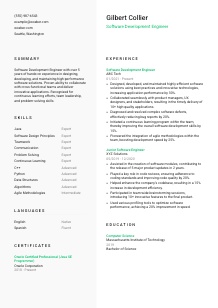
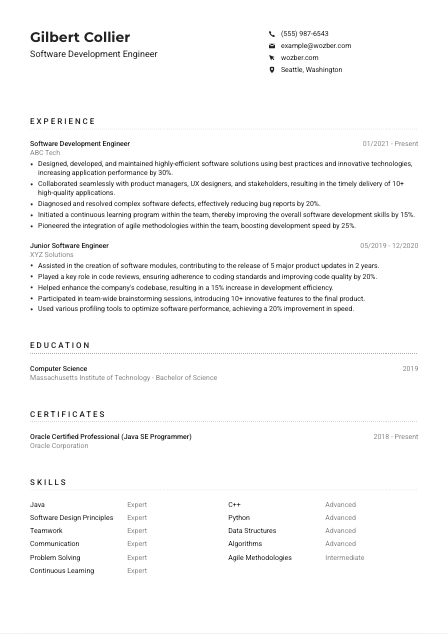
Some Software Development Engineer jobs include an on-site or relocation requirement. Here, Seattle, Washington is explicitly named, so listing Seattle if you are already there can remove an immediate concern. If you plan to relocate, make that clear in a simple, direct way rather than leaving the employer to guess.
A personal site, GitHub profile, or technical portfolio can strengthen your application when it shows real development work such as repositories, architecture decisions, documentation, side projects, or open-source contributions. Keep these links current. Broken repositories, outdated demos, or empty profile pages do not help your case.
Your personal details should quickly confirm who you are, what role you are targeting, and how to reach you. For a Software Development Engineer, that is enough to clear the way for the technical substance that follows.




This section carries the most weight in a Software Development Engineer CV. Hiring teams want to understand the systems you worked on, the problems you solved, the engineering practices you used, and the outcomes your code produced. Strong bullets show execution, not just participation.
Start by identifying the work patterns in the posting. Here, the role emphasizes software design, development, maintenance, debugging, cross-functional collaboration, and agile teamwork, along with proficiency in languages such as Java, C++, or Python. Those should shape which projects, accomplishments, and tools you elevate in your experience section.
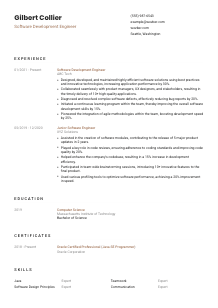
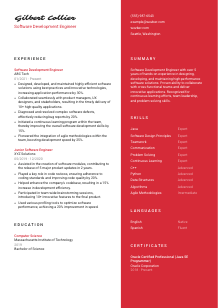
List your most recent engineering work first, including title, company, and dates. Under each role, focus on the parts of the job that map to software delivery, code quality, system performance, and team collaboration. The sample CV does this well by leading with current Software Development Engineer work before earlier junior-level experience, which makes progression easy to follow.
Replace broad duty statements with accomplishment bullets that show what changed because of your work. Good examples include improving application performance, reducing bug volume, increasing development speed, shipping product updates, or improving code quality through reviews and refactoring. In the sample, bullets like a 30% performance improvement and a 20% drop in bug reports give the hiring team something concrete to evaluate.
Quantify where it makes sense. For engineering roles, useful measures include latency or performance gains, release volume, defect reduction, throughput, test coverage, review efficiency, uptime, or delivery speed. Numbers are most convincing when tied to a technical change you drove, such as profiling, optimisation, debugging, automation, or architecture improvements.
If a bullet does not help explain your value as a Software Development Engineer, remove it or rewrite it. Side responsibilities are worth keeping only when they connect to the role, such as mentoring, code reviews, CI improvements, or agile contributions. Every bullet should strengthen one of the employer's likely questions: Can this person build reliable software, solve defects, and work effectively with product and design partners?
A well-tailored experience section should show how you write code, improve systems, and contribute to shipping quality applications. When those outcomes are clear, the rest of the CV becomes much easier to believe.
Education matters most here as proof of core preparation in computer science or a related discipline. It will not outweigh weak experience, but it does help establish that you have formal grounding in the concepts many Software Development Engineer roles still rely on, especially early in your career.
If the job asks for a bachelor's degree in Computer Science, Engineering, or a related field, make sure that information is easy to spot. List the degree name, field, school, and graduation year in a standard format. A direct match, like a Bachelor of Science in Computer Science, checks an explicit requirement quickly.
Do not overcomplicate this section. Hiring teams usually need to confirm the institution, degree, field, and date at a glance. Clean formatting also supports ATS parsing, which matters when degree requirements are used as a screen early in the process.
When your degree directly supports the role, use the formal wording rather than abbreviating it too heavily. In the example, "Bachelor of Science" and "Computer Science" make the connection obvious. That kind of exactness helps when employers are looking for a specific academic background without needing extra interpretation.
Recent graduates or early-career engineers can include relevant coursework, capstone projects, or research if those items demonstrate algorithms, systems programming, software engineering, databases, or application development. Once you have several years of professional experience, this detail usually becomes optional unless a project is especially relevant to the role.
Academic awards, scholarships, hackathons, or technical extracurriculars can be useful if they reinforce your engineering profile. Keep them brief and relevant. A strong GPA, competitive programming work, or a standout senior project can help early-career candidates add technical credibility without crowding the page.
Your education section should make one thing easy to confirm: that you have the academic foundation expected for software engineering work. Once that is clear, the hiring focus returns to what you have built and improved in practice.
Certifications are rarely the main hiring factor for Software Development Engineer roles, but they can support your profile when they deepen a relevant technical area. They are most useful when they reinforce a language, platform, or engineering discipline already reflected in your work experience.
Start with the job description. This role does not require a certification, so certificates should be treated as supporting material rather than the centerpiece of the CV. That said, a relevant credential can still strengthen your profile by showing sustained learning in a language or ecosystem tied to the role.
Choose certifications that align with the technical demands of the job. For a Software Development Engineer, that might mean a credential in Java, cloud platforms, security, or a development framework you genuinely use. The sample CV's Oracle Java certification works because the posting names Java as one of the target languages.
If a certification is current, renewed, or time-bound, add the date or validity period. This matters more in fast-moving technical areas where employers care whether your knowledge is recent. Dates also help separate an actively maintained credential from one earned years ago and never revisited.
Software engineering changes quickly, from language ecosystems to tooling, architecture patterns, and delivery practices. A selective certification list can show that you keep sharpening your skills beyond day-to-day work. Just keep it relevant. Two strong certifications tied to your target stack usually help more than a long generic list.
Certifications work best when they reinforce the engineering story your experience already tells. Keep them relevant, current, and clearly connected to the kind of software work you want to do next.
A Software Development Engineer skills section should read like the toolkit behind your delivery, not a dumping ground for every keyword you have seen in job ads. The right mix of languages, computer science fundamentals, and collaboration skills helps hiring teams understand both how you code and how you work with others.
Pull the most important skills directly from the posting, then keep only the ones you genuinely use. For this role, that includes at least one modern programming language such as Java, C++, or Python, along with software design principles, data structures, algorithms, communication, and teamwork. Those are the core signals to prioritise before adding anything broader.
Technical roles still depend on product discussions, design tradeoffs, debugging conversations, and cross-functional execution. That is why it makes sense to include communication and teamwork alongside coding languages and engineering fundamentals. The sample CV reflects this balance by pairing Java and software design principles with collaboration-oriented skills that match the role's cross-functional emphasis.
Do not overload the section with every framework or tool you have touched once. A tighter list is easier for both ATS systems and hiring managers to process. Use terminology that matches the job description naturally, and let your experience section prove the depth behind those skills. This is where Wozber's AI CV builder can help surface missing role-specific keywords and organise them into a cleaner, more targeted skills section.
The best skills section gives a quick technical snapshot, then hands off to experience for proof. If every listed skill is supported by projects, outcomes, or engineering work elsewhere on the page, the section is doing its job.
Language skills matter in engineering when they affect documentation, code review comments, stakeholder communication, and day-to-day collaboration. For most Software Development Engineer roles, English proficiency belongs on the CV when it is explicitly required or when the role depends heavily on written communication.
If the posting specifies English, include it and state your level directly. That matters in roles where engineers write documentation, contribute to tickets, explain tradeoffs in meetings, and collaborate across product, design, and engineering. Here, English is a stated requirement, so it should not be left implied.
If you speak more than one language, list them by proficiency and relevance. Extra languages can be a plus in global engineering teams or customer-facing product environments, but they should not distract from the core technical profile. Keep the list compact and easy to scan.
Terms like native, fluent, intermediate, and basic are usually enough. Avoid vague wording such as "good working knowledge" unless your application market expects a different scale. Clear labels help hiring teams understand how comfortable you are in technical and professional communication.
A second language can be worth listing if it supports collaboration with distributed teams, regional stakeholders, or multilingual documentation needs. In the sample CV, Spanish adds breadth without competing with the core point that the candidate can work in English, which is the requirement that matters most here.
Language ability is useful, but for a Software Development Engineer it is rarely a decision-driving section unless the role is explicitly multilingual. Treat it as supporting information. One line that confirms English proficiency may be enough for many applications.
For this role, the language section mainly needs to answer one question quickly: can you communicate clearly in the working language of the team. Once that is established, the technical sections carry the heavier weight.
The summary sits at the top of the CV, so it should establish your technical profile fast. For Software Development Engineer roles, the most effective summaries combine years of experience, core engineering strengths, and a few concrete themes such as performance improvement, application delivery, or cross-functional product work.
Read the posting closely before writing the summary. Here, the role centers on building and maintaining software, debugging issues, applying design principles, and working with product and UX partners. Those are the themes your opening lines should reflect, rather than generic statements about being hardworking or enthusiastic.
Lead with a direct description of who you are and how much experience you bring. A line such as "Software Development Engineer with 5+ years of experience building and improving production applications" works because it establishes title, tenure, and scope immediately. The sample summary uses this approach effectively.
Use the next sentence to name the capabilities most relevant to the target role, such as modern programming languages, software design principles, performance optimisation, debugging, or cross-functional delivery. Keep this grounded in your real background. If your strongest experience is in Python services and distributed systems, say that rather than copying every language from the posting.
Aim for 3 to 5 lines that a recruiter or engineering manager can absorb quickly. Save detailed metrics and project stories for the experience section. The summary should establish your direction and strengths, then guide the reader into the evidence below.
A tailored summary should make your engineering profile legible in a few seconds. When it names the right experience level, technical strengths, and delivery themes, the rest of the CV lands with much more force.
A Software Development Engineer CV works when it makes your technical contribution easy to follow from top to bottom. The title matches the role, the experience shows what you built and improved, the skills reflect real engineering practice, and the summary frames the kind of software work you can take on next.
Use Wozber to tighten that alignment across content, keywords, and structure, whether you are refining wording with its AI tools or checking ATS optimisation with an ATS CV scanner. The finished CV should read clearly in an ATS-friendly CV format and make one conclusion easy to reach: you are ready to contribute to production software with confidence.