



Use Wozber and land your dream job
Create CV
No registration required
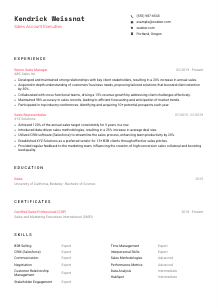
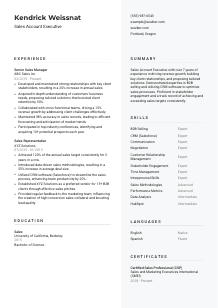
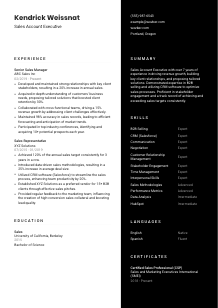
Closing deals, but your CV feels unresolved? Check out this Sales Account Executive CV example, created with Wozber free CV builder. Learn how to showcase your selling ingenuity to better match job milestones, paving the way for a career as successful as your pitch-perfect presentations!
Account executives are hired to grow revenue through trust, timing, and commercial judgment. A CV for this role needs to show more than activity. It should make it easy to see how you built client relationships, uncovered business needs, moved deals forward, and expanded accounts in a B2B sales cycle.
When those details are tailored to the target role, hiring teams can quickly separate general sales backgrounds from candidates who can manage stakeholders, use CRM data well, and speak to executive buyers. Wozber's free CV builder helps you shape that experience into an ATS-compliant CV that surfaces the right sales language early, so your track record reads clearly for both screening systems and the people deciding who can grow the book of business.
This section is brief, but it still does important work in sales hiring. It should confirm who you are, where you are based when location matters, and how a recruiter or sales leader can reach you without friction.
Use your full name as the most visible text on the page. A Sales Account Executive CV does not need design tricks here. Clear formatting and a professional presentation are enough, especially when the rest of the document needs room for revenue results, account growth, and client-facing experience.
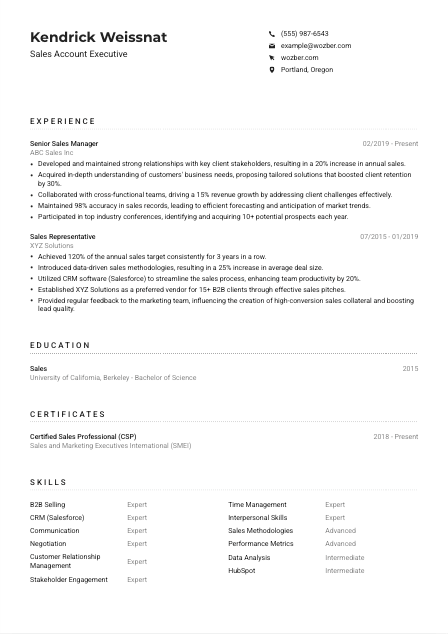
Place "Sales Account Executive" under your name when that matches the role you are pursuing. This immediately positions your background around account management, pipeline ownership, and client growth. If your current title is slightly different, such as Senior Sales Manager, your experience section can show the overlap.
Include a reliable phone number, a professional email address, and your location. For openings with a stated location requirement, this matters. In the example, listing Portland, Oregon directly supports the employer's request for someone based there or ready to relocate. Keep this section factual and easy to scan.
Include LinkedIn or a professional website if it strengthens your candidacy. For sales roles, that profile should reinforce what your CV claims, such as industries sold into, quota performance, account size, or leadership in client relationships. If the profile is outdated or light on detail, leave it off until it matches your CV.
Age, marital status, photo, and other non-job-related details do not help you win a B2B sales role. Keep the attention on your contact information, location, and professional identity so the reader stays focused on your commercial results and client-facing credibility.
Your personal details should answer the basics quickly: who you are, how to contact you, and whether you meet practical requirements such as location. Then the CV can move straight into pipeline results, account growth, and stakeholder management.




This is the section sales leaders read most closely. They want to know what you sold, who you sold to, how you managed relationships, and what business outcomes followed. Generic task lists do not help much here. Performance, scope, and sales judgment do.
Before rewriting bullets, mark the terms that define the role. For this opening, that includes B2B sales experience, relationship building with key stakeholders and C-suite contacts, CRM usage, tailored solutions, reporting discipline, and collaboration with internal teams. Those are the commercial themes your experience should reflect in plain language.
List jobs in reverse-chronological order and give the most space to positions that show revenue ownership, client retention, expansion, or strategic selling. Titles matter less than the substance of the work. A Senior Sales Manager or Sales Representative can still be highly relevant if the bullets show account development, quota attainment, and business-to-business selling.
Every bullet should connect an action to a result. In sales hiring, metrics are persuasive because they show whether your relationship management and sales process actually produced revenue. The sample CV does this well with outcomes like a 20% increase in annual sales, 30% higher client retention, 15% revenue growth, and 120% of target achieved over multiple years. Use numbers that fit your own work, such as quota attainment, deal size, renewal rate, win rate, pipeline growth, or forecast accuracy.
Strong account executive CVs describe the method behind the result. Mention activities that matter in B2B selling, such as discovery, stakeholder mapping, consultative selling, proposal development, CRM tracking, negotiation, cross-functional coordination, and executive presentations. If you used Salesforce or HubSpot to improve follow-up discipline, reporting, or pipeline visibility, say so directly.
Account executives rarely win complex deals alone. Show where you worked with marketing, customer success, product, operations, or leadership to address objections, refine proposals, or solve client issues. The example's bullet about partnering with cross-functional teams to drive 15% revenue growth is effective because it ties internal collaboration to a business result, not just teamwork for its own sake.
Your experience section should leave no doubt that you can manage relationships, run a disciplined sales process, and grow revenue. If the bullets show business context, stakeholder depth, CRM fluency, and measurable results, this section is doing its job.
Education usually supports, rather than leads, a Sales Account Executive application. Still, when a posting asks for a bachelor's degree in business, sales, or a related field, this section needs to confirm that requirement quickly and clearly.
If the role asks for a bachelor's degree, list yours in a straightforward format with degree, field, school, and graduation year. When your field is directly aligned, as in the example's Bachelor of Science in Sales, that connection is worth making clear because it answers a posted requirement immediately.
Hiring managers are not looking for an elaborate academic profile here. They need fast confirmation that you meet the educational baseline. Place the institution, degree, field of study, and graduation date in a clean format so attention can return quickly to quota performance, client growth, and B2B selling results.
Business, marketing, communications, economics, and other adjacent fields can still support this role well. If your degree title does not mirror the posting exactly, the rest of your CV should reinforce the connection through sales methodologies, CRM use, negotiation, account management, or revenue-focused experience.
Early-career candidates can include coursework, projects, or student activities tied to sales, market analysis, negotiation, or business development. For someone with several years of B2B experience, that extra detail usually matters less than sales results and account scope.
If you have completed additional training in consultative selling, account strategy, CRM systems, or sales analytics, that can strengthen the section or work well alongside certificates. It shows that your approach to pipeline management and client conversations keeps evolving with the market.
Use the education section to confirm the credential requirement efficiently. Once that box is checked, let your sales performance, account management work, and client outcomes carry the application.
Certifications are not always required for account executive roles, but the right ones can sharpen your profile. They are most useful when they support how you sell, how you manage accounts, or how seriously you treat professional development in a competitive B2B environment.
List certificates that support the work of an account executive, such as consultative selling, negotiation, customer relationship management, or sales leadership. In the example, CSP and PSM work because they point to formal sales training rather than unrelated credentials.
A short list of relevant certifications is stronger than a long list with weak connection to the role. Prioritise credentials that reinforce your ability to manage client relationships, drive revenue, analyse performance, or work effectively in a structured sales process.
Show when the certification was earned and whether it is current when that information is available. Current credentials suggest continued engagement with sales practice, especially in areas like methodology, account strategy, or professional standards.
Sales roles change with market conditions, buyer expectations, and CRM workflows. Recent certifications can signal that you stay current on prospecting approaches, customer conversations, reporting discipline, and account expansion strategies.
Relevant certificates help round out your profile when they support the way you sell and manage accounts. Keep them focused, current, and clearly connected to the work of winning, growing, and retaining B2B clients.
A Sales Account Executive skills section should reflect how revenue is actually generated and managed. That means a mix of commercial skills, client-facing strengths, and tool familiarity that matches the sales environment in the job description.
Pull the core skill terms from the posting and use them naturally if you genuinely have them. Here, the priorities include B2B sales, sales methodologies, data analysis, performance metrics, communication, negotiation, and CRM software such as Salesforce or HubSpot. Matching that language helps both human reviewers and ATS screening connect your experience to the role.
Do not build this section around soft traits alone. Pair interpersonal strengths with practical sales capabilities. For example, negotiation, stakeholder engagement, discovery, and executive communication are stronger when listed alongside CRM management, pipeline tracking, forecasting, account planning, or sales analytics.
Order matters. Put the most relevant skills first, especially those tied to the actual job such as B2B selling, customer relationship management, Salesforce, HubSpot, and performance metrics. The sample CV gets this mostly right by combining platform knowledge with sales-facing skills. Keep the list focused enough that each skill supports the account executive story.
Your skills section should back up the claims in your experience section, not repeat generic strengths. Done well, it shows that you understand both the human side of sales conversations and the operational side of managing pipeline, CRM data, and account growth.
Language ability matters when the role requires it or when your territory, client base, or event exposure makes it relevant. For account executives, this section should be practical and accurate, especially when communication with buyers and internal teams is central to the job.
If the posting specifies a language requirement, include it exactly and state your level plainly. This role requires English, so that should appear prominently. A label such as "Native" or "Fluent" gives immediate clarity for a role built on calls, meetings, proposals, and stakeholder communication.
Additional languages can strengthen your profile when they help with regional accounts, international buyers, or multicultural client relationships. Spanish, for example, may be useful in some markets even when it is not listed as a requirement. Include only languages you can use credibly in business settings.
Sales conversations can involve nuance, negotiation, and trust. Overstating fluency can become obvious quickly in an interview or client-facing exercise. Use clear levels such as Native, Fluent, Conversational, or Basic so expectations stay realistic.
If the role covers multilingual markets, trade events, or global accounts, this section deserves more visibility. If the job is primarily domestic and English-speaking, keep the section concise and let your revenue history and stakeholder management do more of the work.
For account executives, language skills are useful when they help build rapport, shorten communication gaps, and open access to prospects or decision-makers. Present them that way, as a practical advantage in client development and relationship management, not as a personal detail.
List required language ability clearly and add other languages only when they strengthen your client-facing range. Accuracy matters because communication is central to selling, negotiation, and long-term account management.
The summary is where your sales profile comes into focus fast. In a few lines, it should tell the reader what kind of account executive you are, how much experience you bring, and what results or strengths define your approach to revenue growth.
Start with a direct description that reflects your seniority and market focus. Mention your years of experience, the fact that you work in B2B if that is true, and the kind of outcomes you are known for, such as account growth, client retention, or consistent quota attainment.
Use the summary to connect your background to the employer's priorities. For this role, that could include relationship management with senior stakeholders, consultative solution selling, CRM fluency, and data-aware sales execution. The sample summary works because it ties revenue growth, client relationships, tailored solutions, and CRM use into one focused snapshot.
Aim for three to five lines with real substance. Skip broad claims like "results-driven professional" unless they are supported immediately by something concrete. A concise summary that mentions B2B sales experience, track record against targets, and account development skills will do more than a paragraph of generic confidence statements.
A strong summary gives the reader a quick commercial read on your profile. By the time they reach your experience section, they should already expect to see B2B sales results, stakeholder management, CRM fluency, and evidence that you can grow accounts.
A Sales Account Executive CV works best when it reads like a clear business case. Show how you build relationships, manage the pipeline, use CRM data, and turn client needs into revenue. Keep the proof concrete, especially around quota performance, retention, deal growth, forecasting, and cross-functional account work.
If you want a faster way to tailor each application, Wozber can help you structure your content, align your wording with the job description, and strengthen ATS optimisation with an ATS-friendly CV format. The finished CV should make one thing easy to judge: whether you can step into the territory, manage accounts with discipline, and grow revenue.




