



Use Wozber and land your dream job
Create CV
No registration required
Chasing stories, but your CV feels unpublished? Explore this Journalist CV example, created with Wozber free CV builder. Learn how to present your investigative insights in line with editorial standards, turning your career narrative into tomorrow's must-read!
Journalism CVs get weak when they read like generic content roles. Editors want to see how you report, what kinds of stories you can move from pitch to publication, and whether your work holds up under deadlines, fact-checking, and editorial review. Your CV should make that reporting process visible through story volume, beat coverage, source development, fieldwork, and the platforms you publish on.
A tailored CV also helps separate a general writer from a journalist who can gather facts, verify information, and file clean copy for a newsroom. Using Wozber's free CV builder to match your wording to the posting and build an ATS-compliant CV makes it easier to surface the terms that matter here, such as source relationships, multimedia production, and publication-ready writing. That gives hiring teams a faster read on whether you can report accurately and deliver on deadline.
The top of a journalist CV should read like a clean byline block. Keep it practical, accurate, and relevant to how editors or recruiters will contact you, review your work, and confirm basic requirements for the role.
Your name should be the clearest text on the page, just as a byline is easy to find on a published piece. Use a simple, readable format so the CV opens with your professional identity, not design choices.
Place "Journalist" directly under your name if that is the role you are targeting. Matching the title used in the posting helps frame the rest of the CV around reporting, writing, editing, and story development rather than broader media or communications work.
List a phone number and a professional email address that you check regularly. In a field where interview scheduling, assignment follow-ups, and deadline-driven communication move quickly, your contact details need to be as dependable as your sourcing.
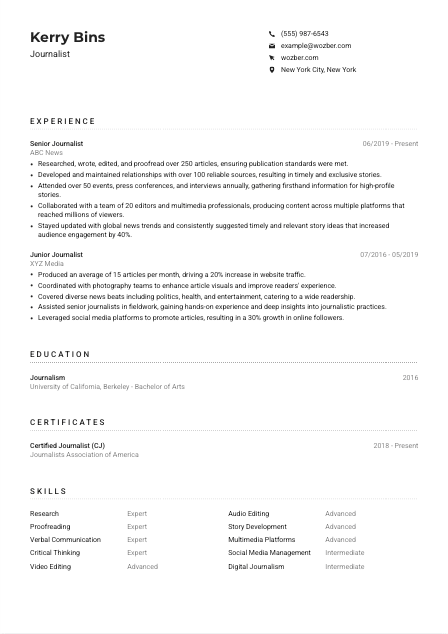
If a newsroom asks for a specific location, include it plainly in your personal details. In this example, "New York City, New York" answers the posting's location requirement right away and removes uncertainty about local availability for events, interviews, and on-the-ground reporting.
A website, portfolio, or polished LinkedIn profile can strengthen your application when it points to clips, multimedia pieces, or a reporting archive. Make sure the work there reflects the same beats, dates, and professional scope shown on your CV.
Keep this header tight and newsroom-ready. It should tell the employer who you are, how to reach you, and whether you meet any immediate requirements before they move into your reporting background.




Experience is where editors look for proof of output, judgment, and range. Focus less on vague media involvement and more on the work journalists actually do: reporting, verifying, interviewing, filing, collaborating with editors, and producing stories that reach an audience.
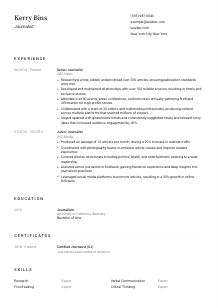
Pull the key actions from the job description and reflect them in your bullets when they match your background. If the posting asks for research, writing, editing, proofreading, source development, and event coverage, your experience should show those exact newsroom tasks. The sample does this well with a bullet like "Researched, wrote, edited, and proofread over 250 articles," which immediately connects to publication standards and daily production.
Start with your most recent reporting position and work backward. For journalists, this helps employers quickly see your current beat exposure, publication level, and progression from earlier fieldwork to larger editorial responsibility, such as moving from junior reporting into a senior newsroom role.
Each bullet should show what you covered, how you worked, and what changed because of your reporting. Useful details include beats covered, number of sources managed, events attended, audience growth, or cross-platform output. A line about maintaining more than 100 reliable sources says much more than a generic claim about communication skills.
Journalism performance is often measured through volume, reach, timeliness, and engagement. Include metrics that fit your work naturally, such as articles published per month, annual event coverage, audience growth, or readership increases. In the example CV, increases in engagement, traffic, and followers all help show business impact without pulling focus away from the reporting itself.
If an older role does not strengthen your case for reporting, editing, research, or multimedia production, trim it or reduce it. Save the space for experience that proves you can gather first-hand information, collaborate with editors, and produce accurate copy under newsroom conditions.
Your experience section should show a working journalist, not just a person who has written before. When the bullets connect reporting actions to published output and audience results, your value becomes much easier to judge.
Education matters most when it confirms the training behind your writing, research, and ethical reporting practice. For journalism roles, keep this section straightforward and make the relevance obvious.
When a posting calls for a bachelor's degree in Journalism, Communications, or a related field, make that qualification easy to find. A degree such as "Bachelor of Arts in Journalism" should appear clearly so the employer can confirm the educational requirement in seconds.
List the school, degree, field of study, and graduation year. That is usually enough for an experienced journalist. The sample education entry does this efficiently and leaves more room for the reporting work that carries greater weight later in your career.
If your degree is directly tied to journalism, that connection already works in your favor. If your degree is in a related discipline, use the field name accurately and let the rest of your CV show how your reporting, editing, or media experience bridges into the role.
Early-career candidates can include capstone projects, student newsroom work, investigative pieces, campus publications, or reporting-focused coursework when professional clips are still limited. Once you have several years of newsroom experience, those details usually become optional.
Honors, scholarships, or academic distinctions can help if they reflect strong writing, research, or communications performance. Keep them brief and include them only if they add useful context to your journalistic track record.
For most journalist CVs, education confirms your formal grounding in reporting or communications. Keep it concise, relevant, and easy to scan so the reader can get back to your clips, output, and newsroom results.
Certifications are secondary to clips and experience in journalism, but they can still strengthen your profile when they point to current tools, reporting specialties, or ongoing professional development.
Start with certificates that support the kind of journalism you want to do. Useful examples include digital journalism, investigative reporting, fact-checking, data storytelling, video production, audio editing, or media law. If the posting does not require a certificate, use this section to reinforce relevant strengths rather than to fill space.
Include the certificate name and issuing organisation exactly. The sample's "Certified Journalist (CJ)" works because it is specific and clearly tied to the profession, which gives the credential more credibility than a vague training label would.
Add the completion date or validity period, especially for certifications tied to changing tools, standards, or continuing education. In media roles, recent training can support your case for current platform knowledge and active professional engagement.
Newsrooms change quickly across formats, distribution channels, and audience habits. A certification section can signal that you keep developing skills beyond core reporting, whether that means multimedia workflows, digital publishing, or updated editorial practices.
Certifications will not replace strong reporting experience, but the right ones can sharpen your profile. Use them to show current tools, added specialization, and continued investment in the craft.
A journalist's skills section should reflect how stories get produced, checked, and published. That means pairing newsroom fundamentals with the tools and platforms that support modern reporting.
Read the posting closely and note both explicit and implied requirements. Here, research, information verification, writing, proofreading, verbal communication, and multimedia tools all deserve space because they are central to the actual work, not just generic preferences.
Include core editorial abilities such as interviewing, source development, fact-checking, copyediting, and story pitching alongside technical skills like video editing, audio editing, CMS use, social media distribution, or multimedia platforms. The sample handles this well by combining research and proofreading with video and audio editing.
Avoid turning this section into a master list of every tool you have touched. Choose the skills that best support the reporting environment you are targeting. For a multimedia newsroom, digital journalism and platform skills may deserve space. For a more traditional reporting role, source work, beat knowledge, and editorial accuracy may matter more.
The skills section should confirm that you can report, refine, and publish stories in the formats the newsroom uses. Keep it focused enough that every item supports the kind of journalism you want to be hired for.
Language ability matters in journalism when it affects interviews, community access, source development, or audience reach. Present it clearly, and keep the emphasis on how those skills support the work.
If English is a core requirement, list it plainly with an accurate proficiency level. For roles built around writing, interviewing, and editing in English, this should never be left implied.
Additional languages can strengthen your profile when they help you interview sources, cover multilingual communities, or work across international or culturally specific beats. In the sample, Spanish adds practical value because it suggests broader reporting access, not just a personal interest.
Include languages that have a realistic connection to the newsroom, audience, or subject matter you want to cover. A short, accurate list is more useful than a long one with marginal relevance.
Terms like "Native," "Fluent," or "Conversational" should reflect what you can actually do in interviews, source calls, and written communication. Journalism depends on precision, so this section should be precise too.
Some local reporting roles may only need strong English-language ability. Others, especially those covering immigrant communities, international news, or bilingual audiences, may benefit from highlighting additional languages more prominently.
List languages as working tools, not decoration. When they support better sourcing, stronger interviews, or wider audience connection, they add real value to a journalist CV.
Your summary sits at the top of the CV and should quickly establish your reporting identity. Keep it compact, specific, and grounded in the type of journalism you actually do.
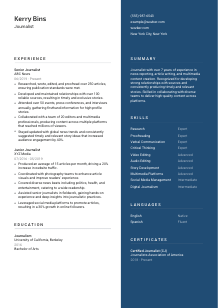
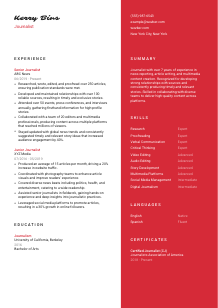
Start with your title and years of experience, then name the work you are known for. A line such as "Journalist with over 7 years of experience in news reporting, article writing, and multimedia content creation" works because it anchors both seniority and editorial range immediately.
Choose two or three details that directly support the posting, such as source development, timely story pitching, beat coverage, or cross-platform collaboration. The sample summary earns attention by mentioning strong source relationships and timely, relevant stories, both of which map directly to the role's responsibilities.
Aim for three to five lines. Avoid broad claims like "results-driven professional" and use the space for real journalistic strengths such as publication output, newsroom collaboration, or multimedia reporting ability.
Your summary should shift based on the newsroom and the work. A breaking news role may call for deadline speed and field reporting. A feature role may benefit from source depth, long-form writing, or subject-matter expertise. Adjust the wording so the opening matches the assignment.
A useful summary gives the reader a fast, accurate sense of your reporting background and editorial value. By the time they reach your experience section, they should already understand what kind of journalist you are.
A journalist CV should show more than a love of storytelling. It should make your reporting process, editorial judgment, source work, and publication results easy to see. When each section points back to how you gather information, shape a story, and deliver clean copy across platforms, the application feels credible from the first line.
Wozber can help you get there faster with an ATS-friendly CV format, AI-assisted tailoring, and an ATS CV scanner that highlights missing requirements and role-specific language. Use that support to sharpen the wording, align your sections with the posting, and present your experience in a way that fits newsroom hiring. The final read should make one thing clear: you can step into the assignment and report.




