



Use Wozber and land your dream job
Create Resume
No registration required
Cruising mile after mile, but your resume seems stuck at a red light? Steer into this Delivery Truck Driver resume example, created with Wozber free resume builder. Learn how to map your driving prowess and time-management skills to match job checkpoints, paving the way for a career journey without detours!
Delivery truck driving gets judged in the details. Employers want someone who can keep deliveries on schedule, handle loading and vehicle checks without cutting corners, and deal with customers professionally at the door or dock. Your resume needs to show that you move freight safely, follow procedure, and stay dependable over long stretches of daily route work.
Screeners often need to separate local delivery drivers with real commercial driving experience from candidates whose background is lighter on route accountability, CDL compliance, or log-based operations. A tailored resume built with Wozber's free resume builder and solid ATS optimization makes those distinctions easier to see early, especially when your experience clearly shows driving history, safety habits, customer interaction, and tools like GPS or electronic logging systems.
For delivery driving, the header should confirm basic eligibility fast. Hiring teams check whether they can contact you easily, whether your title matches the work, and in some cases whether you're already local enough to start without relocation delays.
Use your full name in a clean, slightly larger font so it stands out immediately. Keep the presentation straightforward. For a delivery role, you want the resume to feel practical and reliable from the first line, much like the day-to-day work itself.
If you are applying for a delivery truck driver opening, use "Delivery Truck Driver" as your headline when that reflects your background. Matching the posted title helps connect your resume to the role right away, especially when your previous jobs may have been listed under broader titles like "Truck Driver."
If the employer wants someone based in Los Angeles, CA, include Los Angeles, CA in your header when that is accurate. For local delivery positions, location can affect scheduling, route coverage, and start readiness, so this detail can remove an immediate question.
Include LinkedIn or another professional profile only when it supports the same story as your resume. If it shows clean work history, endorsements, or transportation-related experience, it can reinforce credibility. If it is outdated, leave it off.
This section should answer the practical questions first: who you are, how to reach you, what role you do, and whether you meet basic location expectations. That gives the rest of your resume room to focus on driving record, delivery performance, and day-to-day reliability.




Experience is where delivery employers look for proof of safe operation, consistent timing, and day-to-day discipline. They want to see commercial driving history, the kind of freight or delivery volume you handled, how you managed inspections and loading, and whether customers and dispatch could count on you.
Pull out the practical requirements before you write or edit a single bullet. For this kind of role, that usually means commercial driving experience, safe and timely deliveries, vehicle inspection habits, comfort with GPS or electronic logs, and professional customer interaction. Those priorities should shape which achievements you keep and which you cut.
List your jobs in reverse chronological order so hiring managers can see your current driving scope first. Recent experience usually carries the most weight in delivery hiring, especially when it shows active CDL use, route work, inspection routines, or high-volume delivery responsibility.
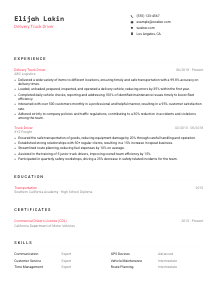
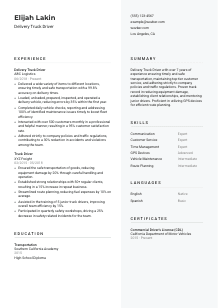
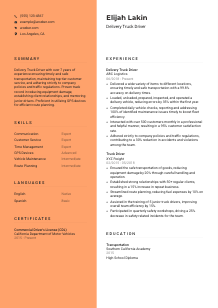
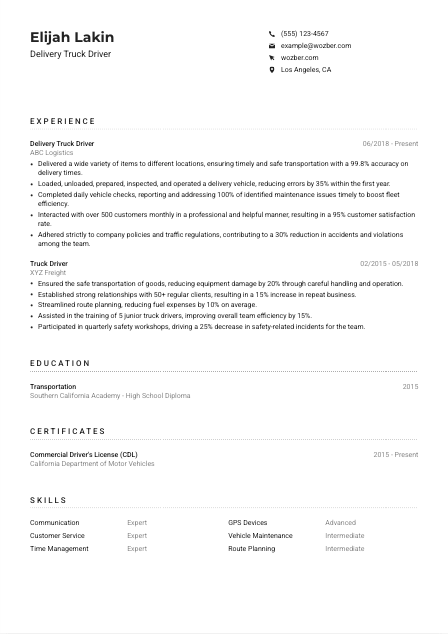
Each bullet should show what you handled and how well you handled it. Instead of stopping at "delivered goods," add the outcome: on-time performance, reduced loading errors, better customer satisfaction, fewer incidents, or stronger fleet uptime. The sample resume does this well with details like 99.8% delivery-time accuracy and a 35% reduction in errors.
Quantify the parts of the job that matter operationally. Useful metrics include on-time delivery rate, number of customers served, reduction in damaged goods, fuel savings, safety improvements, or maintenance issues reported and resolved. These figures give real scale to your route discipline and operational awareness.
Prioritize experience that supports the opening you want now. For a delivery truck driver resume, that means commercial driving, loading and unloading, route planning, inspection checks, customer-facing stops, and compliance with traffic and company rules. Leave out unrelated work unless it adds something directly useful, such as safety training or client service.
A hiring manager should be able to scan this section and quickly see that you have the mileage, safety habits, and delivery consistency the job requires. When your bullets show route performance and operational discipline, your experience does the heavy lifting for you.
Education usually sits behind experience for delivery truck driver roles, but it still matters as part of a complete work profile. Keep it clear and factual, and use it to support the impression that you meet the basic requirements and take the work seriously.
Some delivery roles do not ask for a specific degree, while others may expect a high school diploma or equivalent. If the posting is light on education requirements, keep this section concise and let your driving background carry more weight.
Include the school name, credential, field if relevant, and graduation year or date. That is enough for most driving roles. The example resume keeps this simple with a high school diploma and a transportation-related field, which fits the job without taking attention away from experience.
If your coursework, school program, or vocational training connects to transportation, logistics, vehicle operations, or safety, include that context. It will not replace driving experience, but it can support the story of why you were prepared for route-based work early on.
Only list courses or training when they help the employer understand your qualifications faster. Defensive driving, logistics basics, warehouse handling, or fleet safety topics are more useful here than unrelated classes.
Extra detail belongs here only when it reinforces traits that matter on the job, such as responsibility, consistency, or leadership. If an academic achievement does not strengthen your case for dependable delivery work, leave the section lean.
For most delivery truck driver applications, education should confirm your background without competing with your driving record and route results. A short, relevant entry is usually enough.
For a delivery truck driver, certifications are not decoration. They often determine whether you are eligible to drive the vehicle at all. This section should make license status easy to find and easy to understand.
If the job asks for a valid Class A or B Commercial Driver's License, list your CDL clearly with the issuing authority and current status. This is one of the first credentials hiring teams look for because it directly affects legal eligibility and insurance requirements.
Lead with certifications tied to driving, safety, compliance, or freight handling. Your CDL belongs at the top. If you also hold endorsements or safety-related certifications, add them when they are relevant to the kind of deliveries or vehicle class involved.
Show when the credential was issued and whether it is current. For regulated work, dates matter. In the example resume, the CDL is shown as active from 2015 to present, which quickly communicates continuity and active qualification.
If you renew a license, add an endorsement, or complete updated safety training, refresh the section right away. Delivery employers notice drivers who stay current with compliance requirements, equipment procedures, and operating standards.
Your certifications section should remove doubt about whether you are licensed and current. When the CDL and related credentials are easy to spot, the employer can move on to evaluating your delivery record and safety performance.
A delivery truck driver skills section should read like an honest snapshot of how you operate on the job. Focus on the mix of driving, route execution, equipment awareness, and customer-facing communication that keeps deliveries moving safely and on time.
Start with the language used in the posting. For this role, that includes communication, customer service, GPS use, electronic logging systems, and safe vehicle operation. Those terms are useful because they reflect how the job is actually performed and help with ATS alignment when they match your real experience.
Build the section around what you can actually do well in delivery work. That may include route planning, time management, vehicle inspection, loading and unloading, navigation tools, maintenance awareness, or customer interaction at delivery stops. The sample resume handles this well by pairing soft skills like communication with practical tools like GPS devices.
Do not crowd the section with broad terms that could belong to any resume. Choose the skills that matter in fleet operations and delivery performance. A shorter list of relevant strengths is more useful than a long list that never gets applied in route work or customer handoffs.
This section should back up your experience, not repeat vague buzzwords. When the listed skills connect directly to driving, delivery execution, and customer-facing reliability, the resume reads as grounded and credible.
Language skills matter in delivery driving when they affect customer interactions, written communication, dispatch updates, or basic compliance. Keep this section accurate and practical, especially when the posting names a required language.
If the job states that English speaking and writing are mandatory, list English first and state your level clearly. This is especially important in roles that involve route instructions, customer communication, delivery records, and safety-related documentation.
After the required language, list others from strongest to weakest. That makes the section easy to scan and gives the employer a realistic sense of how you communicate in customer-facing situations or multilingual delivery areas.
Extra languages can be helpful in local delivery work, especially in areas where drivers regularly interact with a diverse customer base. They are not always required, but they can strengthen your profile when the role includes frequent direct contact at homes, businesses, or loading sites.
Use clear labels such as Native, Fluent, Intermediate, or Basic. Avoid overstating proficiency. In delivery work, inaccurate language claims can create problems in customer communication, paperwork, or dispatch coordination.
Only include languages you can genuinely use. If you have conversational Spanish, for example, that may help in some local markets, but the real value comes from being accurate about how well you can assist customers or understand work-related communication.
For delivery roles, language skills should clarify how well you can handle instructions, paperwork, and customer contact. Accuracy matters more than trying to impress.
Your summary should give a fast, grounded picture of the kind of driver you are. Focus on experience level, delivery performance, safety habits, and the work patterns that make you dependable on the road and at the stop.
Open with the parts of delivery driving that matter most across employers: safe transportation, on-time delivery, vehicle responsibility, and customer-facing professionalism. That framing tells the reader what kind of route work you know how to handle.
Mention your years of commercial driving experience and the type of work you have handled. For many applicants, this is also where the delivery specialization becomes clear. The sample summary works because it immediately establishes more than 7 years of experience in timely and safe transportation.
Use brief, specific accomplishments that support the role you are targeting. Reduced equipment damage, strong customer satisfaction, safer operations, fewer delivery errors, or efficient route planning all fit well here because they show both operational and service performance.
Aim for a short paragraph that can be read in seconds. Skip general claims about being hardworking and focus instead on proven delivery habits, useful tools, and measurable outcomes. A concise summary with real route-related detail is far more convincing than a broad personal statement.
After reading your summary, an employer should already understand your experience level, your delivery standards, and the kind of results you bring to daily operations. That is the tone you want the rest of the resume to confirm.
A delivery truck driver resume works best when it shows practical proof: commercial driving experience, current licensing, safe operation, route reliability, and professional customer contact. When each section points back to those realities, the document feels credible to both hiring teams and ATS screening systems.
Use Wozber to tighten that alignment with an ATS-compliant resume, an ATS-friendly resume template, ATS-friendly resume format options, and an ATS resume scanner that helps you match your wording to the job. The final resume should make one thing easy to judge: you can be trusted with the vehicle, the freight, and the delivery schedule from day one.




